
Curl Centric Tools
The Natural Hair Dictionary
Every term, acronym and piece of curl-community slang, defined in plain English. Somebody said your hair needs a "protein-moisture balance" and you nodded along? Start here. If your question is bigger than one word, the curly hair FAQ answers 66 of them.
Try:
Brand new? Learn these 12 first.
The words that come up in almost every wash-day conversation.
248 terms
Every natural hair term, A to Z
#
3C HairHair Science
Tight corkscrew curls about as wide as a pencil. There's plenty of volume and density in 3C hair, and it'll hold definition beautifully as long as you keep your curls moisturized.
See also
4B HairHair Science
A sharp, Z-shaped bend rather than a soft coil, fluffier than 4C and with a slightly more defined pattern. Your hair will still shrink a great deal as it dries.
See also
4C HairHair Science
The tightest curl pattern on the hair typing chart, a dense zig-zag with almost no visible curl until your hair is wet. It shrinks the most, tangles the fastest, and is the most fragile, which is why so much natural hair advice is really 4C advice.
See also
4D HairHair Science
An unofficial label the community added for the very tightest, most tightly packed coils, and no official typing system recognizes it. Treat it as useful shorthand for describing your hair rather than as science.
See also
A
Accordion MethodTechniques
Scrunching product up into your hair with a squeezing motion, the way you'd work an accordion. It encourages wave and body without pulling apart the clumps you're trying to build.
See also
ACV RinseTechniques
Diluted apple cider vinegar poured through your hair after you condition. The acidity lowers the pH and helps your cuticle lie flat, and that flatness is what people mean when they say it adds shine.
See also
African ThreadingTechniques
Wrapping thread tightly down a damp section so your hair dries stretched. There's no heat and no tension on your roots, and you'll get more length out of it than banding gives you.
See also
AfroStyles
Natural hair picked out and worn in its full round shape, and the style most people picture when they think of natural hair. You'll need steady moisture and a good pick to hold that shape all day.
See also
Afro PuffStyles
Your hair gathered into a round ponytail and picked out, which makes it the everyday go-to on a day you don't feel like styling. Just watch how tight the band sits against your edges.
See also
Aloe VeraIngredients
A humectant gel that also sits close to your hair's natural pH. You'll get good slip and light hold out of it, and a small share of people find their hair reacts badly to it.
See also
AlopeciaDamage & Repair
say: al-oh-PEE-shuh
The medical umbrella term for abnormal hair loss. On its own it only names the symptom you're seeing, so the actual cause is always in whatever word comes after it.
See also
Alopecia AreataDamage & Repair
An autoimmune condition where the body attacks its own follicles and leaves round bald patches behind. Alopecia totalis is when all the hair on your scalp goes, and alopecia universalis is all body hair.
See also
ALSIngredients
Ammonium Lauryl or Laureth Sulfate, two of the detergents that make your shampoo lather. They're milder than SLS, but they'll still strip your hair if it's already on the dry side.
See also
Anagen PhaseHair Science
say: AN-uh-jen
The active growing stage of a hair follicle, which runs roughly two to seven years. How long your anagen phase lasts sets the longest your hair can ever get, and no product changes that.
See also
APLLength
Armpit Length. Your hair reaches your armpit when you stretch a strand out straight.
See also
B
BaggyingTechniques
Covering damp, moisturized hair with a plastic cap so the moisture can't escape. Trapped body heat softens your strands, though leaving it on overnight can waterlog them.
See also
Balancing ShampooProduct Types
A shampoo aimed at oily roots and dry ends at the same time, which is more of a marketing category than a chemistry one. Still, it earns its place when your scalp and your length want different things.
See also
BandingTechniques
Wrapping small elastic bands down a damp section so your hair dries stretched instead of shrunken. You'll get heatless length without going anywhere near a blow dryer.
See also
Bantu KnotsStyles
say: BAHN-too
Sections twisted and then coiled into small standing knots against your scalp. You can wear them as a style on their own, or take them down once they're bone dry for a bantu knot-out.
See also
BCStart Here
Big Chop. Cutting off all the relaxed or damaged hair at once so you're left with nothing but your natural texture. That makes it the emotional part of going natural, and the part people most often regret rushing.
See also
Behentrimonium MethosulfateIngredients
say: be-HEN-tri-MOH-nee-um
A conditioning agent with a frightening name and no relation at all to sulfate detergents. This is the ingredient that gives your conditioner its slip, and it's perfectly fine on curly hair.
See also
BiotinIngredients
The vitamin that every hair gummy on the shelf is built around. It reliably helps people who are genuinely deficient in it, and if you aren't, it'll do very little for your hair.
See also
BlowoutStyles
Hair blown dry straight or stretched without a flat iron. There's less heat involved than a silk press, so your curls revert more easily afterward.
See also
BNCStyles
Braid-n-Curl. You braid a damp section for the crimp, set the ends on a rod or roller for a curl, and take it all down once your hair is completely dry.
See also
Bond BuilderDamage & Repair
A treatment that reconnects the broken bonds inside your strand, which is the internal damage bleach and relaxers leave behind. It isn't a protein treatment and it isn't a conditioner, even though it's usually sold beside both.
See also
BonnetStart Here
A satin or silk cap you wear to sleep in. Cotton pillowcases pull moisture out of your hair and rough up the cuticle, so a bonnet is the cheapest breakage prevention there is.
See also
Bowl MethodTechniques
Working with a bowl of water and diluted product beside you, dunking and scrunching each section as you go. It keeps your hair soaking wet the whole time, which is exactly when curls clump best.
See also
Box BraidsBraids, Locs & Wigs
Individual braids sectioned into square parts, usually with added hair. They're a protective style as long as they aren't installed tight enough to pull on your edges.
See also
Braid OutStyles
Braids set on damp hair and unraveled once they're completely dry. You'll get a looser, wavier pattern than a twist-out gives you.
See also
BreakageDamage & Repair
Hair snapping off somewhere along the strand. There's no white bulb on the broken end, and that's how you tell it apart from shedding. Almost every complaint that hair won't grow turns out to be breakage instead.
See also
BSBLength
Below Shoulder Blade, a steadier landmark for tracking your length than BSL, because bra straps sit differently on everybody.
See also
BSLLength
Bra Strap Length. Your hair reaches your bra strap in back when you pull a strand straight down.
See also
BSSSlang & Acronyms
Beauty Supply Store, where most of this actually gets bought and where most of your product-junkie money is going to end up.
See also
BuildupDamage & Repair
Layers of product, oil, and mineral residue coating your strands. Your hair stops absorbing water and starts to feel waxy, and no amount of extra moisturizer helps until you wash it off.
See also
Butterfly LocsBraids, Locs & Wigs
Distressed faux locs with loops left along the length on purpose. They give you a softer, messier finish than a smooth faux loc does.
See also
C
CanopyStart Here
The top layer of your hair, and the only layer anyone else really sees. It takes the most sun, heat, and friction, so it's usually looser, drier, and more damaged than the hair sitting underneath it.
See also
Carrier OilIngredients
A mild base oil like jojoba, grapeseed, or sweet almond that you use to dilute essential oils. Undiluted essential oil will burn your scalp, so this step isn't optional.
See also
CastTechniques
The hard, crunchy shell your gel forms as it dries. That crunch means the gel is doing its job, because it holds the curl shape while your hair sets, and you break the shell once you're completely dry.
See also
CBLLength
Collarbone Length. Your stretched hair touches your collarbone, which is the stop between neck length and shoulder length.
See also
Chelating ShampooProduct Types
say: KEE-lay-ting
A shampoo that strips out mineral deposits rather than just product. If your hair feels coated and dull no matter how often you clarify, hard water is usually the culprit.
See also
Chunky FroStyles
Twists unraveled and picked out so your hair stands up in defined chunks, giving you a looser, more textured look than an even round afro.
See also
Clarifying ShampooProduct Types
A stronger shampoo that strips product buildup back to zero. Most curly hair needs it about once a month, and more often than that if you use a lot of gel or butter.
See also
CLHLength
Classic Length. Your hair reaches the crease where your leg meets your body, which is rare on any texture.
See also
ClosureBraids, Locs & Wigs
A small lace or silk piece, usually four inches square, that covers the crown of a sew-in so you don't need any leave-out. You'll pay less for one than a frontal, and you get less freedom to part it.
See also
Co-WashTechniques
Washing your hair with conditioner instead of shampoo, which is gentler and far less stripping. Conditioner won't shift buildup though, so this works best in rotation with a real shampoo rather than instead of one.
See also
Comb CoilsBraids, Locs & Wigs
Small coils set with a fine comb. You'll see them worn as a style on short hair, and they're also one of the standard ways to start locs.
See also
ConesIngredients
Silicones. They coat your strands for instant slip and shine, and the water-soluble ones rinse straight out. Heavier ones need a sulfate shampoo to remove, which is the whole reason the Curly Girl Method bans them.
See also
CornrowsStyles
Braids worked flat against your scalp, picking up more hair as they go. They're the base of countless protective styles and the foundation under most wigs and weaves.
See also
CortexHair Science
The thick middle layer of your strand, where the protein bonds and your natural pigment live. Damage that reaches the cortex is the kind you can't condition away.
See also
Cottony HairHair Science
A texture in the LOIS system that runs frizzy, dull, and slow to wet. You'll often need several soakings before your hair is properly saturated.
See also
Creamy CrackSlang & Acronyms
Relaxer, named for how hard it is to quit, because you keep going back every six to eight weeks even when you mean to stop.
See also
Crochet BraidsBraids, Locs & Wigs
Extension hair looped through your cornrows with a crochet hook. They're fast to install, far gentler on your edges than individual braids, and easy to take down.
See also
Curl ClumpingTechniques
Letting neighboring strands stick together into one defined curl instead of separating into frizz. Most definition techniques you'll read about are really just clumping techniques.
See also
Curl CreamProduct Types
A creamy styler that adds moisture and soft definition without leaving a hard cast. You'll often see it layered underneath gel.
See also
Curl MemoryHair Science
Your hair's tendency to fall back into whatever pattern it has been drying in. You can break it with a few wash days of different handling, though heat damage takes it for good.
See also
Curl PatternStart Here
How tight or loose your curls are, usually written as 2A through 4C. It tells you a little about styling and almost nothing about which products to buy, because your porosity matters far more.
See also
Curly Girl MethodTechniques
Lorraine Massey's regimen: no sulfates, no silicones, no drying alcohols, no heat, and no brushes on dry hair. Plenty of people run a modified version and do perfectly well, so treat it as a starting framework for your routine rather than a rulebook.
See also
CWCTechniques
Conditioner, Wash, Conditioner. You condition before you shampoo so your hair loses less moisture, then condition it again afterward.
See also
D
DandruffDamage & Repair
White or yellow flaking from your scalp, usually caused by a yeast overgrowth rather than dryness. That's why adding more oil so often makes it worse instead of better.
See also
Deep ConditioningTechniques
A concentrated conditioner left on your hair for 20 to 30 minutes, often with a little heat. This is the single highest-return thing most people can add to a routine, and you'll usually feel the difference the first time.
See also
Demarcation LineDamage & Repair
The point where your new growth meets relaxed or heat-damaged hair, and the weakest spot on the whole strand. This is where transitioning hair snaps.
See also
Denman BrushProduct Types
A rowed brush used on wet, product-loaded hair to force your strands into clumps. Curlies argue about it constantly, because it gives real definition and it also pulls out more hair than your fingers do.
See also
DensityHair Science
How many strands you have per square inch of scalp, which isn't the same thing as how thick each strand is. You can have fine hair and high density at once, and that's why so many people misjudge their own hair.
See also
DetanglingTechniques
Separating knots before they turn into mats. On coily hair you'll want to work on soaking wet hair loaded with slippery conditioner, starting at your ends and moving up, never from the roots down.
See also
Deva CutStyles
A haircut done curl by curl on dry hair, so your stylist cuts what you'll actually wear instead of guessing how it'll spring up. It isn't the only dry-cutting method anymore, but it's the name that stuck.
See also
Dew PointHair Science
How much moisture is actually in the air, which decides whether humectants help your style or wreck it. A low dew point pulls water out of your hair, and a high one pushes it in and puffs it up.
See also
DiffuserProduct Types
The bowl attachment for a blow dryer that spreads the airflow instead of blasting it. It dries your curls without blowing apart the clumps you worked to build.
See also
Disulfide BondsHair Science
The strong sulfur links inside your cortex that hold your curl pattern in place. Relaxers, perms, and bleach break them permanently, and that's exactly why those changes never wash out.
See also
Drying AlcoholsIngredients
Short-chain alcohols that evaporate fast and take your hair's water with them. These are the ones worth avoiding, and they're the reason the whole alcohol question confuses people.
See also
DuragProduct Types
A tied cloth wrap you wear to compress and protect a style overnight, most often for waves or after a press. Think of it as a bonnet in a different fit, doing the same job for your hair.
See also
DustingTechniques
Trimming off a tiny amount, roughly an eighth to a quarter inch, just to clear your split ends. You'll keep essentially all of your length.
See also
E
Edge ControlProduct Types
A heavy-hold gel for laying your hairline flat, which is fine to use now and then. Daily slicking paired with daily brushing is one of the most common routes to thinning edges.
See also
EdgesStart Here
The fine hairs along your hairline. They're the most fragile hair on your head and the first casualty of a tight style, which is why you'll hear people say to protect your edges so often.
See also
ELLength
Ear Length. Your stretched hair reaches your ear, and it's usually the first milestone after a big chop.
See also
ElasticityHair Science
How far a wet strand stretches and then bounces back. If it snaps straight away your hair wants moisture, and if it stretches like gum and stays stretched, it wants protein.
See also
EOIngredients
Essential Oil. Concentrated plant oils like rosemary, peppermint, and tea tree that have to be diluted in a carrier oil before they ever touch your scalp.
See also
EVCOIngredients
Extra Virgin Coconut Oil, one of the few oils proven to get inside your strand. That's why it works so well as a pre-poo, and also why it tips some people straight into protein overload.
See also
EVOOIngredients
Extra Virgin Olive Oil, a penetrating oil you'll usually see used as a pre-poo or warmed up for a hot oil treatment.
See also
F
Fairy KnotsDamage & Repair
Tiny knots that form when a single coily strand loops around itself. You can't detangle them out, so they get snipped off instead. They're very common on 4C hair and a leading hidden cause of breakage.
See also
Fatty AlcoholsIngredients
Cetyl, cetearyl, and stearyl alcohol. They're conditioning and moisturizing despite the word alcohol on the label, so these are the ones you want to see.
See also
Faux LocsBraids, Locs & Wigs
Temporary locs made by wrapping extension hair around your own braids or twists. You get the look of locs with none of the commitment, though they carry real weight if you install them long.
See also
Feed-In BraidsBraids, Locs & Wigs
Cornrows where the extension hair is added gradually as the braid travels, so your root stays flat and light instead of starting with a heavy knot.
See also
Finger CoilingTechniques
Wrapping individual sections around your finger to set the curl shape while your hair is damp. The process is slow and genuinely tedious, and it gives you the most defined result you'll get without heat.
See also
Flat TwistStyles
A two-strand twist worked flat against your scalp, picking up more hair as you go. Think of it as a cornrow made of twists instead of a braid.
See also
Flaxseed GelIngredients
Gel you make by boiling flaxseeds. It gives light hold with no drying alcohol and costs almost nothing, but it molds in the fridge in about two weeks.
See also
Flexi RodsProduct Types
Bendable foam rods you wrap damp hair around and twist shut. You'll get heatless curls, and the size of the rod decides the size of the curl.
See also
Float TestTechniques
Dropping a clean shed strand into water to guess your porosity. The test is popular and genuinely unreliable, so how your hair behaves in the shower will tell you far more than a glass of water will.
See also
FrizzDamage & Repair
Individual strands escaping the curl clump, usually because your cuticle is raised and thirsty. Frizz is a moisture signal much more than it's a styling failure.
See also
G
GlazingTechniques
Gliding product down a section with a flat palm, the way you'd glaze a cake. It sits between praying hands and raking, so it's more even than scrunching and gentler on the clump than a rake.
See also
GlycerinIngredients
The most common humectant in curly products. It pulls water out of the air and into your hair, which is wonderful in mild weather and a frizz machine when the air is very dry or very humid.
See also
Going NaturalStart Here
Stopping relaxers and growing your own texture back in, either slowly by transitioning or all at once with a big chop. Think of it as the umbrella term for the whole decision.
See also
Greasing the ScalpTechniques
The classic petrolatum-based scalp routine a lot of us grew up with. It doesn't moisturize your hair and it can clog things up, but it does cut friction, and it isn't the villain it got made out to be.
See also
Greenhouse EffectTechniques
Baggying with your own scalp oils and a little water instead of product, usually overnight, so heat and moisture stay trapped at your roots.
See also
H
Hair AnalysisStart Here
A working read of your hair across five things: texture, elasticity, density, growth pattern, and porosity. Do it once and most of your product questions answer themselves.
See also
Hair CrushSlang & Acronyms
A creator whose hair you want, which is useful right up until you learn that their texture and porosity are nothing like yours. That mismatch is where most product disappointment starts.
See also
Hair CuticleHair Science
The outer layer of overlapping scales that protects your strand. Lying flat gives you shine and moisture retention, and lifted gives you frizz and moisture loss, so porosity is really just a description of this layer.
See also
Hair FollicleHair Science
The pocket in your scalp that each strand grows out of. Its shape decides your curl pattern, so your curl is settled at the root before the hair ever appears.
See also
Hair PorosityStart Here
say: por-OSS-ih-tee
How easily your hair takes in water and then holds onto it. This is the single most useful thing to know about your hair, more useful than your curl pattern, because it tells you which products will actually absorb.
See also
Hair SpongeProduct Types
A textured foam pad you rub in circles on short hair to twist it into instant coils. The results come cheap and fast, and the sponge is rough on your hair if you press hard.
See also
Hair Volume ClassificationsHair Science
Ponytail circumference used as a stand-in for how much hair you have. Under 2 inches is thin, 2 to 4 inches is medium, and anything over 4 is thick.
See also
Halo BraidStyles
A single braid wrapped around your head like a crown. The style is genuinely protective, because it keeps your ends fully tucked away.
See also
Hard WaterDamage & Repair
Tap water high in calcium and magnesium. Those minerals deposit on your strands, so your hair feels rough and coated no matter what you put on it, and you'll need a chelating shampoo or a shower filter to shift them.
See also
Heat DamageDamage & Repair
Curls that no longer revert after you wash them, because the heat permanently broke the bonds that made the curl. There's no treatment that brings your pattern back, so it either grows out or gets cut off.
See also
Heat ProtectantProduct Types
A product you apply before heat that slows how fast your strand reaches a damaging temperature. It reduces the damage, but it doesn't prevent it.
See also
Heat TrainingTechniques
Straightening with heat over and over until your curl loosens permanently in those sections. Some people do it on purpose, but it's still heat damage, and the only real difference is that you meant to do it.
See also
HennaIngredients
A plant powder that stains your hair red and coats the strand. The color is permanent, it can loosen your curl pattern over time, and it doesn't wash out.
See also
HGSlang & Acronyms
Holy Grail, the one product you'd repurchase forever and panic about if it ever got discontinued.
See also
HHGSlang & Acronyms
Happy Hair Growing, a sign-off you'll see at the end of a forum post, usually from someone wishing you luck with your own progress.
See also
HHJSlang & Acronyms
Healthy Hair Journey, the long-game framing where the health of your hair comes ahead of chasing quick length.
See also
High PorosityStart Here
A raised cuticle that soaks moisture up fast and loses it just as fast, usually as the result of damage. Your hair will want heavier products, sealing oils, and protein.
See also
HIHSlang & Acronyms
Hand-In-Hair Syndrome. Constantly touching, twirling, and checking your hair. It feels like nothing at the time, and it roughs up your cuticle and causes breakage over the long run.
See also
HLLength
Hip Length. Your stretched hair reaches your hips, which is past most people's terminal length.
See also
Hooded DryerProduct Types
A dryer you sit under, so the heat surrounds your hair instead of blasting one spot. You'll see it used for roller sets and for deep conditioning with heat.
See also
Hot Oil TreatmentTechniques
Warmed oil worked through your hair before you shampoo. The heat helps it penetrate rather than just sit on top, and that's why it's done warm and before the wash.
See also
HumectantsIngredients
say: hyoo-MECK-tants
Ingredients like glycerin, honey, and aloe that pull water out of the air and into your hair. How well they work for you depends entirely on the dew point outside.
See also
Hydrolyzed ProteinIngredients
Protein broken into pieces small enough to attach to your strand, which is what makes a protein treatment work. That same ability is what makes protein overload possible.
See also
Hygral FatigueDamage & Repair
say: HIGH-gral
Damage from your strand swelling with water and shrinking back too many times. Your hair goes limp, mushy, and overly stretchy, and the usual cause is too much deep conditioning with no protein to balance it.
See also
I
InterlockingBraids, Locs & Wigs
A loc maintenance method where your new growth gets pulled through the loc with a tool instead of palm rolled. It holds longer between sessions, and it's much harder to undo.
See also
J
JBCOIngredients
Jamaican Black Castor Oil, a thick and ashy oil used mostly on your edges and scalp. It seals beautifully, and it doesn't grow hair, whatever the bottle implies.
See also
K
KeratinHair Science
say: KAIR-uh-tin
The structural protein your hair is made of. When people say hair needs protein, this is the protein they're talking about.
See also
Keratin TreatmentDamage & Repair
A salon service that coats and smooths your strand, usually with formaldehyde-releasing chemicals, and loosens your curl for months. It isn't a protein treatment, and it doesn't reverse on a set schedule.
See also
Knotless BraidsBraids, Locs & Wigs
Box braids started with your own hair, with extensions fed in gradually so there's no tight knot at the root. You'll feel far less tension than traditional box braids put on your scalp.
See also
L
Lace FrontBraids, Locs & Wigs
A wig with a sheer lace panel at the hairline, so the hair looks like it's growing out of your scalp. The lace runs across the front only, and a full lace wig is lace all the way around.
See also
LCO MethodTechniques
Liquid, then Cream, then Oil. The same idea as LOC with the last two steps swapped, and often better for low porosity hair, because your oil goes on last instead of blocking the cream from getting in.
See also
Leave-In ConditionerProduct Types
A light conditioner you don't rinse out, and the moisture layer that everything else you use gets applied over.
See also
Length CheckLength
Stretching sections of your hair against a marker, like a shirt seam or a length-check tee, so you can track your progress. Do it on stretched hair in the same spot every time, or the numbers won't mean anything.
See also
Length RetentionStart Here
Keeping the length you already grow instead of losing it to breakage. Your hair grows from the root at a fairly steady rate no matter what you do, so retention is the part you actually control, and it's the real answer when your hair doesn't seem to be growing.
See also
LOC MethodTechniques
Liquid, then Oil, then Cream. A layering order for locking moisture in after you wash, and it works well for high porosity hair that loses water quickly.
See also
Low ManipulationTechniques
Handling your hair as little as you can manage, so fewer combs, fewer restyles, and fewer takedowns. Every single time you touch textured hair you risk breaking some of it.
See also
Low PorosityStart Here
A tightly closed cuticle. Water beads on the surface and your products sit on top instead of soaking in, so your hair wants lighter products, a little warmth to open the cuticle, and less protein than you'd expect.
See also
Low-PooTechniques
Washing with a gentle, sulfate-free shampoo, which sits in the middle ground between co-washing and a lather that strips your hair bare.
See also
M
Marley TwistsBraids, Locs & Wigs
Chunky twists made with coarse, matte Marley hair. The texture mimics natural type 4 hair, so they blend in rather than sitting on top of your own.
See also
Matted HairDamage & Repair
Hair tangled into a solid mass that a comb can't move through. It happens when shed hair goes unremoved, a style stays in too long, or your hair dries in knots, and you'll take it apart with conditioner and patience in small sections.
See also
Max Hydration MethodTechniques
A five-step regimen of clarify, clay, cowash, condition, and gel, built to force moisture into stubborn type 4 hair. The routine is demanding and it genuinely works for some people, but treat it as a project rather than something you'll keep up forever.
See also
MBLLength
Mid Back Length. Your stretched hair reaches the middle of your back.
See also
MedullaHair Science
say: muh-DULL-uh
The hollow core at the center of thick strands. Fine hair often has none at all, and nothing you put on your hair reaches it.
See also
Melted HairlineBraids, Locs & Wigs
Lace blended so smoothly into your skin that the wig line disappears. You get there with adhesive, a band, and tinted lace, not with heat, despite what the name suggests.
See also
Microfiber TowelProduct Types
A smooth, absorbent towel that soaks the water out of your hair without the friction a terry cloth towel causes. Terry towels are a frizz machine on curly hair, so this is a cheap upgrade.
See also
MicrolocsBraids, Locs & Wigs
Locs installed much smaller than traditional locs but larger than Sisterlocks. You'll usually get them done without a trademarked method or a certified consultant, which keeps the cost down.
See also
MicroplopTechniques
A quick 30-second plop with a t-shirt that takes off the surface water only, instead of the full wrap. You'll see it on waves and fine hair, where a long plop flattens your roots.
See also
Mineral OilIngredients
A sealing oil that sits entirely on the surface and blocks water in both directions, and the base of most hair greases. It doesn't suffocate your follicles the way the internet claims, though it does need a real shampoo to come off.
See also
Modified CGTechniques
Following the Curly Girl Method but breaking one or two of its rules on purpose, usually by keeping a sulfate shampoo or allowing water-soluble silicones. Most long-term curlies end up here once they know what their hair actually needs.
See also
MoisturizingStart Here
Getting water into your hair and keeping it there. Water is the moisturizer, and oils and butters only hold it in, so getting that backwards is the most common routine mistake there is.
See also
MousseProduct Types
A light foam that adds hold and volume to your hair without any weight behind it. That makes it useful on fine or low-density hair that a cream would flatten out completely.
See also
N
Nappy HairSlang & Acronyms
A word for tightly coiled Black hair that carries a long history of being used as an insult. Some people have reclaimed it and plenty haven't, so it's worth knowing you'll run into it and worth not applying to somebody else's hair.
See also
Natural HairStart Here
Hair that hasn't been relaxed, texturized, or chemically altered in any other way. Heat-straightened hair still counts, as long as your curls revert.
See also
Natural Hair GuruSlang & Acronyms
Someone treated as an authority on natural hair, usually a creator with a following. Worth remembering that their hair isn't your hair.
See also
Natural Hair JournalTechniques
A written or photo record of what you did and how your hair responded. Keeping one is tedious, and it's the fastest way to stop repeating the same mistake.
See also
Natural Hair JourneySlang & Acronyms
The whole arc of going natural and staying there. Most people mean it sincerely, and occasionally it gets used to make a bad hair year sound like it was intentional.
See also
Natural Hair PoliceSlang & Acronyms
People who'll tell you your natural hair is wrong, whether that's too much heat, the wrong products, or not natural enough. They're a big part of why so many questions get asked anonymously.
See also
NaturalistaSlang & Acronyms
Someone who wears their hair in its natural texture, usually with some intent behind it. The word gets worn as a badge, not handed to you as a label.
See also
NaturalversarySlang & Acronyms
The anniversary of your big chop or your last relaxer. People count these in years, and they mean it.
See also
New GrowthStart Here
The natural hair coming in at your roots, most obvious when the rest of the strand is still relaxed or straightened.
See also
NHCSlang & Acronyms
Natural Hair Community, the whole ecosystem of forums, subreddits, creators, and comment sections where most of the vocabulary in this dictionary got invented.
See also
No-PooTechniques
Washing your hair without any shampoo at all, so conditioner only or water only. That puts it one step past co-washing, and your hair will still need a clarifying reset eventually.
See also
O
Over-ElasticityDamage & Repair
Hair that stretches like chewing gum and doesn't spring back, which is the signature of moisture overload or chemical damage. When you see it, your strand is about to snap.
See also
Over-ProcessedDamage & Repair
Chemical left on your hair too long. Your hair goes limp, overly stretchy, and weak, and it doesn't come back.
See also
OverlappingDamage & Repair
Putting relaxer on hair that's already relaxed instead of only on your new growth. It processes the same section twice, and it's a leading cause of relaxer breakage.
See also
P
Palm RollingBraids, Locs & Wigs
Rolling a loc between your palms after a retwist to smooth and compress it. This is the gentlest maintenance method you'll find, and the slowest to hold.
See also
PanthenolIngredients
Provitamin B5, a humectant that also binds to your strand, so it adds moisture and a little body without leaving buildup behind. Quietly one of the best things you can find on an ingredient list.
See also
Passion TwistsBraids, Locs & Wigs
Two-strand twists made with wavy water-wave extension hair. The finish is soft and bohemian rather than sleek, so they're a good fit if you want something that doesn't read as polished.
See also
Penetrating OilsIngredients
Coconut, olive, and avocado oil actually get inside your strand. Most others, including jojoba, grapeseed, and castor, sit on top and seal instead, and knowing which is which is the difference between softer hair and greasy hair.
See also
pHHair Science
say: pee-AITCH
How acidic or alkaline something is, on a scale of 0 to 14. Your hair sits around 4.5 to 5.5, so it's slightly acidic, and products in that range keep your cuticle flat while alkaline ones swell it open.
See also
PineapplingTechniques
Gathering your hair into a very loose high ponytail on top of your head before bed, so you aren't sleeping directly on your curls. It'll buy you an extra day or two out of a style.
See also
PJSlang & Acronyms
Product Junkie. Someone with a cabinet full of half-used bottles who's still buying more, and if you're reading a dictionary of hair terms, you may already be one. Said with affection, mostly.
See also
PloppingTechniques
Dropping your wet curls onto a cotton t-shirt or microfiber towel and wrapping it all up. It soaks the water out without the friction a terry towel causes.
See also
Praying HandsTechniques
Smoothing product onto a section between two flat palms instead of raking it through. It distributes evenly without disturbing your clumps, so it's the low-frizz way to apply gel.
See also
Pre-PooTechniques
Oil or conditioner applied before you shampoo, so the shampoo can't strip your strand bare. Worth doing any week, and especially worth it on a day you're clarifying.
See also
Protective StyleStyles
Any style that tucks your ends away and leaves your hair alone for a while, like braids, twists, buns, and wigs. The style only earns the name if it isn't installed tight and isn't left in too long.
See also
Protein OverloadDamage & Repair
Too much protein with not enough moisture behind it. Your hair feels straw-like and stiff, and it snaps rather than stretches. You fix it by pausing protein and deep conditioning, not by adding more product.
See also
Protein TreatmentTechniques
A treatment that temporarily patches the weak spots in your strand with hydrolyzed protein. The right dose leaves your hair stronger, and the wrong one leaves it brittle.
See also
Protein-Moisture BalanceStart Here
The push and pull that every curly routine is trying to solve. Too much protein and your hair goes stiff and brittle, too much moisture and it goes limp and mushy, and because both of those feel like dryness, people treat the wrong one.
See also
Q
Quick WeaveBraids, Locs & Wigs
Wefts glued to a protective cap rather than sewn into your hair, which makes it fast and cheap. The glue is the whole risk here, because it must never touch your own hair.
See also
R
Rake and ShakeTechniques
Raking product down a section with your fingers, then catching the ends and shaking them so the curl springs back into its own pattern. It works best on looser curls.
See also
RakingTechniques
Pulling product through a section with your fingers spread like a comb. It coats every strand but breaks your clumps apart, so you're trading definition for even coverage.
See also
RefreshTechniques
Reviving your day-two or day-three hair with water and a little product instead of washing all over again. A good refresh is the whole point of a wash-and-go routine, because it's what buys you the days in between.
See also
RelaxerDamage & Repair
A chemical straightener that permanently breaks the bonds making your hair curl. Lye works faster and burns more easily, and no-lye is gentler on your scalp and drier on your hair. Neither one is reversible.
See also
RetwistBraids, Locs & Wigs
Twisting your new growth at the root to keep your locs neat. Done too often or too tight it thins your roots, so six weeks is a lot safer than two.
See also
ReversionStart Here
Straightened hair returning to its natural pattern the moment it meets water, sweat, or humidity. That's your hair working normally, and it's the section that stays flat when it's soaking wet that should worry you.
See also
Rice WaterIngredients
Fermented or plain rice-soaking water used as a rinse, which is a protein treatment in practice. So if your hair is low porosity or protein-sensitive, there's a good chance it'll react badly.
See also
Roller SetTechniques
Setting wet hair on rollers and drying it all the way, usually under a hooded dryer. You'll get stretched, uniform curls with no direct heat touching your strands.
See also
Root ClippingTechniques
Putting small clips at your roots while your hair dries, to hold it up off your scalp. It buys volume on hair that dries flat on top, which is most fine and wavy hair.
See also
RopingTechniques
Twisting a section between both hands like you're wringing out a rope, so the strands stick together. It builds bigger clumps on hair that separates into stringy pieces.
See also
Rosemary OilIngredients
The oil that went viral for hair growth. There's a real study behind it, where it performed about as well as minoxidil over several months, and it still has to be diluted in a carrier oil before it touches your scalp.
See also
S
S&DTechniques
Search and Destroy. Hunting through your hair for individual split ends and snipping them off, instead of cutting a whole inch away.
See also
Satin vs SilkProduct Types
Silk is a fiber and satin is a weave that can be made from polyester. For your hair the weave is what matters, because both are smooth enough to stop the friction cotton causes.
See also
Scab HairDamage & Repair
Dry, wiry, crinkly growth in the months right after a big chop, coming from follicles that are still recovering from relaxer. It isn't your real texture, and it grows out.
See also
Scalp BurnsDamage & Repair
Chemical burns from relaxer left on too long or applied to a scalp you'd scratched beforehand. They scar, and scarred follicles don't grow hair back, so this is the one relaxer risk worth taking seriously.
See also
Scalp MassageTechniques
Working your scalp with your fingertips to bring more blood flow to the follicles. This is one of the few growth interventions with real evidence behind it, and it costs you nothing.
See also
SealingTechniques
Putting oil or butter over hair that's already damp and moisturized, so the water leaves more slowly. Oil doesn't moisturize your hair, it only holds in the moisture that's already sitting there.
See also
SebumHair Science
say: SEE-bum
The oil your scalp makes on its own. On straight hair it slides right down the strand, and on tightly coiled hair it can't get past all the bends, which is why coily hair reads as dry at the ends.
See also
Second-Day HairTechniques
A style you've managed to keep past the first day. Getting there comes down to how you sleep on it, not what you put on it.
See also
SectioningTechniques
Splitting your hair into four to eight parts before you touch it. Detangling, conditioning, and styling all get faster and do less damage when your hair is sectioned first.
See also
Senegalese TwistsBraids, Locs & Wigs
Sleek, rope-like twists made with smooth kanekalon hair. They're shinier and more polished than Marley twists, so pick them when you want your style to read as neat.
See also
Sew-InBraids, Locs & Wigs
Extension wefts sewn onto your cornrowed hair. They're long-wearing and genuinely protective, as long as the braids underneath aren't tight and the whole thing comes out on schedule.
See also
Shea ButterIngredients
A thick plant butter used to seal moisture in and soften your hair. The weight of it is a gift on coarse type 4 hair and a burden on fine hair.
See also
SheddingDamage & Repair
Hair falling out at the root with the little white bulb still attached. That's completely normal at 50 to 100 strands a day, and if there's no bulb on the end, what you're looking at is breakage instead.
See also
ShinglingTechniques
Smoothing product down one small section at a time, curl by curl, on soaking wet hair. It takes an hour or more, and it gives you the most definition and length you'll get on type 4 hair without heat.
See also
ShrinkageStart Here
The gap between how long your hair actually is and how long it looks. Tight coils can shrink 70 to 80 percent, so 12 inches of hair can read as 3, and it's a sign of healthy, springy curls rather than a problem.
See also
Silk PressStyles
A blowout plus a flat iron on natural hair, with no chemicals involved, meant to revert once you wash it. Done too hot or too often it stops reverting, and at that point it's heat damage.
See also
Silky HairHair Science
A texture in the LOIS system that's shiny, wets easily, and takes a curl without much of a fight. Your styling time tends to be shorter as a result.
See also
SisterlocksBraids, Locs & Wigs
A trademarked micro-loc system installed with a specific tool by a certified consultant. They're very small and very uniform, and you'll pay accordingly for that consistency.
See also
SLLength
Shoulder Length, and the stall point people complain about most. Your ends rub your shoulders and break there, so the problem is rarely that your hair stopped growing.
See also
SlipTechniques
How slippery a conditioner is, meaning how easily your fingers or a comb glide through with it on. High slip is the single most important quality in a detangling conditioner.
See also
SLSIngredients
Sodium Lauryl Sulfate, the harshest of the common shampoo detergents. It cleans thoroughly, and that thoroughness is exactly the problem when your hair is already dry.
See also
Smasters MethodTechniques
Adding a second layer of gel once your hair is partly dry, so the cast sets harder and frizz has nowhere to escape into. The name comes from the forum user who worked it out.
See also
SOTCTechniques
Scrunch Out The Crunch. Once your gel cast is bone dry, you scrunch it with a little oil to break the shell and leave soft, defined curls behind.
See also
Split EndsDamage & Repair
Your strand fraying apart at the tip. They travel up the shaft if you leave them alone, so trimming isn't optional here, it's damage control.
See also
Spongy HairHair Science
A texture in the LOIS system that's compact, frizzy, and low shine. It'll drink a lot of water before your hair feels properly wet at all.
See also
Spring TwistsBraids, Locs & Wigs
Springy, pre-curled twists made with lightweight coiled extension hair. They're bouncier and much lighter on your scalp than Marley twists, which matters over a long install.
See also
Squish to CondishTechniques
Scrunching water and conditioner up into soaking wet hair until you hear it squelch. It forces water into your strand before you seal it in.
See also
Stages of LocsBraids, Locs & Wigs
The five phases your locs move through: starter, budding, teen, mature, and rooted. The teen stage is the messy one people quit during.
See also
Starter LocsBraids, Locs & Wigs
The first stage of your locs, before they've matured and locked. They unravel and they look fuzzy, and that's completely normal for the three to six months the stage takes.
See also
SteamingTechniques
Using moist heat while your deep conditioner is on. The warmth lifts your cuticle so the product can get in, which is why it's the standard fix for low porosity hair.
See also
Straight HairHair Science
Type 1. There's no curl pattern to slow anything down, so sebum slides straight from your scalp down the strand, and that's why it goes oily fast while coily hair never does.
See also
Strand ThicknessHair Science
How wide one individual hair is, whether that's fine, medium, or coarse. It isn't the same thing as density. Fine strands break easily and get weighed down, and coarse strands take longer to absorb anything you put on them.
See also
Stretched FroStyles
An afro picked out to its full length after you've braided or twisted it first. It shrinks back over the course of the day, so it's a morning look more than an all-day one.
See also
StretchingTechniques
Elongating your curls without straightening them, using banding, braiding, threading, or a cool blow dry on tension. You'll get less shrinkage and less tangling with no heat damage.
See also
StringyDamage & Repair
Curls hanging in thin separated ropes instead of grouped clumps. The cause is usually too much product, too little water when you styled, or a cast you scrunched out too early.
See also
T
Team NaturalSlang & Acronyms
Shorthand for the natural-hair movement as a whole. You'll hear it as a genuine rallying cry, and you'll also hear it said with an eye-roll at the people policing everyone else's choices.
See also
Telogen PhaseHair Science
say: TEL-uh-jen
The resting stage at the end of a hair's life, before it sheds and your follicle starts the cycle over. Stress, illness, and childbirth can push a lot of hairs into it at once, which is why shedding sometimes spikes.
See also
Tension BumpsDamage & Repair
Small painful bumps along your hairline after a tight install. They're inflamed follicles and they're an early warning, so take the style down.
See also
Tension MethodTechniques
Blow drying while you pull a section taut with your hand instead of using a brush. There's less heat and less mechanical damage, and your hair still stretches.
See also
Terminal LengthLength
The longest your hair can get before it sheds naturally, set by your growth cycle. Most people never reach it, because they hit a breakage ceiling first and assume that's terminal length.
See also
TexlaxedDamage & Repair
Deliberately under-processing a relaxer so some of your curl pattern survives, leaving hair less straight than relaxed and more manageable than natural. Your hair is still chemically altered, whatever it looks like.
See also
TexturizingDamage & Repair
A short relaxer application meant to loosen your curl rather than remove it. The change is still permanent, and it's harder to control than it sounds.
See also
Thready HairHair Science
A texture in the LOIS system. It has low sheen worn loose and high shine when you braid it taut, and it dries fast.
See also
TNCStyles
Twist-n-Curl. Two-strand twists with the ends set on rods or rollers, which makes it a good transitioning style, because it works on both of your textures at once.
See also
Traction AlopeciaDamage & Repair
say: al-oh-PEE-shuh
Hair loss caused by sustained pulling, whether that's tight braids, tight ponytails, heavy extensions, or weekly retwists. Caught early it grows back, and left long enough your follicle scars and it doesn't.
See also
TransitionerSlang & Acronyms
Someone growing out relaxed or damaged hair who hasn't done the big chop yet. If you're carrying two textures on one strand right now, that's you.
See also
TransitioningStart Here
Growing out relaxed or heat-damaged hair without cutting it all off at once. You're managing two textures on one strand, and the join between them is where your hair breaks.
See also
TWAStyles
Teeny Weeny Afro, the very short natural hair you're left with right after a big chop.
See also
Twist OutStyles
Two-strand twists set on damp hair, dried completely, then unraveled. This is the most forgiving definition style there is, as long as you don't take them down while they're still damp.
See also
Two Strand TwistsStyles
Two sections wrapped around each other all the way down the length. You can wear them as a style, use them as a set for a twist-out, or use them to start locs.
See also
Type 2 HairStart Here
Wavy hair, running from a loose 2A bend to a defined 2C S-shape. It behaves less like straight hair than people expect, and it gets weighed down faster than any curlier type will.
See also
U
Under-ProcessedDamage & Repair
A relaxer that didn't take all the way, so waves and kinks are still there. Going back over it is tempting, but that's overlapping, and that's exactly how hair breaks.
See also
V
Velcro EndsDamage & Repair
Ends so frayed and rough that they cling to each other like Velcro. They're past the point conditioner can fix, so the only thing left to do is cut them off.
See also
Virgin HairBraids, Locs & Wigs
Extension hair that has never been dyed, permed, or chemically processed. It costs more and it lasts longer than processed hair, and the label gets used pretty loosely, so buy from someone you trust.
See also
W
Wash and GoStyles
Washing your hair, applying product, and letting your natural curl pattern dry as it falls. The name is a lie, because done well it's often the most technique-heavy style in your rotation.
See also
Wash DayStart Here
Your whole cleansing routine treated as one session, so pre-poo, cleanse, condition, deep condition, and style. The name isn't a joke, because for a lot of people it genuinely takes one.
See also
Wavy Girl MethodStart Here
The Curly Girl Method adjusted for waves, which are finer and flatten under weight far sooner than curls do. Same idea, lighter products, and less of everything you'd use on a tighter texture.
See also
Weighed DownDamage & Repair
Hair hanging limp and separated because the product on it is heavier than your hair can carry. You'll see it most on fine and wavy hair, and you fix it by clarifying and going lighter rather than adding more.
See also
Wet FrizzDamage & Repair
Frizz that shows up while your hair is still soaking wet, before any product goes on. That usually points to real cuticle damage or protein loss rather than a styling mistake.
See also
Wet StylingTechniques
Whether you apply product to soaking wet hair or to damp hair. Soaking wet gives you the strongest clumps and the most shrinkage, and damp gives you more volume and more frizz.
See also
Wide-Tooth CombProduct Types
A comb with widely spaced teeth, used on wet, conditioner-soaked hair only. A fine-tooth comb through dry curly hair is a breakage machine, so this is the one comb worth owning.
See also
Wig DensityBraids, Locs & Wigs
How much hair is on the wig cap, given as a percentage. 130 to 150 reads as natural on most people, and 180 and up reads as full and dramatic, so match it to the look you're after.
See also
No match for yet
That is useful to know. The words readers look for and do not find are the next words we define.
Ask us to define itBuilt into the dictionary
Hair length abbreviations, as an actual picture
EL, NL, SL, APL, BSL, MBL, WL, HL. They are one idea, so here they are as one visual. Bar length is roughly where the hair falls on the body when stretched.
Measure your hair stretched rather than shrunken, because that is why 4C length checks surprise people. How to measure your hair length →
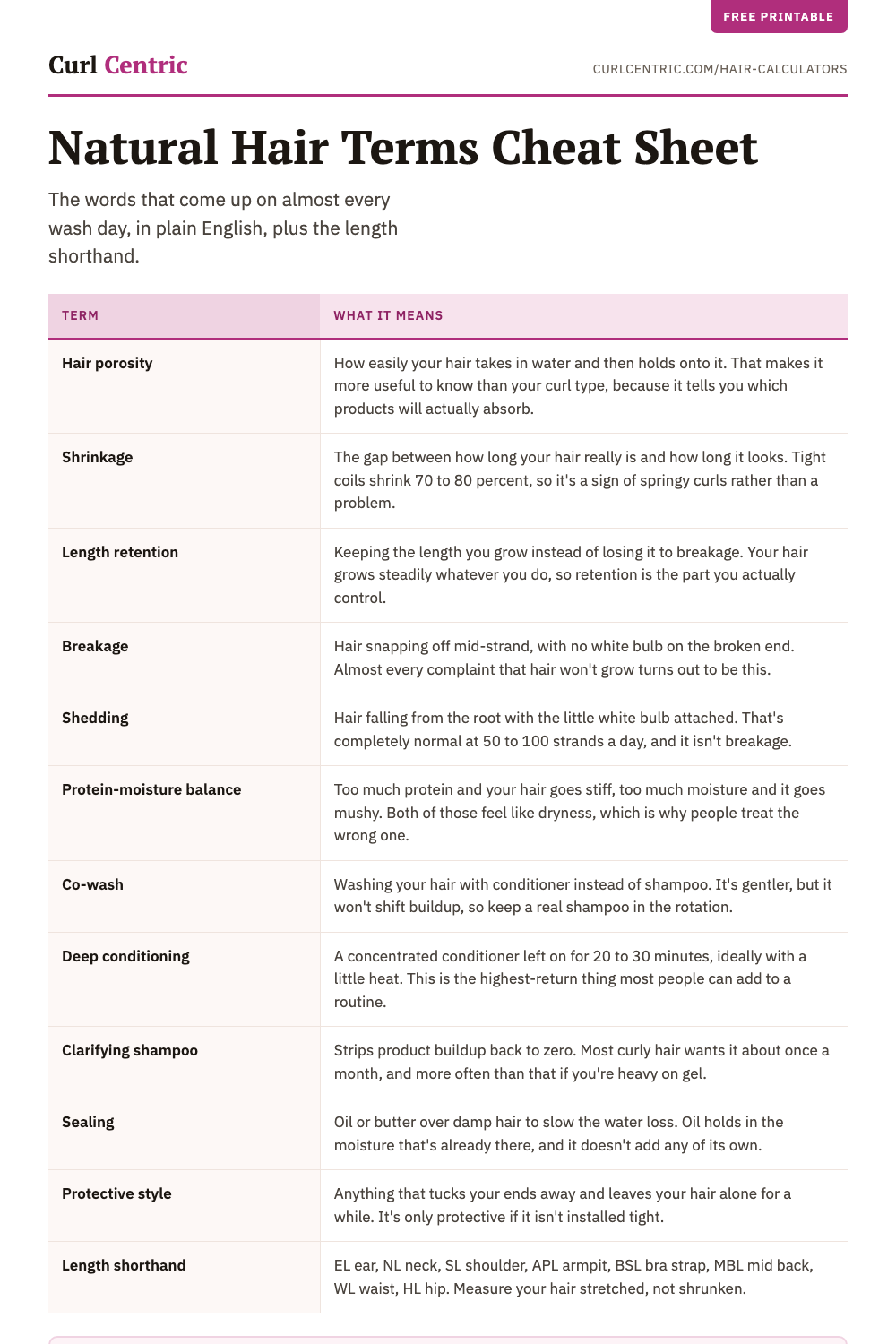
Free one-page printable
Keep the short version on your phone for wash day.
You’ve just scrolled a page full of terms, and you won’t remember all of them. This one-page sheet has the twelve that come up most, in plain English, plus the length shorthand for measuring your hair.
Free. One email a week after that. Unsubscribe anytime.
Frequently asked questions
The questions people search for most often alongside these terms.
What is natural hair?
Natural hair is hair that hasn't been relaxed, texturized, or put through any other chemical process. Heat-straightened hair still counts, as long as your curls revert once you wash it.
The word describes what you haven't done to your hair rather than a particular curl pattern.
What are the four natural hair types?
The hair typing chart sorts hair into four natural hair types: straight, wavy, curly, and coily. Most people land in type 3 or type 4, and each one splits again into A, B, and C. Andre Walker built the original chart; 4C was added later by the natural hair community.
Your type tells you a little about styling and almost nothing about which products to buy, so treat it as a description rather than a shopping list.
What is another word for natural hair?
You'll hear textured hair, curly hair, coily hair, and kinky hair used for much the same thing. People who wear theirs out often call themselves naturalistas.
A few of those words carry history worth knowing before you use them, which is why a term like nappy hair has its own entry in this natural hair dictionary.
How do you use this natural hair dictionary?
Type any word into the search box and the list filters as you go, so you don't need to know the spelling. Every term links out to the full guide when you want the long version.
Each one also has its own link you can save or send to someone else.
Which terms should you learn first?
Start with porosity, shrinkage, and the difference between breakage and shedding. Those three explain most of what confuses people about their own hair.
The twelve-term list at the top of this page covers the rest of the basics.
What do the oil abbreviations mean?
EVOO is extra virgin olive oil, EVCO is extra virgin coconut oil, and JBCO is Jamaican black castor oil. The first two get inside your hair shaft, and the third sits on top of it and seals.
That difference is why you'll see them used at different points in the process.