

If you've been told to keep a natural hair journal and were never sure what to actually write in it, we're here to help. Our hair journal is free, it's 26 pages, and there is no email wall in front of it.

Twelve wash days, a length and shrinkage chart, a protective style tracker, and a plain-English glossary. Built for coily, kinky, curly and loc'd hair.
There are two versions of the same printable hair journal. The print edition is for a binder or a clipboard. The fillable edition is the same 26 pages with 1,303 form fields in it, so you can type your responses into the PDF on a laptop, a tablet or a phone and never print a page.
We explain what's inside below, and the method the journal is built around. If you would rather use a notebook you already own, that works too. Everything the journal asks for is listed further down, so you can also create your own pages.
What's in the printable hair journal
| Pages | What they do |
|---|---|
| Where your hair is starting from | Texture, porosity, density, strand thickness, scalp, four starting lengths, shrinkage, and one goal |
| Your hair regimen plan | Twelve steps, each with what you are using, why that one, and how often |
| Month at a glance | A calendar for wash days, deep conditioning, clarifying, style installs and take-downs |
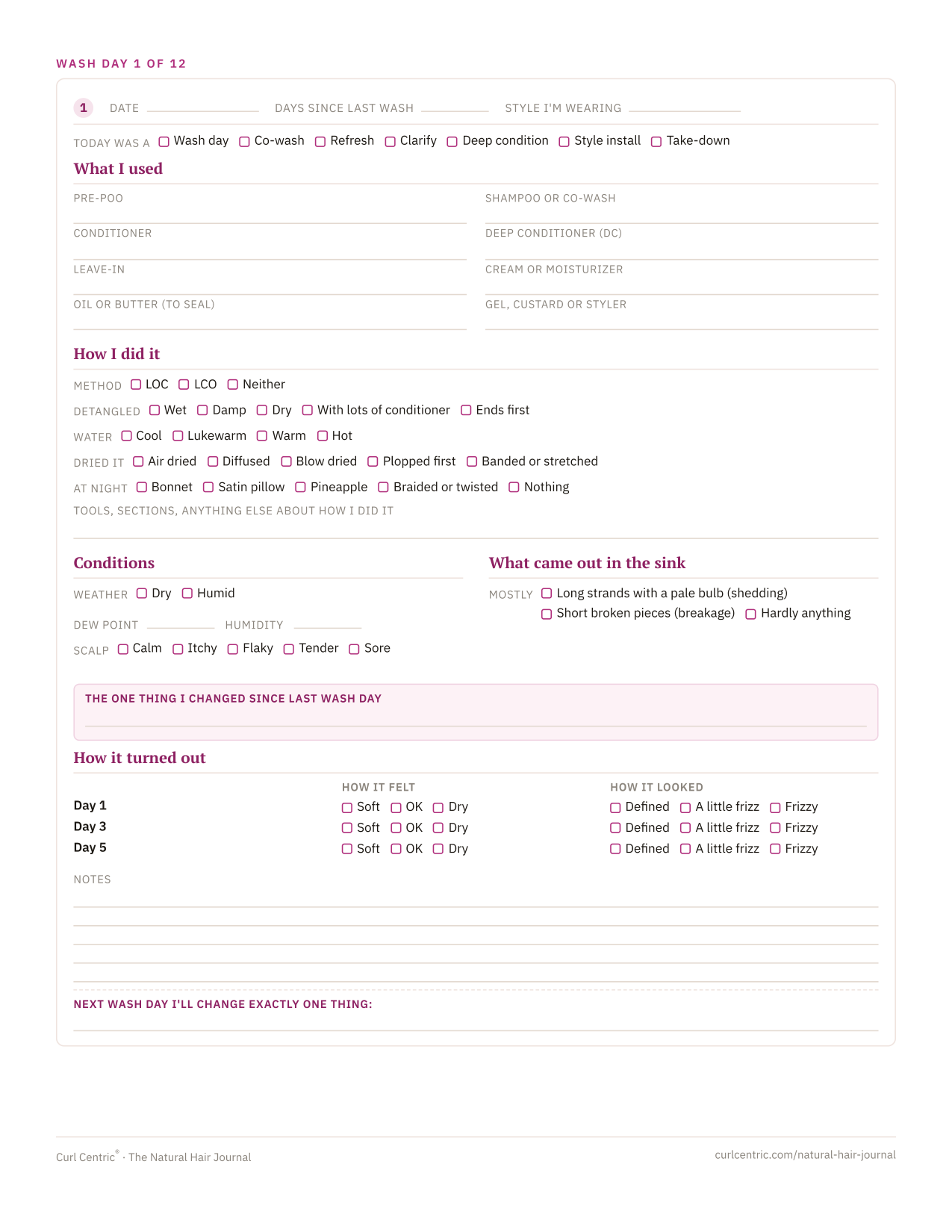
| Twelve wash day pages | One full page each: products by step, technique, conditions, scalp, what came out in the sink, and how your hair turned out on days 1, 3 and 5 |
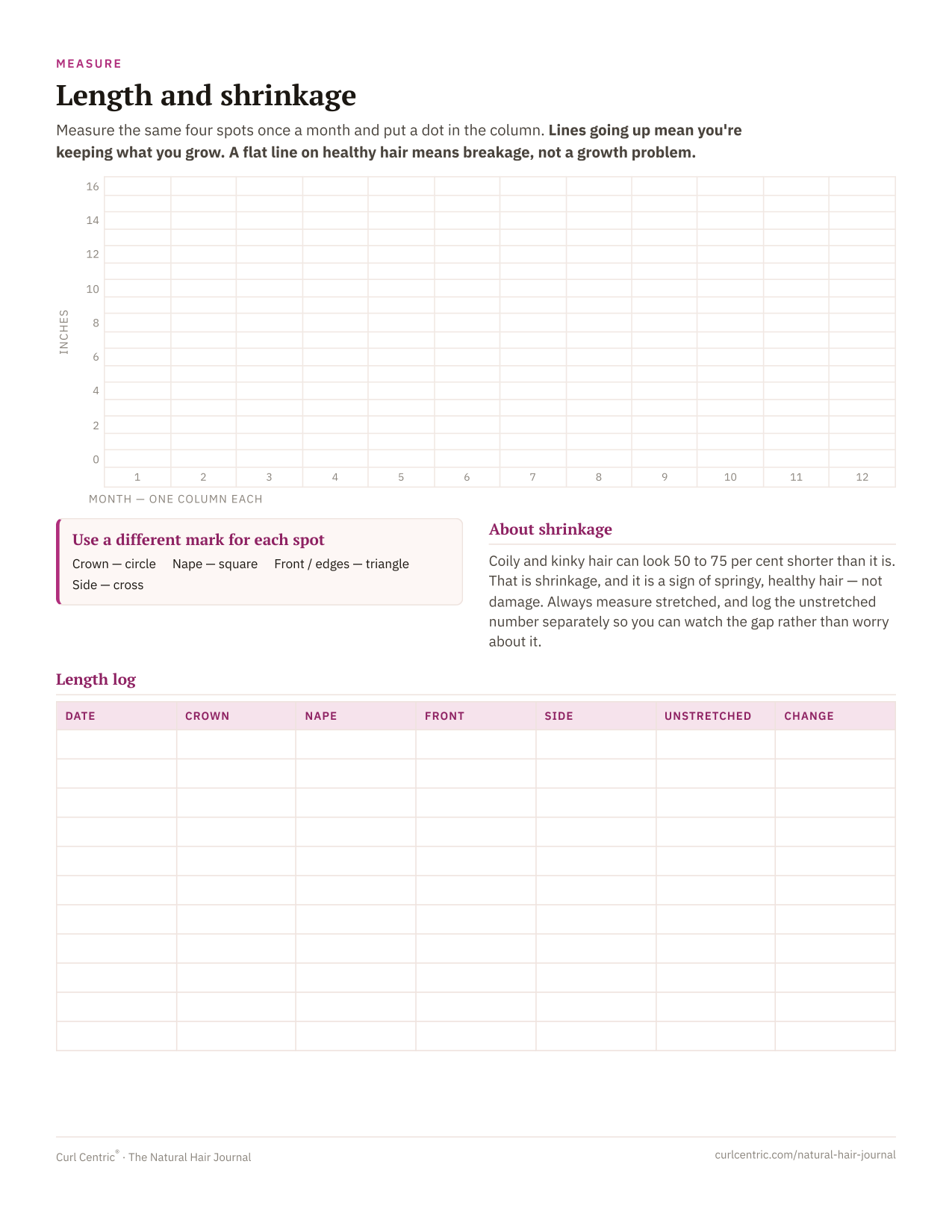
| Length and shrinkage | A chart you plot monthly at four spots on your head, plus a log with a change column |
| Protective style tracker | What went in, when it is due out, and how the take-down went |
| Product verdicts | Keep, repurchase, maybe, never again |
| Monthly check-ins and a twelve-week review | The questions that turn twelve weeks of notes into a decision |
| The words people use | Thirty-six terms in plain English, from pre-poo to dew point |
Why a hair journal works
Not because journaling is magic. Because you cannot compare what you did not write down.
Three months from now you will not remember whether the wash day your hair loved was the one where you detangled wet, or the one where you switched leave-ins, or the one where it simply happened to be humid. You will remember that your hair was good that week. That is not enough to repeat it.
A journal turns a vague sense that something is working into something you can check. That is why so many natural hair journals fill up and still answer nothing: they record what went on your hair and never what your hair did next.
Four habits that make a hair journal work
1. Change one thing at a time
Switch your shampoo, your detangling method and your leave-in in the same week and your hair improves, and you have learned nothing about which one helped. Change one thing, keep the rest of your routine steady, and give it three or four wash days.
This is the habit people skip, and it is why most hair journals become a list of products rather than an answer.
2. Write down how your hair turned out, not just what you used
What you used is the easy half. What matters is how your hair felt and looked on day 1, day 3 and day 5, what your scalp did, and what came out in the sink. A page that reads "Shea Moisture, As I Am, Jojoba Oil" tells you nothing in March. Record the outcome and you can track your hair progress instead of guessing at it.
3. Learn to read your sink
This is the most useful thing you can learn to notice about your hair, and it takes about ten seconds.
A shed hair is full length with a pale little bulb on one end. That is your hair growth cycle working normally; the American Academy of Dermatology puts normal shedding at 50 to 100 hairs a day.
A broken hair is short, uneven, and has no bulb.
Shedding is a cycle. Breakage is a handling problem. They need opposite responses, and most people treat them as the same thing.
4. Measure your hair once a month, in the same four spots
Growth happens at your scalp. Whether that growth stays is decided at your ends. Measuring the crown, nape, front and side on a monthly basis is the only way to tell which of the two you actually have a problem with.
If your measurements creep up while your hair looks the same length, you are growing and breaking at similar rates. That is a retention problem, and it has completely different fixes from a growth problem, see our complete guide to natural hair.
What to write down on each wash day
If you are using your own notebook, create your pages to capture these details. This is what every wash day page in the journal asks for:
- The date, and how many days since your last wash
- The style you are wearing - a wash and go, a twist-out, a braid-out, or a protective style
- What kind of day it was - wash day, co-wash, refresh, clarify, deep condition, style install, take-down
- Every product you used, by step - pre-poo, shampoo or co-wash, conditioner, deep conditioner, leave-in, cream, oil or butter, styler
- How you did it - LOC or LCO, whether you detangled wet or dry and with how much conditioner, water temperature, how you dried your hair, what you did at night
- The weather - dew point and humidity, which matter more than most people expect
- Your scalp - calm, itchy, flaky, tender or sore
- What came out in the sink - long strands with a bulb, or short broken pieces
- The one thing you changed since last time
- How your hair turned out on day 1, day 3 and day 5 - how it felt, and how it looked
- What you will change next time. One thing.
Building your hair regimen inside the journal
Whatever you write in, the entries fall into three groups. Get all three and you have something you can troubleshoot from.
Foundation: where your hair actually is
Porosity, density, strand thickness, your scalp, current length, and how much damage you are working with. Assess your hair once at the start and again at the end - that comparison is the point of keeping a regimen journal at all.
Eating well helps your hair, but it moves slowly. One line about any real change to your diet is plenty; you do not need a food diary in a hair journal.
Products: what you used and what your hair did
Record every product, at which step, and what happened. Note what you like and dislike about each one. Over a few months you will see which ingredients and which products your hair responds to and which products you keep rebuying out of hope. Give any product at least three wash days before you judge it, and only judge it if it was the one thing you changed.
Styling and maintenance: your routine, your tools, your styles
Your routine, the tools you use, the styles you wear, and any problems. Photograph your styles. A photo from the same angle in the same light, once a month, will tell you more about your hair progress than your memory will.
If you wear protective styles, write down the date the style went in and the date it should come out. Six to eight weeks is the usual limit; past that, the take-down tends to do more damage to your hair than the style prevented.
Setting natural hair goals you can actually check
This is where most natural hair goals fall apart. "I am going to wear more protective styles" is not a goal. There is no way to know whether you did it.
"I am going to wear protective styles three days a week" is a goal. You will know on Sunday whether it happened.
The same applies across your routine. Not "moisturize more" but "moisturize my ends every other night." Not "stop using heat" but "no heat for twelve weeks." Specific enough that the answer is yes or no.
How often to update your journal
Every wash day, not every week. Most people with textured hair are not washing weekly, and tying your journal to the calendar rather than to what you actually did is how it drifts.
A wash day entry takes two minutes if you fill it in while your deep conditioner is on. That is the trick - do it during the wait, not after you have cleaned up and moved on.
Then on a monthly basis, sit down for twenty minutes with the pages you have filled in and answer four questions: which single change made the biggest difference, whether you are seeing shedding or breakage, what you are keeping and what you are dropping, and what your measurements did. The journal has those pages built in.
Paper, PDF, or a hair journal app?
Plenty of hair journal apps exist, and some people genuinely stick with them better than paper. The honest answer is that the format matters far less than the four habits above; an app that only records products has the same blind spot as a notebook that only records products.
Apps are easier to carry and easier to search. Paper is faster to fill in with wet hands, and you keep control of your own data rather than handing your hair journeys to whoever owns the app this year. Our printable hair journal is a PDF for that reason: print it or type into it, and either way the file is yours.
Common questions
Do I have to print the natural hair journal?
No. The fillable edition has form fields on every page, so you can type into it and save it. Open it in any PDF reader - Preview, Acrobat, or most phone readers.
Is this natural hair journal template really free?
Yes, and there is no email wall. Print it as many times as you like, for yourself, for clients, or for a salon. We only ask that you do not resell it or strip the branding off it.
What if I only have a plain notebook?
Use the list above and create your own pages. The method matters far more than the paper, and the four habits work in any notebook.
How long before the journal tells me anything useful?
Give it twelve weeks. That is long enough for a real answer and short enough that you still remember what you did. The journal is built around exactly that window.
Where to go next
New to all of this? Start with our complete guide to natural hair, it covers what this journal assumes you know about caring for natural hair. If a term is unfamiliar, page 3 defines the thirty-six that come up most, and the natural hair dictionary has another two hundred. And if you would rather have a number than a notebook, our free hair calculators work out shrinkage and growth for you.