
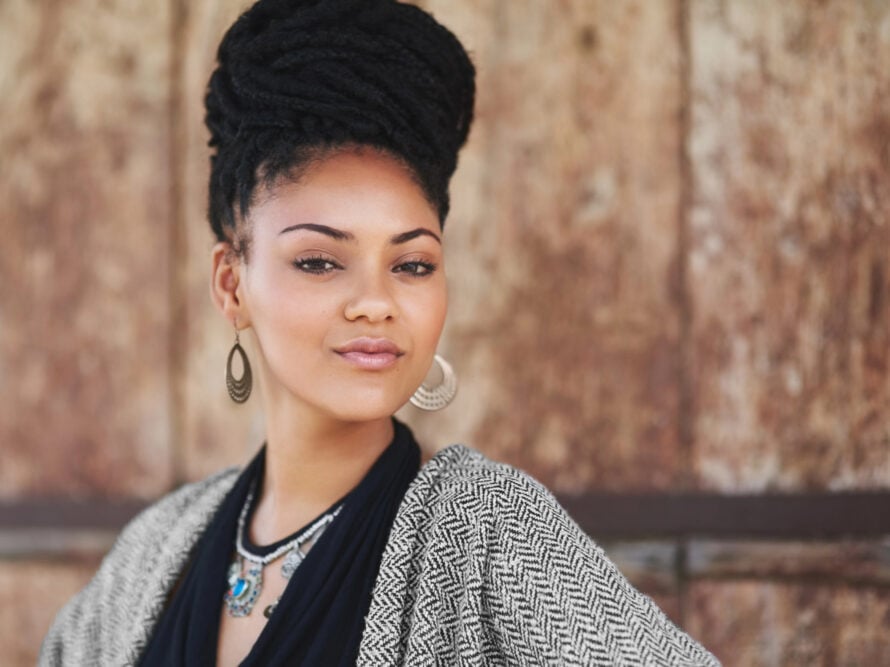
Three things decide whether a protective style actually protects your hair: how long you leave it in, how tightly the style was installed, and how you take it out. Get those right and the protective style does exactly what it promises. Get them wrong and it quietly costs you the length you were trying to hold onto.
This planner covers all three. If you're picking a protective style, work down from the top. If you're already wearing one and something doesn't feel right, go straight to the tension check in the middle.
Which Style Fits Your Hair?
Chances are you already have a protective style in mind, and what you want to know is whether your hair can carry the style. That comes down to three things, and not one of them is the name on the salon menu.
The first is weight, because added hair pulls on the roots holding it up. A protective style built from a lot of extra hair asks far more of your scalp than one you build from your own hair strands.
The second is section size. Smaller sections anchor to fewer follicles each, so the same weight lands on less hair and the tension concentrates.
Your curl pattern matters less here than how thick your strands are and how many of them you have. Fine hair and loose curls carry added weight less comfortably than dense, tightly coiled natural hair does, so the same set of braids can feel light on one head and heavy on another.
The third is how tight it went in at the root, and that's the only one of the three you can feel while it's happening. Work those out for the protective style you're considering, and the table below gives you the rest.
How Long Should Protective Styles Last?
Find your style in the table below and you get three things: a realistic wear window, how hard that style pulls, and how long you should set aside to take it out.
The styles are grouped by what's actually carrying the weight rather than by what they're called, because that's the thing that decides how hard they pull. One number here is real research: the six-to-eight-week ceiling comes from the American Academy of Dermatology and applies to every row. The rest is what stylists generally agree on, since nobody has compared these styles head to head.
How Long Should Protective Styles Last?
Twenty-two styles, sorted by what's actually carrying the weight.
| Style | Typical wear | Tension load | Take-down | Gets wet? |
|---|---|---|---|---|
| Braids with hair added | ||||
| The braiding hair is attached at your root, so its weight hangs on that one follicle for every single day you wear the style. Part the sections smaller and you spread the same weight over fewer hairs. | ||||
| Box braids | 6-8 weeks | High | 2-4 hours | Yes |
| Knotless braids | 6-8 weeks | Moderate | 2-4 hours | Yes |
| Micro braids | 4-6 weeks | High | 4+ hours | With care |
| Cornrows | 2-4 weeks | Moderate | 30-60 min | Yes |
| Feed-in braids | 4-6 weeks | Moderate | 1-2 hours | Yes |
| Lemonade braids | 2-4 weeks | High | 1-2 hours | Yes |
| Tribal / Fulani braids | 4-6 weeks | Moderate | 2-3 hours | Yes |
| Twists with hair added | ||||
| Twists attach at the root the same way braids do, but they usually use less hair in bigger sections. That means less weight per follicle, and a much faster take-down, which matters more than it sounds like it should. | ||||
| Senegalese twists | 4-6 weeks | Moderate | 1-2 hours | With care |
| Marley twists | 4-6 weeks | Moderate | 1-2 hours | With care |
| Passion twists | 4-6 weeks | Moderate | 1-2 hours | With care |
| Your own hair, nothing added | ||||
| Nothing extra is hanging on your strands here, so the only tension is whatever your hands and your hair tie put there. Luckily, that is the one thing you control completely. | ||||
| Two-strand twists | 1-2 weeks | Low | 20-40 min | Yes |
| Flat twists | About 1 week | Low | 15-30 min | Yes |
| Bantu knots | 3-7 days | Low | 10-20 min | Yes |
| Halo / crown braid | 3-5 days | Low | 10-15 min | Yes |
| Low bun | 2-3 days | Moderate | Minutes | Yes |
| Afro puff | 2-3 days | Moderate | Minutes | Yes |
| Locs and loc styles | ||||
| Locs carry their own weight all the time, so the trouble spot is your roots when they get retwisted too tight. Temporary loc styles often add hair, which is a different problem. | ||||
| Faux locs | 4-6 weeks | High | 3-5 hours | With care |
| Butterfly locs | 4-6 weeks | Moderate | 2-4 hours | With care |
| Starter locs | Permanent | Moderate | Not removable | Yes |
| Wigs, weaves and crochet | ||||
| The piece itself doesn't pull on your hair at all. What carries the whole load is the braided base underneath it, and that's exactly the part everyone forgets about. | ||||
| Crochet braids | 4-6 weeks | Moderate | 30-60 min | With care |
| Sew-in weave | 6-8 weeks | High | 1-2 hours | With care |
| Wig over a braid-down | Daily, off at night | Low | Seconds | Yes |
One number here is real research. The rest isn't, and we'd rather say so. The six-to-eight-week limit comes from the American Academy of Dermatology, and it applies to every style here. Everything else in the Typical wear column is what stylists generally agree on. Nobody has ever run a study comparing these styles to each other. Tension load is our own read on two things you can see for yourself: how much hair gets added, and whether it's attached at your root. A style in the Low column that goes into your hair too tight is still too tight.
Braids, Twists, and Locs Compared
We grouped the protective styles in the table by what carries the weight, not by what they're called. That's the thing that decides how hard a protective style pulls on your hair. Here's what that means for the braids, twists, and locs readers ask us about most.
Boho braids and goddess styles are variations rather than separate categories. They're braids or locs with curly pieces left loose, so they pull on your roots the same way the braid or loc underneath them does.

Knotless Braids and Stitch Braids
Knotless braids start with your own hair and feed the braiding hair in gradually, so nothing cinches into a knot at your root on day one. Stitch braids are cornrows, parted into clean rows and braided flat against your scalp.
Both spread their weight along the length of the braid instead of hanging all of it at the base. Most people will tell you knotless braids are gentler than knotted box braids, and the mechanism holds up. But nobody has compared the two in a study, so treat that as reasoning rather than proof.
Marley Twists and Two-Strand Twists
Marley twists use a coarse, kinky-textured braiding hair that grips your own hair, which is how they hold without going in tight. They still add weight, so the rule about section size still applies to your hair.
You can wear two-strand twists on your own hair with no additional hair added at all. That makes them one of the lightest styles you can put your hair in, and it's why they sit in the low-tension row of the table.
Faux Locs and Crochet Styles
Faux locs wrap added hair around a base braid or twist, and wrapping piles on weight fast. A full head of faux locs can get heavy enough that you'll notice it by the end of the first day.
Crochet styles work differently, because your stylist loops the hair onto a cornrow base instead of attaching it to your strands one piece at a time. Those base cornrows carry everything, so the install is only ever as gentle as they are.
Which Style Pulls Your Hair the Least?
Readers asked us to name one protective style here, and there isn't one, because how a style goes in matters more than what it's called. A loose set of knotless braids asks less of your edges than a tight set of two-strand twists does.
The pattern underneath is consistent, though. Styles that add no hair, use bigger sections, and sit back from your hairline ask the least of your scalp. That's why two-strand twists on your own hair land at the gentle end of the table.
Nobody has run a study ranking these styles against each other, so this is mechanics rather than measurement. The short version: choose styles with less added hair, bigger sections, and nothing dragging at your edges.
Is Your Protective Style Too Tight?
Tick anything that sounds like your hair right now, and be honest about the sore bits. Here's why that matters: in one study, four out of five women who lost hair to pulling had felt a warning sign before they lost any hair.
So the soreness isn't your style settling in, and it isn't something you have to put up with. It's the part you can still do something about.
Is Your Protective Style Too Tight?
Eleven things dermatologists look for, in language you can use on your own head tonight. And here's why it's worth doing, of the women in one study who lost hair to pulling or tension, only 18.9% had never felt a warning sign first. Four out of five felt it coming.
What you can feel
What you can see
Two things that change what the rest of this means
One thing this can't do is diagnose you. Only a board-certified dermatologist can tell you for certain whether what you're seeing is traction alopecia. That's the medical name for hair loss caused by pulling. What we can tell you is why checking early beats checking late. Caught in the first stage, your hair grows back completely. Left alone long enough, the follicle scars over and it doesn't. The signs above come from the American Academy of Dermatology and from three published studies. The largest followed 1,178 South African women and girls.
What Protective Styles Cost Your Hair
A protective style doesn't grow your hair. It cuts down how often you comb, part, and handle your strands, which is what people mean by low manipulation. Less handling means less breakage, and that's how you keep more of the length you were already growing.
The costs of protective styles are real, though, and you should know them before you book. Your scalp gets harder to reach, so buildup collects unless you wash it on purpose. Your natural hair dries out faster too, because the leave-in that used to reach every strand now sits on the outside of a braid.
Then there's tension, and that's the one that does lasting damage. Nearly everything else on this list grows back.
How to Sleep in Braids and Twists
If you've ever woken up with frizz along the top of a fresh install, your pillowcase is the reason. Cotton pulls moisture out of your natural hair and catches on your braids all night, and a satin or silk scarf, bonnet, or pillowcase fixes both problems at once.
At night, tie your hair down loosely. Be sure to be careful around your edges, because that's the finest hair you have and the first place nightly tension shows up. A scarf pulled too tight at your hairline every night for six weeks does the same thing a tight install does; it just takes longer to show up.
Why Does My Hair Shed After Braids?
If you've ever taken your braids out and felt sick at the amount of shedding you experienced, this chart is for you. You shed somewhere between 50 and 100 hairs a day whether your hair is loose or braided. The difference is that a braid holds onto some of the shed hair, so eight weeks of ordinary shedding turns up all at once. Move the slider to however long your was installed for a shedding estimate.
Why Does My Hair Shed So Much When I Take Braids Out?
If you've ever taken your braids out and felt sick at the amount of shedding you experienced, this chart is for you. Move the slider to however long your hair was installed for a shedding estimate.
| Time in | Days | Shed hairs held in the style |
|---|---|---|
| 2 weeks | 14 days | 700-1,400 hairs |
| 4 weeks | 28 days | 1,400-2,800 hairs |
| 6 weeks | 42 days | 2,100-4,200 hairs |
| 8 weeks | 56 days | 2,800-5,600 hairs |
| 12 weeks | 84 days | 4,200-8,400 hairs |
Where these numbers come from. The American Academy of Dermatology puts normal shedding at 50 to 100 hairs a day. The rest is just arithmetic, and it's ours rather than anyone's research. While your hair is braided or twisted up, the hairs you shed have nowhere to go. So they sit there instead of washing out on your wash day. Treat these as the high end, though, because some of them do work loose while you're wearing it.
Before and After a Protective Style
You'll want to do some work before your appointment rather than after it. Deep condition your hair a day or two ahead, and detangle it. Whatever state your curls are in on install day is the state they stay in for the next six weeks.
Take-down is where most of the damage happens, so give it longer than you think you need. Work in sections from the ends up, keep your hair damp and slippery with conditioner, and stop when you get tired instead of dragging through the last row.
Then give your scalp a rest before the next protective style.
Resting for two to four weeks is what you'll usually hear, and no study has put a number on it. But the reasoning holds: your follicles get a break from tension, and you get to wash, deep condition, and look at your edges again.
That gap is the point of the whole exercise. Protective styles work by cutting down manipulation, which is just how often you comb, part, and pull at your hair, and that's when you find out whether it paid off.
Where These Numbers Come From
The planner gives you the numbers. Our full guide to protective styling explains what sits behind them: what traction alopecia actually is, why it takes your edges before your crown, how to wash your scalp without wrecking the style, and how to take your style down without undoing six weeks of work.
Everything here is sourced, and where the evidence is thin we say so rather than rounding it up into something firmer than it is.