

Hair Growth Calculator
Estimate how much new hair you'll grow over a set number of months — and what your length could look like if you hold on to it.
Growth isn't the same thing as length
Your scalp keeps producing new hair whether or not you see it in the mirror. What shows up as "my hair isn't growing" is usually breakage at the ends, so the length you keep depends on moisture, gentle detangling, protective styling, and how often you trim. This calculator estimates biological growth — retention is the part your regimen controls.
Interested in knowing how long your hair will be at defined points in time? Estimating future hair length can be tricky, but coming up with an educated prediction is 100% possible. Whether you're serious about growing your hair to a certain length or are just curious about your hair growth potential, this is where you need to be.
On this page, you'll find a hair growth calculator, which is an online tool that provides you with an estimate of your hair length after a given period of time using a hair growth formula. In addition to that, we'll provide research-based information about hair growth stages and factors that influence your average hair growth rate.
Get to Know the Hair Growth Cycle
Your hair is always growing...or at least a portion of it is. Every hair on your head is subject to the growth cycle, where it grows, transitions, rests, and then sheds, ending up in your shower drain and styling tools.
At any given time, about 85 - 95 percent of your hair follicles are in the growing stage, and the rest is in one of the other phases. Below, we'll discuss the stages of the hair growth cycle:
Note: Some experts only recognize three distinct hair growth phases, while others acknowledge four. We'll focus on all four.
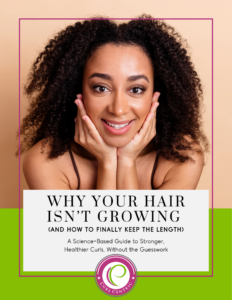
Free 50-page guide
Your hair is already growing. The problem is keeping it.
About a third of an inch a month on textured hair, not the half inch you’ve read. If your length looks stuck, that’s your hair breaking off as fast as it grows in. Here are the seven causes of breakage and the weekly routine that stops them.
Free. One email a week after that. Unsubscribe anytime.

The Anagen Phase - Growing Phase
This phase is the active growth phase for hair follicles, lasting anywhere from two to seven years. The Anagen phase is determined by genetics and can vary from person to person. During this stage your hair's genuinely growing, and on textured hair that works out to about a third of an inch a month.
The Catagen Phase - Transition Phase
Also known as the transitional phase, the catagen phase usually lasts only two or three weeks. It is the brief transition period between growth and rest. During the catagen phase, hair growth slows or stops, and the hair's root detaches from the bottom of the hair follicle. Experts estimate that about 5 percent of hair is in this stage at any moment.
The Telogen Phase - Resting Phase
During the telogen phase, the hair still isn't growing. It is resting. About 10 - 15 percent of your hair is in this stage at any moment. The telogen phase is roughly three months long.
The Exogen Phase - Shedding Phase
After the resting phase is the shedding phase - the exogen phase. In this phase, old hair falls out, and new hair starts to grow in the follicles. The hairs don't pop out spontaneously; your hair care and styling routines encourage this shedding to occur. The exogen phase for any individual hair could last up to 5 months.

How Fast Does Hair Grow?
Now that you know more about the hair growth cycle and its stages, let's get to the question you're likely most interested in - how fast does hair grow? Textured hair grows about a third of an inch a month, which comes to a little under four inches a year. Straighter hair averages closer to half an inch, so if you've been working from that number, your hair's on a slower clock than you'd planned for. That's an average too. The spread between people is wide, and the same measurements put individual rates anywhere from roughly two to five inches a year. Those numbers come from a study that measured African and Caucasian hair the same way (Loussouarn, British Journal of Dermatology, 2001). It covered 38 people, so treat it as a good average to plan from, not a promise about your own hair.
Several things decide where in that range your own hair lands:
What You Eat
A healthy diet is essential for hair growth. Foods rich in Vitamin C, Biotin, Iron, Zinc, and vitamin E can promote healthy hair growth. And if you're deficient in any nutrients vital to hair growth, your hair growth could stall or stop for a time.
If you're not sure whether you have a vitamin deficiency, it's best to speak with your healthcare provider. They will run any necessary tests to determine which supplements and vitamins, if any, you might need.

Age
Your hair growth rate also slows down as you age. Generally, people from ages 15 to 30 see the fastest hair growth rate compared to other age groups. Hair tends to grow slower past age 30 and even slower still for older individuals.
Your Genetic Makeup
Your genetic makeup also affects your hair growth rate. Some people are genetically predisposed to faster-growing, longer hair than others. Other people's hair may take longer to reach certain lengths. But, despite gene variation, hair growth rates are still pretty consistent.
Whether You Retain Your Length with Mindful Hair Care
The amount of hair growth you see on a regular basis is directly affected by your hair care routine. Do you frequently color or bleach your hair? Do you heat style your hair without using a heat protectant? If so, you might be damaging your hair, making it harder to retain length.

How to Calculate Hair Growth
Calculating hair growth is much simpler than it seems. All you need to know is how many months you'd like to calculate growth for.
Hair Growth Calculator Formula
Since textured hair grows about a third of an inch a month, you can multiply 0.33 inches by the number of months you want to count.
For example, if you wanted to know how much hair you'd grow in 6 months, you'd multiply 0.33 inches by 6 and get about 2 inches. So your hair would put on roughly 2 inches over those six months. You can run the same calculation for 10 or 20 months to see what to expect over a longer stretch.
Of course, the results of any hair growth calculator won't be 100 percent accurate - many factors can affect the rate at which your hair grows. Although, it's a great way to satisfy your curiosity about how much hair you can expect to grow in a certain amount of time.

What to Do with the Information from This Calculator
After you get your results from the hair growth calculator, you might not know how to use the information. If this resonates with you, keep on reading. While it's great to know that your hair can grow so much in a certain amount of time, there are some things you can do to keep your hair healthy and ensure that it reaches its full potential.
If you are underwhelmed by your results, that's understandable.
Just know that superhuman hair growth rates are not the norm, and it takes time to get to the length you may be dreaming of. You'll find loads of products online that claim to speed up your hair growth, but the vast majority of them will do nothing more than empty your bank account.
To ensure that you reach your hair length goals, it's essential to practice proper hair care, including using the right products for your hair type and avoiding excessive heat tool use (and using a heat protectant when necessary).
Additionally, trim your hair regularly to keep split ends and other damage at bay. It also helps not to go overboard with chemical treatments like relaxers, perms, hair coloring treatments, and the like.
Finally, ensure you are getting the essential vitamins and minerals needed for optimal hair growth, such as biotin and vitamin E. You can get these through your diet and/or via supplement form.
And if you ever have questions, don't hesitate to ask a hairstylist in your area or do some research on it yourself. Sometimes, it's best to get professional help to maintain your hair's health. There are some things that you just don't know.
Can Hair Grow 2 Inches in a Month?
No, and it isn't close. Textured hair grows about a third of an inch a month, and straighter hair runs closer to half an inch, so a month of growth is a fraction of an inch either way. Your genetics, your diet, and how gently you handle your hair all move that number a little, but nothing moves it to 2 inches. What you see in the mirror depends far more on what you keep than on what you grow, so don't chase speed. A balanced diet and a gentle routine will do more for your length.
How Do I Calculate My Hair Growth?
Multiply your monthly growth rate by the number of months you want to count. Textured hair grows at about a third of an inch a month, so use 0.33 inches. Six months works out to 0.33 times 6, or roughly 2 inches of new growth. That's what your scalp makes, though, not what you'll measure at your ends; whatever breaks off comes out of the total. If your tape measure keeps reading the same year after year, that gap is the reason.
How Long Does It Take to Grow 1 Inch of Hair?
About three months on textured hair. That's from a growth rate of roughly a third of an inch a month, and it shifts with your genetics, your age, and how gently you handle your hair. Straighter hair covers the same inch in about two months. Keeping that inch is the harder half, and split ends are usually what takes it back.
How Long Does Hair Grow in 2 Weeks?
About 0.15 inches, a little under a sixth of an inch. Textured hair grows roughly a third of an inch a month, which is about 0.08 inches a week. That's an average, so your own hair can sit either side of it. Whatever breaks off at your ends over those two weeks comes out of what you actually keep, which is why you usually can't see 2 weeks of growth at all.
Related Articles
- Why Is My Hair Growing So Fast?
- Growing Longer Natural Hair
- Can You Feel Hair Growing On Your Scalp?
- How to Regrow Edges
We hope that this hair growth calculator and accompanying tips have been helpful to you and that it has given you valuable insight into the hair growth cycle and factors that affect your hair growth and length retention.
By combining the knowledge provided by this calculator with mindful hair care practices, you can reach the hair length of your dreams. We wish you the best of luck with your hair care journey!