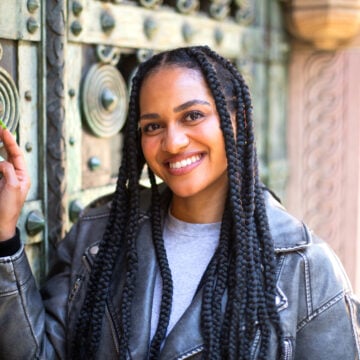

A low-tension protective style keeps your hair in place without pulling on your strands. These styles either avoid putting extension weight on your hairline or spread the weight along the braid instead of tying it at your hair's root. The best low-tension styling options include bantu knots, two-strand twists, African threading, a halo braid, and wearing a wig over a loose braided base (e.g., loose cornrows).
A protective hairstyle hides your ends and keeps you from touching your hair too much. This helps you prevent tangles, retain moisture, and reduce breakage from daily styling. But tension is often overlooked. Even if a style protects your ends, it can still thin your hairline if you do it too tightly.
Use the tool below to sort every protective style we've measured by tension, cost, and time in the chair. All 21 styles are rated the same way, so you can compare them easily.
Showing all 21 styles
| Box Braids Box braids are a popular extension style, but the added hair is attached directly to each section at the root. This can place significant tension on your hairline, especially when the braids are small, long, heavy, or installed too tightly. | High | 5–7 hrs | $125–$265 | 6–8 wks | 10–20 min | With practice |
|---|---|---|---|---|---|---|
| Goddess Braids Goddess braids are quicker to remove than many other braided styles. However, because the cornrows sit directly against your scalp, a tight installation can pull on your edges. | High | 2–5 hrs | $150–$250 | 4–6 wks | 5–10 min | No |
| Crochet Braids Crochet braids can be a gentle, beginner-friendly way to wear extensions. The extension hair attaches to a cornrow base instead of being tied to individual strands, but the base still needs to be loose. | Moderate | 2–3 hrs | $80–$150 | 2–8 wks | 10–15 min | Yes |
| Sisterlocks Sisterlocks do not add extension weight, but they are a long-term commitment. They also require regular retightening appointments to maintain the locs. | Moderate | 8–36 hrs | $450–$1000 | Years | 5–10 min | No |
| Spring Twists Spring twists use lightweight, springy extension hair. They are relatively easy to remove and require very little weekly maintenance compared with many other extension styles. | Moderate | 4–6 hrs | $150–$300 | 4–6 wks | 5–10 min | With practice |
| Faux Locs Faux locs can be one of the heaviest protective styles because each section includes wrapped extension hair. They also take longer to remove, so choose a lightweight length and take your time during takedown to protect your natural hair. | High | 4–9 hrs | $150–$500 | 4–6 wks | 10–15 min | With practice |
| Bantu Knots Bantu knots use only your natural hair, so there is no added extension weight. Keep each knot comfortably loose, especially around your edges. | Low | 45 min–2 hrs | Home style | 1–2 wks | 5–10 min | Yes |
| Two-Strand Twists Two-strand twists hang freely instead of sitting tightly against your scalp. Because they use your natural hair, they place very little weight on your roots. | Low | 2–4 hrs | $60–$150 | 2–6 wks | 5–10 min | Yes |
| Flat Twists Flat twists sit against your scalp like cornrows, but they can be created without extension hair. That removes the extra weight, although a tight installation can still create tension. | Moderate | 1–3 hrs | $50–$120 | 1–2 wks | 5–10 min | With practice |
| African Threading African threading wraps thread around your natural hair without adding heavy extensions. It can also stretch your curls without using heat. | Low | 1–3 hrs | Home style | 2–4 wks | 5 min | With practice |
| Wig Over a Braided Base A wig worn over loose cornrows lets you remove the style at night. That daily break can reduce pulling, friction, and stress on your scalp. | Low | 1–3 hrs | $40–$100 | 4–6 wks | 10–15 min | Yes |
| Knotless Braids Knotless braids gradually feed extension hair into the braid instead of securing all the added hair at your root. This spreads the weight more evenly and usually creates less tension than traditional box braids. | Moderate | 6–8 hrs | $200–$450 | 6–8 wks | 10–20 min | With practice |
| Cornrows Cornrows are one of the quickest and most affordable braided styles. Because they sit close to the scalp, they can place steady tension on your roots and edges when braided too tightly. | High | 2–5 hrs | $40–$185 | 2–6 wks | 5–10 min | No |
| Senegalese Twists Senegalese twists have a smooth, rope-like appearance and tend to last longer than many other twist styles. However, the large number of individual twists can add weight to your roots. | Moderate | 4–6 hrs | $180–$300 | 4–8 wks | 10–15 min | With practice |
| Marley Twists Marley twists are usually larger and use textured extension hair that blends well with natural curls. Because the twists are chunkier, you may need fewer individual sections. | Moderate | 3–6 hrs | $150–$250 | 4–8 wks | 10–15 min | With practice |
| Microlocs Microlocs are small, long-term locs created with your natural hair. They do not require Sisterlocks certification and typically cost less to establish and maintain. | Moderate | 6–24 hrs | $400–$1200 | Years | 5–10 min | No |
| Passion Twists Passion twists use water wave hair to create a loose, curly finish. The extension hair is generally lightweight, which may make the style more comfortable for a sensitive scalp. | Moderate | 4–6 hrs | $150–$280 | 6–8 wks | 10–15 min | With practice |
| Halo Braid A halo braid wraps your natural hair around your crown like a headband. It is an attractive, low-tension option that you can style quickly once you learn the technique. | Low | 15 min–0.75 hrs | Home style | 1–2 wks | 5–10 min | Yes |
| Loc Extensions Loc extensions are premade human hair locs crocheted onto your own hair. They give you finished locs on day one, and your new growth locks around the attachment over the months that follow. | High | 5–16 hrs | $600–$1400 | 4–8 wks | — | Yes |
| Butterfly Locs Butterfly locs are water wave hair crocheted over a braid, with loops left free along each loc. They’re a temporary style, taken down after about six weeks. | Moderate | 4–7 hrs | $150–$500 | 4–6 wks | — | Yes |
| Soft Locs Soft locs are pre-made locs attached to your own plaits with a crochet needle, then wrapped with springy passion twist or spring twist hair. They come down after about six weeks. | Moderate | 4–8 hrs | $150–$400 | 4–6 wks | — | Yes |
Nothing matches every filter you’ve set. Try widening your budget or your time in the chair, because those two rule out the most styles.
What makes a protective style low tension?
Tension is the steady pulling force a hairstyle places on your hair and scalp. Three factors have the greatest effect on the tension level.

The first is how the extension hair is attached. When a large amount of hair is tied directly to your root with a knot, all that weight pulls from one small area.
Free 50-page guide
Your hair is already growing. The problem is keeping it.
On average, hair grows a third to half an inch a month, and curlier hair tends to grow more slowly. If your length looks stuck, that’s your hair breaking off as fast as it grows in. Here are the seven causes of breakage and the weekly routine that stops them.
Free. One email a week after that. Unsubscribe anytime.
The second is the total weight of the hairstyle. Long, thick extensions place more weight on your roots than shorter, lighter styles. The third is where the style begins. Hair around your edges is usually finer and more fragile, so styles that pull directly on your hairline require extra care.
This is why two similar styles can have different tension ratings. Traditional box braids and knotless braids may create the same finished look, but they distribute the extension hair differently. With knotless braids, the stylist gradually feeds in the extension hair instead of tying it all at your root. The final styles may look similar, but the tension on your natural hair is different.
How We Rate Tension
Every protective style in our comparison tool uses the same tension scale:
- Low tension: Little or no extension weight sits directly on your hairline, or the weight is added gradually. You can wear these styles while your edges recover.
- Moderate tension: Extension weight is present but distributed along the braid, or the installation begins away from your hairline.
- High tension: Extension hair is tied directly to your roots, or the style places steady pressure on your hairline.
The scale measures the tension you may experience while wearing a specific style, regardless of where that tension comes from.
For example, Sisterlocks use only your natural hair, but we rate them as moderate tension. Repeated retightening creates tension on the same small sections of hair. If you tighten those sections too firmly every four to six weeks, that repeated tension over several months can eventually affect your hairline.
Our scale is anchored to guidance from the American Academy of Dermatology. The AAD explains that tight braids, cornrows, locs, and extensions can cause traction alopecia, a form of hair loss caused by repeated pulling on your hair strands. The AAD also notes that if you're of African descent, the shape of your hair follicles makes textured hair more vulnerable to damage from rough or tight styling.
Understanding Installation Time and Weekly Upkeep
Two columns in the comparison tool deserve a closer look: time in the chair and weekly upkeep.
Time in the chair covers the installation itself. If a style requires a cornrow base, you may need to add approximately one hour to the total time.
Weekly upkeep tells you how much ongoing maintenance the style will require after installation. This matters because a protective style should reduce the time you spend restyling and handling your curls.
A style that looks convenient but requires 20 minutes of maintenance every night may not save as much time as you expected.
Which low tension hairstyles are gentlest?
If your edges are thinning or breaking, use the tool to focus on low and moderate tension styles. These options place less steady pressure on the delicate hairs around your hairline.
Bantu Knots
Bantu knots do not require extension hair, so there is no added weight pulling on your roots. Avoid twisting the knots too tightly, and consider using bobby pins instead of tight elastics around your hairline.
Two-Strand Twists
Two-strand twists, including mini twists, hang away from your scalp and use only your natural hair. Keep the twists around your edges loose, particularly if your hairline is already fragile.
African Threading
African threading wraps your natural hair with thread instead of adding heavy extension hair. This allows you to stretch and style your curls without asking your roots to support extra weight.
A Wig Over Loose Braids
A wig worn over a loose braided base can be removed at night. This gives your scalp and hairline a regular break, which is one of the biggest advantages of this option. Make sure the braids underneath the wig are loose, and that the wig, clips, or combs aren't rubbing the same areas every day.
Halo Braid
A halo braid, sometimes called a braided headband, wraps your natural hair around your crown. It can take about 15 minutes once you learn the technique and only a few minutes to remove. Keep the braid loose when it crosses your hairline.
Natural Locs
Locs grown from your natural hair do not carry the weight of extensions. However, Sisterlocks and microlocs receive a moderate rating because regular retightening returns to the same small sections of hair.
Retightening should feel secure, but it should not leave your scalp painful or irritated.
Crochet Braids
Crochet braids are one of the gentler options in our tool that still use extension hair. The hair is attached to a cornrow base instead of being tied to individual strands at the root.
The cornrows underneath still matter. Ask your stylist to keep the base comfortably loose, especially near your edges.
How long can you wear each style?
Our tool estimates how long you can wear a style; however, the time period may be shorter than some of the recommendations you see online. The American Academy of Dermatology recommends wearing braids for no longer than six to eight weeks. Treat eight weeks as the maximum, not the goal for every installation.
If your edges are fragile, shorten the suggested wear time by about two weeks. You should also give your hair and scalp a meaningful break before installing another long-term style. Taking one style down and installing another a few days later does not give your hair much time to recover.
How do you know a style is too tight?
Do not ignore the warning signs of excessive tension. Your hairstyle may be too tight if you notice:
- Small bumps along your part(s) or hairline
- A headache after the installation
- A scalp that feels tender when you move your head
- Stinging, burning, or persistent soreness
- Short, broken hairs around your edges
- Skin that appears pulled or raised around the braids
A painful installation is not something you need to "get used to." If the style hurts, ask your stylist to loosen it immediately.
Loosening a braid during the appointment takes only a few minutes. Regrowing a damaged hairline can take months, and hair loss may become permanent if the tension continues for too long.
You can make two changes to reduce tension without giving up your favorite style.
- Choose larger sections, because small braids and twists place the extension weight on smaller amounts of your natural hair. Larger sections allow more hair strands to share that weight.
- Choose a shorter length, because long extensions are heavier. Choosing shoulder-length braids or twists instead of waist-length hair can significantly reduce the weight your roots must carry all day.
You can still enjoy the overall look you want while making the style more comfortable for your scalp.
What if your edges are already thinning?
Stop wearing any style that puts tension on the affected area. Swapping one tight hairstyle for another one doesn't give your edges a chance to recover.
During your break, keep your routine simple:
- Clean your scalp regularly.
- Condition and moisturize your curls.
- Detangle gently.
- Avoid tight ponytails, buns, braids, and headbands.
- Reduce pulling and friction around your hairline.
- Sleep with a satin bonnet, scarf, or pillowcase.
When you are ready to try another protective style, start with a low-tension option. Keep the extensions short and lightweight, and consider limiting the wear time to four to six weeks.
For example, wearing a wig over a loose braided base or a lightweight crochet installation may help you maintain a finished look without stressing your edges as much.
When worn properly, protective hairstyles can reduce daily manipulation, limit breakage, and help you retain length. When worn too tightly, they can damage the same hair you are trying to protect.
Traction alopecia may be reversible if you notice it early and address it. However, repeated pulling can permanently damage the hair follicles.
You don't have to wait to see a board-certified dermatologist about hair loss, and the earlier you go, the better. Make an appointment if:
- Your hairline is receding.
- You see smooth or shiny areas where hair used to grow.
- Your scalp remains painful after removing the style.
- Your edges don't start filling in after you stop tight styling.
- You are unsure whether you are experiencing breakage, shedding, or hair loss.
Frequently Asked Questions
What Is the Lowest-Tension Protective Style?
Bantu knots have the lowest tension, based on our measurements. They use only your natural hair, and nothing is tied to your roots unless you wrap the knots too tightly. African threading and two-strand twists are close behind. All three options avoid the added weight of extension hair.
What are some low tension styles?
Bantu knots, two-strand twists, African threading, a halo braid, and a wig over a loose braided base are the five we rate low on our scale. Crochet braids are one of the gentlest options that still use extension hair. Be more careful with styles that tie heavy extensions directly to your roots, including traditional box braids, some cornrow-based styles, and heavy faux locs.
Are two-strand twists low tension?
Yes. Two-strand twists hang away from your scalp and usually carry only the weight of your natural hair, so there's almost no steady tension anywhere. Keep the twists around your hairline loose, especially if your edges are recovering. Mini twists work in a similar way and may last longer because the sections are smaller.
What are the easiest protective styles to do yourself?
Bantu knots are one of the easiest options for beginners. Each knot is created separately, so you can redo one section without disturbing the rest of your hairstyle. Two-strand twists are also beginner-friendly. Crochet braids are manageable with practice, although you may need help creating the cornrow base. Styles that require neat cornrows can be harder to install on your own head.
What is the lowest maintenance hairstyle?
Spring twists require the least weekly upkeep, approximately five to ten minutes for basic scalp care and wrapping the hair at night. Sisterlocks also require very little daily styling, but you must include the time and cost of regular retightening appointments. These appointments are typically needed every four to six weeks at $100 to $250. Use the weekly-upkeep column in the comparison tool to find a style that fits your preferences.
Every figure within this article comes from the hairstyle's own guide, where we show the published range and flag where sources disagree. We reconcile those numbers instead of averaging them, because a contradiction usually means one source left out an assumption about length or size. Tension risk is rated on one scale across all 21 styles, anchored to the American Academy of Dermatology's guidance on hairstyles and hair loss. Costs are typical US mid-market and will vary by region and stylist.