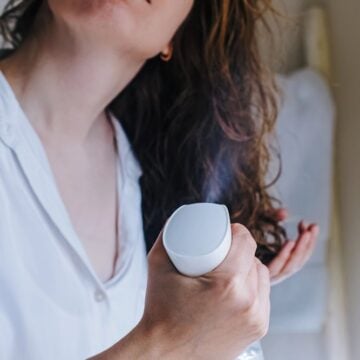


Dew point is the temperature the air would have to cool to before dew forms, and the higher it is, the more water is in the air. That's why curly and wavy girls watch it. On muggy days, your hair takes in water from the air, and that can turn defined waves into frizz. On dry winter days, curls can feel crunchy and rough instead.
But here's the part most dew point charts skip. Your hair doesn't respond to the dew point itself. It responds to relative humidity, the percent you see in a forecast, which depends on both the dew point and the temperature of the air around you.
In this article, we'll explain what dew point and humidity mean for your hair, where the popular dew point chart for curly hair comes from, and how glycerin fits in. We've also built a tool that checks today's humidity where you live and helps you find the range your own hair likes. Let's get into it!
What Is Dew Point?
Dew point is the temperature the air needs to cool down to before it's completely full of water vapor and the extra water turns into dew or fog (National Weather Service). A higher dew point means more moisture in the air. A low dew point means the air is dry.
Weather forecasters like dew point because it tracks how muggy the day feels to your skin. A dew point of 55°F or lower feels dry and comfortable, 55 to 65°F starts to feel sticky, and 65°F and up feels oppressive. Those ranges describe how air feels to people, though, not how it affects your hair.
Free 50-page guide
Your hair is already growing. The problem is keeping it.
On average, hair grows a third to half an inch a month, and curlier hair tends to grow more slowly. If your length looks stuck, that’s your hair breaking off as fast as it grows in. Here are the seven causes of breakage and the weekly routine that stops them.
Free. One email a week after that. Unsubscribe anytime.
Dew Point vs. Humidity: Which One Affects Curly Hair?
Relative humidity is how full the air is compared to how much water it could hold at its current temperature. Warm air can hold more water than cold air, so the same amount of water gives a lower humidity on a hot afternoon and a higher humidity on a cool morning.
Here's an example. A 30°F day with a 30°F dew point has 100% humidity, while an 80°F day with a 60°F dew point has about 50% humidity. The second day feels much muggier because the dew point is higher, even though the humidity is lower.
Your Hair Follows Relative Humidity
Each strand of hair takes in water from the air or gives it back until it reaches a balance with the relative humidity around it. In lab tests, the amount of water in hair rose steadily as the humidity climbed from 40% to 85% (Gao, 2007). Weather stations even used to measure humidity with a strand of hair, because hair gets slightly longer as the air gets more humid.
So the number that tells you what the air is doing to your curls right now is the humidity. And with the dew point holding steady, the humidity is usually highest in the early morning and lowest in the afternoon (National Weather Service). That's one reason waves that looked great at 7 a.m. can look different by lunch.
Dew Point Still Helps in Winter
Dew point earns its place when you spend most of the day inside. If your home isn't adding or removing much moisture, the air brought indoors starts with about the same amount of water as the air outside. Warming that air makes the humidity drop. For example, air with a 30°F dew point would be about 23% humidity after it warms to 70°F, which helps explain why curls can feel so dry and crunchy in winter.
Use the tool below to check today's humidity where you live, estimate the humidity in a heated room, and keep a short log of how your hair does.
Original Curl Centric tool
Check today’s humidity for your hair
Your hair’s water content changes with the relative humidity around it, the percent you see in a forecast. Check today’s number here, estimate the humidity in a heated room, and keep a short log to find the range your waves like best.
Where are you today?
US only. The forecast comes from the National Weather Service.
The next 12 hours
Watch the dew point hold steady while the humidity rises and falls with the temperature.
| Time | Temp | Dew point | Humidity |
|---|
Spending most of the day inside?
If your home isn’t adding or removing much moisture, air brought indoors starts with about the same amount of water as the air outside, and the relative humidity drops as it warms. Enter today’s outdoor dew point and your room temperature for an estimate.
This works for heated rooms without a humidifier. Air conditioning and a steamy bathroom change the number.
How did your hair do today?
Tap one after you check the humidity. We’ll save today’s number with it on this device only.
Your days so far
Dew point to indoor humidity
With the heat on and no humidifier, today’s outdoor dew point can help estimate the humidity in your room.
| Dew point | 68°F room | 70°F room | 72°F room |
|---|---|---|---|
| 20°F | 16% | 15% | 14% |
| 30°F | 24% | 23% | 21% |
| 40°F | 36% | 34% | 31% |
| 50°F | 53% | 49% | 46% |
| 60°F | 76% | 71% | 66% |
| 65°F | 90% | 84% | 79% |
Humidity from the dew point is worked out with the Magnus formula (Lawrence, 2005). Forecasts come from the National Weather Service, and ZIP codes are looked up with Zippopotam.us. Your ZIP and location aren’t saved, and your log stays in this browser.
Why Does Humidity Make Curly Hair Frizz?
Water changes the shape your hair is holding. When your hair dries, weak bonds inside each strand, called hydrogen bonds, set it in the shape it dried in. Water breaks those bonds again, which is why your hair is easier to reshape when it's wet. We explain this in more detail in our guide to why hair is curly when wet.

On a humid day, your hair takes in water from the air, so some of those bonds loosen, and your waves start to lose the shape they dried in. Strands that dried together in a clump can start to separate and go their own way, and that's the fuzzy halo we call frizz. Researchers have also found that changes in humidity can make curly hair feel frizzier by touch, because the strands rub against each other differently (Skedung et al., 2021).
Not every wavy girl frizzes in humid air. Some find that 2A and 2B waves just drop flatter instead. If that's you, our guide to limp curls covers the fixes. And if your hair looks frizzy while it's still wet, that's a different problem called wet frizz, and the weather isn't the cause.
The Dew Point Chart for Curly Hair
The dew point chart you'll find in curly hair groups usually looks something like this:
- Below about 30 to 45°F: too dry, so go easy on glycerin and other humectants (ingredients that pull in moisture)
- About 40 to 60°F: the "sweet spot" for curly hair
- Above about 60 to 70°F: humid, so use a stronger hold and fewer humectants
The exact cutoffs change from chart to chart. The "too dry" line falls anywhere from 30°F to 45°F, and the "too humid" line falls anywhere from 60°F to 70°F. That's because the chart started as a rule of thumb, not a measurement. It traces back to a curly hair blogger's 2009 chart, which the author described as theoretical and based on what seemed to work in her own city.
That doesn't mean the chart is useless. Many curly girls find it a helpful starting point. Just keep in mind that the same dew point can mean very different humidity depending on the temperature, so your hair might not agree with the chart. The log in our tool helps you find your own range instead of borrowing someone else's.
Does Glycerin Work at a High or Low Dew Point?
Glycerin is a humectant, which means it draws water toward itself and holds onto it. It's one of the most common ingredients in curl creams and gels, and the American Academy of Dermatology lists it among the ingredients to look for in a conditioner for curly hair (AAD).
Like your hair, glycerin takes on or gives off water as the relative humidity around it changes. So its effect depends on the air your hair is in, not on a single dew point number.
Glycerin on Dry Winter Days
A common worry is that in very dry air, glycerin pulls water out of your hair. That idea comes from skin care, where a humectant can draw water up from the living layers of skin underneath. Your hair strands don't have a living water supply, so in dry air, your hair and the glycerin in your products both end up holding less water.
What you'll probably notice on a dry day is hair that feels crunchy or rough and gel that dries harder than usual. If that happens, try a little more leave-in conditioner under your gel, or a softer hold. Our curly girl method ingredient checker can show you whether glycerin is high on your product's ingredient list.
Glycerin on Muggy Days
On humid days, products with a lot of glycerin can soak up extra water along with your hair. Many curly and wavy girls switch to a gel with fewer humectants and a firmer hold in the summer, and scrunch out the crunch once their hair is completely dry. If your hair frizzes more on humid days, that's an easy change to test.
How to Style Wavy and Curly Hair for the Weather
You can't change the weather, but you can change what's in your hair. These are the changes curly and wavy girls most often make for different kinds of air.
On Damp, Muggy Days
- Put your gel or mousse on while your hair is soaking wet, so it holds your clumps together before they can separate.
- Choose a firmer hold, and keep heavy creams to a minimum.
- Leave your hair alone until it's completely dry, then scrunch out the crunch.
- Keep a little gel on hand to smooth over frizz later in the day.
Curl Care on Dry Days
- Add a little more leave-in conditioner under your styler.
- Use a softer hold, or a cream instead of a gel.
- If your hair still feels crunchy once it's dry, scrunch it with a drop of light oil on your palms.
Dry Indoor Air in Winter
If the humidity in your home drops below about 30% in winter, a humidifier can raise it. Just don't overdo it, since damp indoor air can lead to mold. The EPA suggests keeping indoor humidity between 30% and 50% (EPA).
For more ideas on fighting frizz that isn't caused by the weather, see our guide on how to get rid of frizzy curly hair. And for the full routine that holds your waves in any weather, see our wavy hair routine.
And if muggy air has already undone yesterday's waves, our guide on how to refresh your waves shows you how to bring them back without a full wash.
How to Find Your Own Humidity Range
The most reliable chart is the one you make for your own hair. Here's how to do it with the tool above:
- Check the humidity in the morning, before you head out for the day.
- That evening, tap how your hair did: good, frizzy, flat, or dry and crunchy.
- Keep it up for 10 days, ideally with the same routine each time.
- Look at the humidity on your good days next to your frizzy or flat days.
After a couple of weeks, you'll have a range that's based on your own hair, your own products, and the air you actually live in. If your hair has been bleached, colored, or heat-styled, it may take in water differently than untreated hair, which is another reason your range might not match anyone else's. Our guide to hair porosity explains how damage changes the way your hair handles water.
We hope this helps you plan for the weather instead of fighting it. Here's to more good hair days, whatever the dew point says!
Frequently Asked Questions
What Dew Point Is Bad for Curly Hair?
There's no single number that's bad for every curly head. Popular charts call a dew point above about 60 to 70°F humid and below about 30 to 45°F dry, but the cutoffs vary from chart to chart. Your hair responds to relative humidity, so the best way to find your limit is to track the humidity on your good and bad hair days.
Is Dew Point or Humidity Better for Predicting Frizz?
Relative humidity tells you what the air is doing to your hair at that moment. Dew point is steadier through the day and helps you estimate the humidity indoors when the heat is on, so it's useful in winter.
Does Glycerin Cause Frizz in High Humidity?
It can contribute. On humid days, products with a lot of glycerin take on extra water along with your hair. Many curly girls switch to a gel with fewer humectants and a firmer hold in the summer.
What Humidity Is Best for Curly Hair?
It varies from person to person. Popular charts point to the middle of the range, neither very dry nor very damp, but your hair, products, and routine all play a part. Logging the humidity on your good hair days is the best way to find your own range.