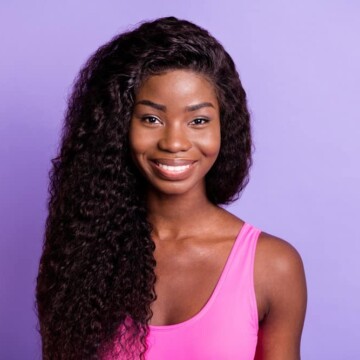
Hair straightening can be a fun change of pace for women with natural curls. If you're ready to ditch the straight strands and get your coils back, you can!
This article will tell you everything you need to know to bring your curls back to life after flat ironing them (assuming that you don't have severely damaged hair).
Here's How to Get Curls Back After Flat Ironing
The easiest way to get your curls back is to wet your hair with water. Water undoes the effects of flat ironing and causes your hair to revert to its natural state.
It's as simple as spritzing your hair with water or hopping in the shower and letting the water run on your hair. But if your curls need a little more help, follow the below steps on your next wash day to help your curls revert after flat ironing.

Use a Pre-Poo
The first step you should take when you want to get your curls back is to use a pre-poo treatment (like this one). For those who aren't familiar with the term, pre-poos are deeply nourishing treatments that you apply to your strands before shampooing them.
Free 50-page guide
Your hair is already growing. The problem is keeping it.
On average, hair grows a third to half an inch a month, and curlier hair tends to grow more slowly. If your length looks stuck, that’s your hair breaking off as fast as it grows in. Here are the seven causes of breakage and the weekly routine that stops them.
Free. An email every few days for two weeks, then one every Thursday, plus the odd extra. Unsubscribe anytime.
A pre-poo gives your hair an extra dose of moisture and prepares it for the drying effects of a clarifying shampoo. Read this article to learn more about how to pre-poo curly hair.
Clarifying Shampoo
Many heat protectants and anti-humidity products are silicone-based. Although silicones effectively protect your hair, they can leave behind stubborn buildup.
Regular shampoos aren't strong enough to dissolve this residue, so occasionally, you will have to use something more robust. Clarifying shampoos can cut through product buildup and help your curls revert after being straightened.

Deep Conditioner
As we mentioned before, the key to getting your curls to bounce back is to give them plenty of moisture. A deep conditioner has a higher concentration of moisture-promoting ingredients and can revive thirsty locks.
Straightened and curly hair is already more prone to dryness, so your ringlets will thank you for the extra source of hydration. Use one before and after you flat iron your hair to undo some damaging effects.
Cover your hair with a shower cap and sit under a hooded hair dryer for 10 minutes if you want to enhance the treatment's effects.
When the time is up, rinse your deep conditioner out thoroughly. You can repeat the process once or twice a week, depending on how your curls respond.
Use Curl-enhancing Styling Products
Whether you choose a curl-enhancing spray, mousse, cream, or gel, curl-enhancing products can help coax out reluctant curls. In addition to enhancing your hair's natural texture, most of these products come with a range of benefits, including:
- Frizz control
- Increased definition
- Greater moisture retention
- Damage repair
- UV ray protection

Let Your Hair Air-Dry
One of the best things you can do for your curls is to let them dry in their natural state. Air drying doesn't disturb the curls as much as blow-drying does, and this leads to tighter coils and increased definition!
You also get to cut out the potential heat damage of a blow dryer.
If letting your hair air-dry isn't an option, you can also blow-dry your hair with a diffuser attachment. Diffusers disperse heat over a larger area, so it doesn't damage your hair as much.
Just make sure to apply a heat protectant beforehand and keep the dryer on a low setting. Doing this will help you avoid damage and keep your curls perfectly defined for days!
How To Get Your Natural Curl Pattern Back
If your hair doesn't respond to the usual curl reversion methods, this could signify severe heat damage. Unfortunately, the changes in your curl pattern caused by heat damage are usually irreversible.
However, there are measures you can take to protect your new growth and ease the process of growing your curls back out. Here's how to get your natural curl pattern back after heat damage.

Get a Trim
When you've damaged your curl pattern beyond repair, your only real option to get rid of the damage is to cut it off.
Trims remove damaged strands gradually so you can retain your length, and as your hair grows, your mane will transition from damaged and stringy to springy and curly.
On the other hand, if you're feeling particularly adventurous, you can speed things up and opt for a short haircut.
Upgrade Your Heat Protectant
Severe heat damage could signify that your current heat protectant isn't working the way you need it to. Heat protectants create a protective barrier that cuts down on the harmful effects of heat tools.
If you think your heat protectant is to blame, switch it out with a different product. That way, you can make sure future flat ironing sessions don't damage your hair further.
Cut Back on the Heat
As you know, heat damages your hair. If your curls aren't coming back, it's probably from using too much heat or using it too often.
To prevent the damage from happening again, turn the temperature of your heat tools to a lower setting, and don't straighten your hair as often. Try to use heat once a week or less.

Do Regular Protein Treatments
The symptoms of heat damage arise from the heat chipping away at the protective outer layer of your strands. Protein treatments help repair these holes and gaps and strengthen your hair from the inside out.
Protein won't bring back curls that heat has damaged, but it can make that hair feel stronger while you grow it out. Your new growth will benefit from the reinforcing effects of the treatment, too.
Get Plenty of Moisture
Your hair is most defined when it's at its healthiest. So, making sure your locks stay hydrated will keep them in peak condition.
Use plenty of conditioner and moisturizing hair products throughout your hair care routine. You might also consider using the LOC or LCO methods of moisturizing your hair. Both methods involve layering products to increase your hair's moisture retention.
Try a Clay Mask
A clay mask won't bring back curls that heat has damaged, because heat changes the inside of your strands and clay only works on the outside. What a DIY mask made from bentonite clay and apple cider vinegar can do is soak up oil and product buildup, a bit like a clarifying shampoo. So if your curls are weighed down rather than damaged, it may help them spring back. The apple cider vinegar is acidic, which can help smooth your hair after the clay.
Just follow these simple steps to give this mask a try.
- Using a nonmetal measuring cup, measure out two tablespoons of bentonite clay and put them into a nonmetal mixing bowl.
- Add in 2 tablespoons of apple cider vinegar.
- Add in a few drops of your favorite essential oils.
- Mix well with a plastic spoon.
- Spread the mixture over unwashed hair. If it's too thick, add a couple of teaspoons of water.
- Once your hair is thoroughly coated, put on a shower cap.
- Set a timer and wait for 15-20 minutes.
- Rinse the clay from your hair with warm water.
- Follow up with a co-wash and rinse well.
- Dry and style your hair as usual.
- Repeat the process once or twice a month if your hair responds well to it.

Related Articles
- How to Keep Black Hair Straight in Humidity
- How to Use Hair Spray Before Straightening
- How to Get the Burnt Smell Out of Your Hair
- Can Flat Irons Damage Your Hair?
Your curls should come back after flat ironing them as long as your hair isn't severely heat damaged. If they don't come springing back to life right away, don't panic!
Sometimes they just need a bit of extra time. Just follow the steps we went over in this article, and your curls should reappear before you know it!