
If you've ever stood in the beauty supply aisle trying to determine how much braiding hair to buy, you already know the problem. Every guide gives you a different number, and not one of them tells you what they're actually counting. One website says three packs of passion twist hair is plenty. The next website says you need seven or eight packs for the same head of hair.
Here's the thing: they're both right. They're just not talking about the same bag of braiding hair.
Our braiding hair calculator asks you questions about the type of hair your beauty supply shop sells before it gives you a number, so the estimate you get matches your specific situation. Also, it covers thirteen styles, from box braids to feed-in cornrows.

Braiding hair calculator
Pick your style, your braid size, and how long you want your braids to fall. If you're buying pre-made crochet or passion twist strands, the tool switches over to counting strands instead of ounces, because that's how those are sold.
How Much Braiding Hair Do You Actually Need?
Thirteen styles, answered in the pack format you’re actually buying. No numbers without a unit attached.
Twists and locs need different amounts than braids do, even at the same size.
This is how big each parted square is, not how thick your finished braid looks.
Straight-back styles usually run 6 to 10. Tribal and other detailed patterns run 20 or more.
Where you want your braids to fall when they’re done, not the length printed on the pack.
Thicker hair takes more sections to part cleanly, so you’ll need more hair overall.
This is the setting that makes every other site disagree with itself. Check your bag first.
It’s printed on the bag. Pre-made styles run anywhere from about 10 to 30 a pack.
Boho only. Curls throughout take roughly twice the curly hair that ends-only does.
Soft locs only. Wrapping the whole loc takes about half again as much wrapping hair as the root alone.
Optional. Add it and you’ll get your total, plus what you’re paying per week of wear.
Boho only. Curly hair usually costs more a pack than pre-stretched braiding hair does.
Soft locs only. The wrapping hair is passion twist or spring twist, sold in its own packs.
Buy this much
—
Sections
—
Hair weight
—
Install time
—
Typical wear
—
Hair cost
—
Add a pack price to see this
Cost per week worn
—
Add a pack price to see this
These ranges cover real differences in head size and parting. If you land between two numbers, buy the higher one. Leftover hair keeps, and matching a dye lot on a second trip almost never works.
Why every site gives you a different number
A pack labeled 3X is one bag with three separate bundles inside it. A pack labeled as a single is one bundle. Shops use the word "pack" for both, and honestly, most of us read "3 pack" as three packs showing up at the door, not one bag with three bundles in it.
So when one site tells you medium box braids take seven packs and another says three, nobody's lying to you. The first one is counting bundles. The second one is counting bags. Here's the same install written out both ways.
Why Every Site Gives You A Different Number
Mid back, average density. Nothing changes across these columns except the unit.
| Style | Braids | Hair needed | Single bundles | 3X bags |
|---|---|---|---|---|
| Jumbo box braids | 24 | 441 g | 5 bundles | 2 bags |
| Large box braids | 40 | 525 g | 6 bundles | 2 bags |
| Medium box braids | 75 | 630 g | 7 bundles | 3 bags |
| Small box braids | 130 | 737 g | 9 bundles | 3 bags |
| Micro box braids | 200 | 840 g | 10 bundles | 3 bags |
A 3X bag holds three bundles. So for medium box braids, “7 packs” and “3 packs” describe the exact same install. Both get published as flat advice, with no unit attached to either one.
There's a second reason those numbers drift, and this one is less innocent. Almost every page that answers this question belongs to a shop that sells the hair. Rounding up costs them nothing and costs you a pack, so you buy more hair than you need. Keep that in mind when you read their charts.
How much hair each style needs
Smaller braids need more hair in total, not less. That catches people off guard, because each braid is obviously thinner. But when you halve your parting size, you roughly double how many braids you're making, and all those extra ends and root grips add up to more than the thinner strands save you. Micro braids take about twice as much hair as jumbo ones.

Thirteen Styles At A Glance
Medium sections, mid back, average density. Change any of those above and the calculator adjusts.
| Style | Sold | Buy | Hair | Install | Wear |
|---|---|---|---|---|---|
| Box braids | By weight | 6–9 bundles | 630 g | 5–7 hr | 6–8 wks |
| Knotless braids | By weight | 7–10 bundles | 724 g | 6–8 hr | 6–8 wks |
| Boho knotless braids | By weight | 6–9 bundles, plus 3–4 curly† | 661 g | 6–11 hr | 6–8 wks |
| Senegalese twists | By weight | 6–8 bundles | 598 g | 4–6 hr | 4–8 wks |
| Marley twists | By weight | 6–9 bundles | 661 g | 3–6 hr | 4–8 wks |
| Spring twists | By weight | 6–8 bundles | 598 g | 4–6 hr | 4–6 wks |
| Passion twists (from bulk water-wave hair) | By weight | 7–10 bundles | 693 g | 4–6 hr | 6–8 wks |
| Passion twists (pre-twisted crochet) | By strand | 4–6 packs | 75 strands | 2–4 hr | 4–6 wks |
| Butterfly locs | By strand | 5–8 packs | 75 strands | 3–5 hr | 4–6 wks |
| Faux locs | By weight | 8–12 bundles | 850 g | 4–9 hr | 4–6 wks |
| Soft locs | By strand | 3–4 packs, plus 3–4 wrap† | 75 strands | 4–8 hr | 4–6 wks |
| Crochet braids / locs / twists | By strand | 3–4 packs | 75 strands | 2–3 hr | 2–8 wks* |
| Feed-in / Ghana cornrows | By weight | 2–3 bundles | 185 g | 1–3 hr | 2–4 wks |
Styles marked by strand come as pre-made pieces, so ounces tell you nothing. Count the strands printed on the bag instead.
†Boho braids and soft locs each need a second purchase on top of the first: curly hair for your boho pieces, and passion twist or spring twist hair to wrap your locs. How much of each braid or loc that second hair covers changes the count, so set that in the calculator above.
*Crochet wear time depends on the hair used. Synthetic crochet styles may need to come down after two to six weeks, while some human-hair installs may last up to eight weeks.
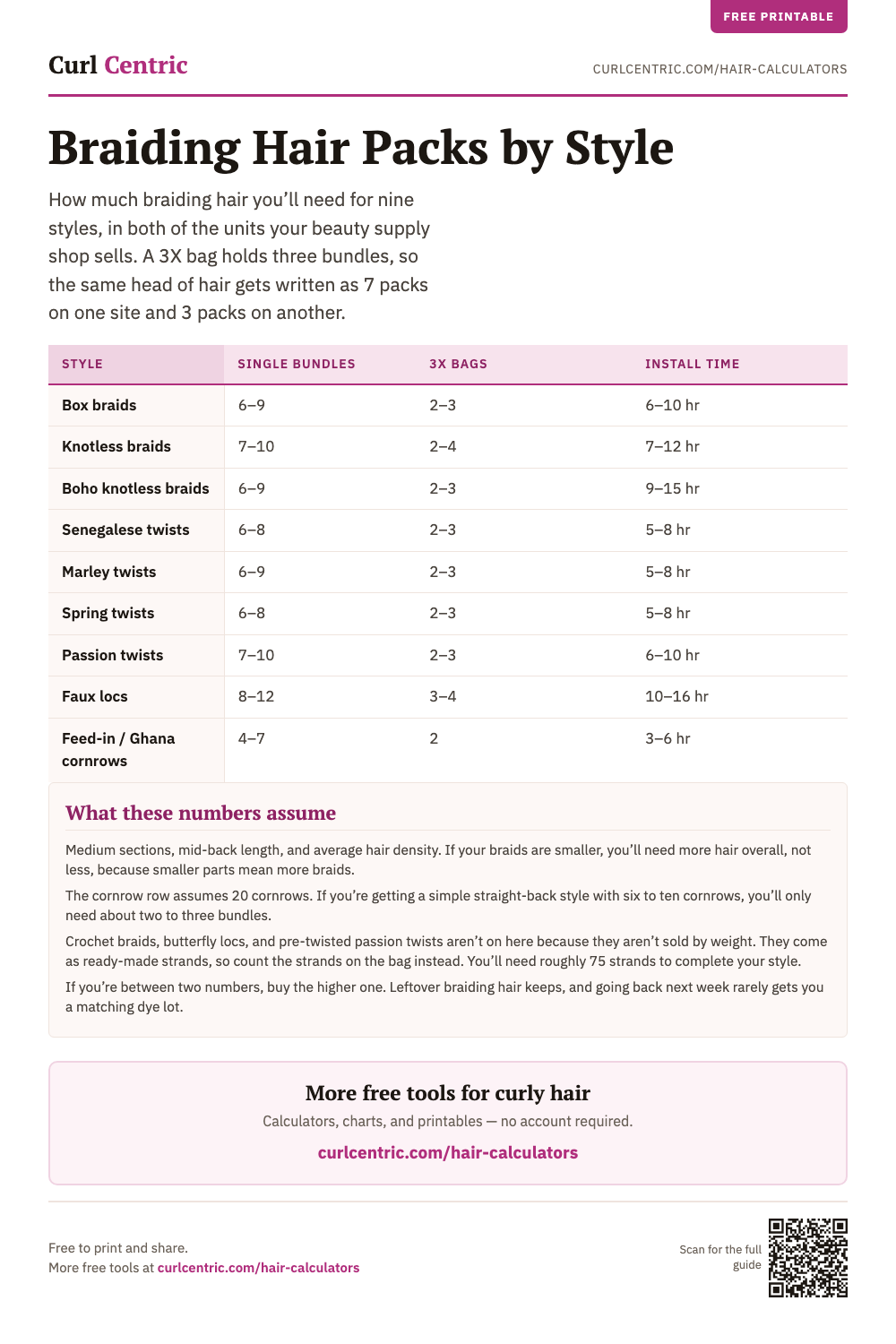
Free printable
Braiding Hair Packs by Style
One page with all nine styles, so you can see what you'll need in single bundles and in 3X bags side by side. Take it with you to the beauty supply shop and you won't be guessing at the shelf.
How these numbers were calculated
Two things drive every answer here. The first is how many sections fit on an average adult head at a given parting size, which gives you your braid count. The second is how much braiding hair one braid actually holds at a given finished length.
That second figure is anchored to the one number everybody agrees on: medium box braids at about 24 inches take six to eight single bundles. Every other size, length, and style scales from that anchor, which is why the model lands on 4.9 bundles for jumbo and 8.3 for small at that same 24 inches.
Three adjustments sit on top of that. Length scales the hair per braid, though not from zero, because even a short braid needs enough hair to grip your root and finish the end. Density widens or narrows your section count by up to about 18%. And every style carries a multiplier against box braids: faux locs need roughly a third more hair because the wrapping process requires lots of hair, knotless braids need about 15% more than box braids of the same size, and two-strand twists need a little less braiding hair.
Pack weights default to 85 grams for a single bundle and about 240 grams for a 3X bag, which is where X-Pression and similar hair brands land. However, brands do vary. If your bag prints a gram weight on it, trust that over our default.
The ranges are the honest part. Head size and parting vary more than any calculator can really model, so every answer here is a bracket instead of one number. When you land between two, buy the higher one. You can use leftover braiding hair later, and going back for one more pack next week rarely gets you a matching dye lot.
How many packs are needed for knotless braids?
Knotless braids are the style people ask about most, and it's also the one that gets underestimated most. In a knotless braid, your braider feeds the extension in gradually over the first few inches instead of knotting it at your root, so a longer run of each strand ends up buried inside the braid rather than hanging free.
That costs you hair. Plan on about 15% more than box braids at the same braid size, which is more than the "grab an extra pack or two" you'll see repeated everywhere once you're past shoulder length. At mid-back length, medium knotless braids run around eight single bundles, whereas medium box braids run seven.
The sizes people search for most, at mid-back length on average density: jumbo knotless braids require nearly six bundles, large knotless require approximately seven, medium knotless about eight, and small knotless nine or ten. Set the calculator to knotless and put in your own length to get the version that fits your head instead of an average one.
One more thing worth knowing before you book. Knotless is gentler on your edges than knotted box braids, because the weight builds up gradually instead of sitting on your follicle from day one. But it isn't tension-free. A knotless braid put in too tight still pulls, and it pulls on hair that doesn't have a knot holding the load further down.

Boho braids need two separate purchases
Boho knotless braids are where pack counts go wrong the most, and there's a good reason for that. It's the only common style that needs two different kinds of hair. You buy pre-stretched braiding hair for the braid itself, then curly hair separately for the pieces your braider leaves loose.
That curly hair is its own purchase, in its own packs, usually water wave, deep wave, or spring curl. Miscalculate this estimate, and you'll turn up to your appointment with everything you need for plain knotless braids and nothing that makes them boho.
How much curly hair you need comes down to where your curls start. Curls at the ends only, which is what most people are picturing, takes roughly three packs on medium braids at mid-back length. Curls running throughout takes closer to five packs. That's not a small gap, and it's why the calculator asks you which one you want.
The published advice contradicts itself here too, of course. One boho guide says about two packs of braiding hair; another says six to eight for the same style. Same head, same look, different bag on the shelf. Set your pack format above, and the calculator will give you both.
Synthetic braiding hair, human hair, and what pre-stretched changes
Most braiding hair is kanekalon, a synthetic fiber made to hold a braid and take hot water sealing. Toyokalon and various blends sit alongside it. A high-quality fiber costs a bit more per pack, tangles less on takedown, and itches less in that first week, which is worth more than the price gap on something you'll wear for two months.
Human braiding hair exists, and it's used mainly for boho pieces and wavy styles where the curl pattern needs to look real. It costs several times more per pack and is heavier for the same look, so a full head of human hair extensions creates more tension than the same style using synthetic hair. For a whole head of braids, almost nobody uses it.
Pre-stretched or bulk?
Pre-stretched braiding hair comes already tapered at the ends, and that taper is what gives your braids a natural finish instead of a blunt stop. It saves you real time on wash day setup and at the install. It also means your usable length is shorter than the number on the pack, because that taper is thin hair you can't braid all the way down.
Bulk braiding hair isn't tapered. It's cheaper per pack, and there's more usable hair in the bag, but somebody has to stretch and trim it, and that adds an hour or more to your prep. If you're buying bulk and doing that yourself, add roughly half a pack to cover what you trim off.
Here's a number that trips almost everybody up: the length printed on your pack is the length of the hair fiber, not your style's finished length. A 42-inch pack folds roughly in half over your section, so it gives you a braid closer to 20 inches once it's in. Buy for the finished length you want, which is exactly what this calculator asks you for.
What braiding hair costs
Pre-stretched synthetic runs roughly $3 to $6 a bundle, or $8 to $15 for a 3X bag. Curly boho hair costs more, usually $12 to $25 a pack. Human braiding hair starts around $40. Put your own price in above, and the calculator gives you your total plus what you're paying per week to wear the style, which is the number that makes a long protective style look as cheap as it really is.
Two things make getting this wrong genuinely expensive, and neither one is the price of a spare pack.
- Running out mid-install. You stop, you go back to the shop, and that replacement pack is a different dye lot. On black hair, nobody notices. On any color, browns and burgundies especially, you'll see it in daylight.
- Buying for the wrong unit. Read a chart written in 3X bags, buy that many single bundles, and you'll end up with a third of the hair you need. That's the most expensive mistake on this page, and it's exactly why the calculator asks you what your shop is selling.
Leftover braiding hair keeps indefinitely in a sealed bag. If you're choosing between one spare pack and a second trip, take the spare pack.
Before you buy
A few things worth settling before you check out, because they change your number more than you'd expect.
Pre-stretched or not. Pre-stretched saves you real time, but you lose some length to the taper. If you're buying bulk hair and stretching it yourself, add roughly half a pack to cover the trimming.
Knotless costs you more hair than you think. Because your braider feeds the extension in gradually instead of knotting it at the root, more of each strand ends up inside the braid. Plan on about 15% over the box braid number for the same size, which is more than the extra pack or two most guides suggest at longer lengths.
Check your tension before you check the mirror. None of this matters if your braids go in too tight. If your scalp is stinging, you've got bumps along your hairline, or you can't move your forehead, that's traction, not a style settling in. Our protective style planner walks through how long each of these should stay in and what takedown should look like.
Frequently asked questions
Is 3 packs of braiding hair enough?
It depends entirely on what your shop means by a pack, which is why you'll see this answered both ways. Three 3X bags hold nine bundles, and that covers medium box braids at just about any length. Three single bundles are about 255 grams, which will finish jumbo braids at shoulder length and leave you short on anything smaller or longer. Check the bag before you trust a number.
How many packs of hair for 20 braids?
Twenty braids puts you in jumbo territory, roughly two-inch parts. At mid-back length, that runs about four single bundles, or roughly a bag and a half. Fewer, thicker braids need less hair overall than many thin ones, because on a small-braid style the extra ends and root grips add up faster than the thinner strands save you.
Is 2 bundles enough for a full head?
Not for a full head of braids or twists. Two bundles are about 170 grams, roughly a third of what medium box braids need at mid-back length. Where two bundles will work is for feed-in cornrows, where six to ten cornrows carry all your added hair and the pack count really is that low.
How much is 4 packs of braiding hair?
At typical pre-stretched prices, four single bundles run roughly $12 to $24, and four 3X bags roughly $32 to $60. Four packs of curly boho hair cost more, usually $48 to $100. Put your own price into the calculator, and it'll work out your total and your cost per week of wear.
How much braiding hair do I need for knotless braids?
About 15% more than box braids at the same braid size. Medium knotless braids at mid-back length take around eight single bundles, or three 3X bags. The feed-in method buries more of each strand inside your braid, so that hair disappearing into the first few inches still has to be bought, even though you never see it.
How many packs of hair for soft locs?
About four packs of pre-made locs, plus about three packs of wrapping hair, if your locs are medium and fall to your mid back. Soft locs are two separate purchases, which is why the published numbers are all over the place. The pre-made locs run roughly 24 locs a pack, and the passion twist or spring twist hair wrapped around them is sold in its own packs. Add the two together and your shopping list is about seven packs, which is where a flat five to eight packs comes from; a flat two to three is usually counting only one of them. Our soft locs guide covers the install, how long they last, and the takedown.
For the styles themselves: box braids, box braids versus knotless, passion twists, Senegalese twists, Marley twists, spring twists, faux locs, butterfly locs, soft locs, crochet braids, feed-in braids and Ghana braids.
For looking after your braids once they're in: how long you can keep braids in, how to relieve tight braids, and what to do when your hair feels thin afterward.