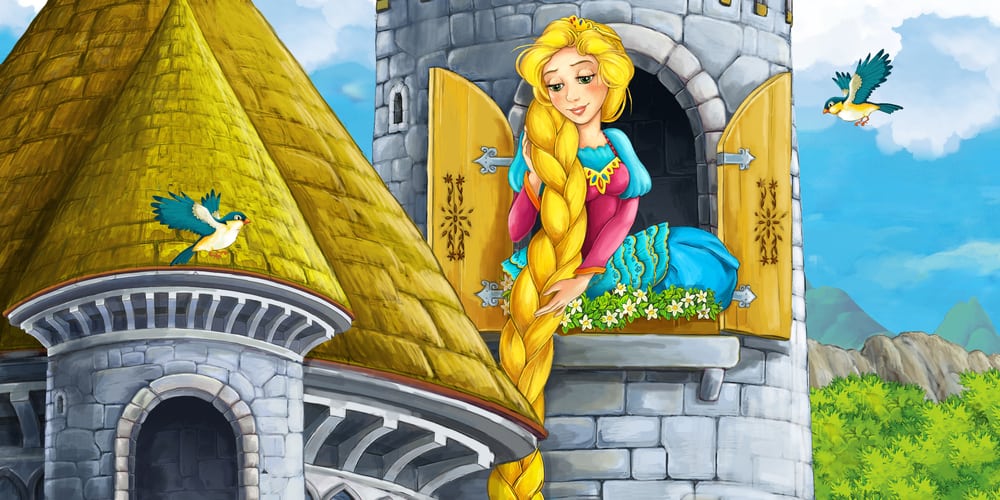
Rapunzel is one of the most beloved fairy tales, thanks in part to Disney's Tangled, and we imagine it's because of Rapunzel's long, magical hair.
One question that many Rapunzel lovers have about the iconic story is, "How long is Rapunzel's hair?"
If that's you, you've come to the right place! In this article, we'll tell you how long Rapunzel's hair is and give you tips on how you can get long "magic hair" of your own. The short answer: about 75 feet in the Grimm fairy tale and 70 feet in Disney's Tangled.
How Long Is Rapunzel's Hair?
In the Brothers Grimm fairy tale, Rapunzel's hair is about 75 feet long, and in Disney's Tangled, it's 70 feet. Here's where each number comes from.
Rapunzel's Hair Length in the Grimm Fairy Tale
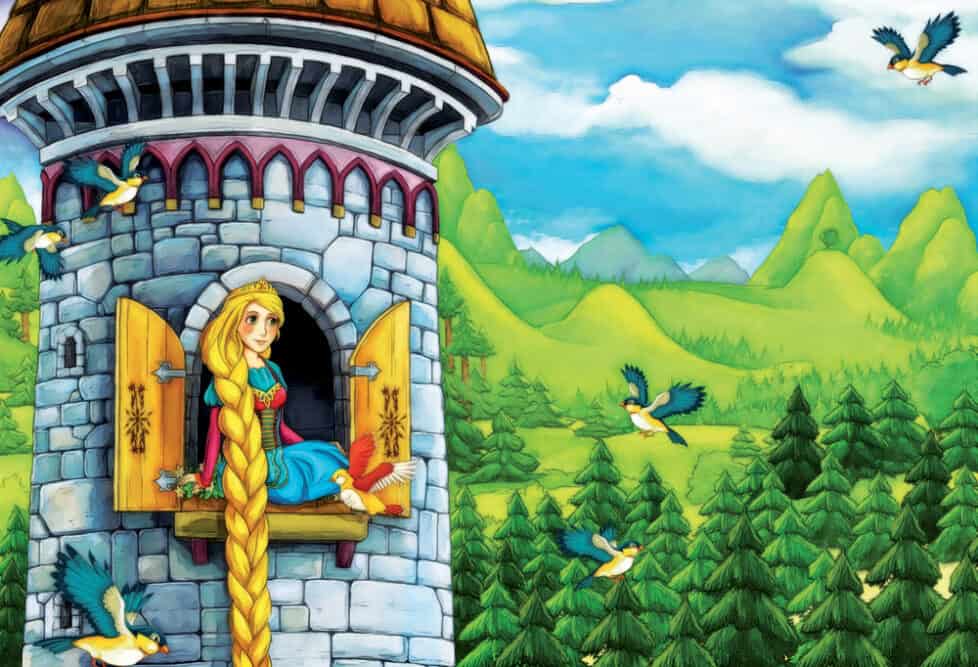
The Grimms never give her hair length in feet. Instead, when Rapunzel winds her braids around a hook in the tower window and lets them down, the hair falls twenty ells to the ground. The tale never says how tall the tower is, so those twenty ells are the only measurement you get.

Free 50-page guide
Your hair is already growing. The problem is keeping it.
On average, hair grows a third to half an inch a month, and curlier hair tends to grow more slowly. If your length looks stuck, that’s your hair breaking off as fast as it grows in. Here are the seven causes of breakage and the weekly routine that stops them.
Free. An email every few days for two weeks, then one every Thursday, plus the odd extra. Unsubscribe anytime.
An ell was an old measure for cloth. The English ell was 45 inches, or 3.75 feet, so twenty ells comes to 75 feet. The Grimms wrote the tale in German, though, so treat 75 feet as a close estimate.
Rapunzel's Hair Length in Tangled
In Tangled, Disney gives the number itself. Its own description of the movie calls Rapunzel a teen with 70 feet of magical, golden hair. That's 5 feet shorter than the Grimm version.

How Rapunzel's Hair Got So Long
The fairy tale never says what made Rapunzel's hair so long. Her story begins before she was even born. While Rapunzel's mother was pregnant, she lived next to a beautiful garden owned by a powerful sorceress.
One day, while staring out of the window, she noticed a delicious-looking patch of salad greens called rapunzel. She longed for the greens so badly that she grew pale and miserable without them.
Desperate to feed his increasingly ill wife, Rapunzel's father snuck into the garden and stole some of the rapunzel salad greens. His wife wanted even more the next day, so he went back, and this time the sorceress caught him.
She demanded the man's firstborn child, and, in desperation, he agreed. When Rapunzel was born, the sorceress took the babe to raise as her own.
The tale only says that Rapunzel grew into a beautiful girl with magnificent long hair, fine as spun gold, and that the sorceress locked her in a tower when she was 12. Disney's Tangled is where the hair itself becomes magical.
If you haven't seen Disney's Tangled, check out the video above to see just how long Rapunzel's hair is in the movie. You can also enjoy Mandy Moore singing a song titled "When Will My Life Begin?", which is a very popular song from the movie.
In addition to Mandy Moore as Rapunzel, Disney's Tangled featured a star-studded cast, including Zachary Levi as Flynn Rider, Donna Murphy, Ron Perlman, M.C. Gainey, and Jeffrey Tambor. Nathan Greno and Byron Howard directed it.
We love Rapunzel and her long hair, but is it possible to grow your human hair as long as Rapunzel's hair? We'll discuss this and more in the next section.
Can Human Hair Grow to Rapunzel Lengths?
On average, hair grows somewhere between a third of an inch and half an inch a month, depending on the person, and the tightest curls tend to grow a little slower than looser hair. At those rates, growing Rapunzel's 75 feet of hair would take 150 to 225 years, and her 70 feet in Tangled would take 140 to 210 years.
Unfortunately, that's far longer than anyone lives. Even if Rapunzel's hair had grown at the fast end of that range from the day she was born, without a single strand breaking, it would have been about 6 feet long when the fairy tale has her locked in the tower at 12. In short, it's impossible to grow Rapunzel-length hair.
Furthermore, each hair follicle has a predetermined growing, resting, and shedding period that determines how long that strand will grow. Scalp hair usually grows for five to seven years before it rests and falls out, which works out to about 20 to 43 inches. A rare few people grow much longer hair. The longest on record, certified by Guinness World Records, measured about 18 and a half feet, which is still only a quarter of Rapunzel's.
Scientists think the length of time your hair spends in the growing phase is set by your genetics. Although genes play a significant role in the length of a person's hair, they aren't the only determining factor.
There's a second limit on length, and it's the one you can do something about: breakage. In a study of 1,042 schoolchildren in South Africa, hair that wasn't relaxed and was combed out stopped getting longer within about a year of a haircut. The researchers concluded that breakage eventually equals new growth. So if your hair seems stuck at the same length, it's usually still growing; your ends are breaking off about as fast as your roots grow in.
There are steps you can take to increase and retain your hair growth. We'll get into those in the section below focused on maximizing your hair growth.
Original Curl Centric chart
Can your hair reach your goal length?
Find your goal, measured with your hair pulled straight from your scalp to your ends. The times assume your hair grows a third to half an inch a month and none of it breaks off.
| Your goal | Time to grow it | Can your hair get there? | What to do |
|---|---|---|---|
| Your shoulders (10 inches) | About 20 to 30 months. | Yes. Your scalp hair grows for years before it sheds, so this is well within reach. | Measure your hair stretched every few months, and protect your ends.How to measure your hair |
| Mid-back (18 inches) | About 3 to 4 and a half years. | Yes, for most people, as long as your ends don’t break off as fast as your roots grow. | Go easy on heat, tight styles, and rough detangling, and trim only when your ends split. |
| Past your waist (26 inches) | About 4 and a half to 6 and a half years. | Maybe. Scalp hair usually grows for five to seven years before it falls out, so at the slower end, some strands may shed before they get here. | Keep measuring. If your length keeps climbing, keep going.Hair growth calculator |
| About 3 and a half feet (43 inches) | About 7 to 11 years. | Only if your hair grows at the fast end and keeps growing for a full seven years. That’s about the most a typical growing phase allows. | Set a shorter goal first. If you pass it and your hair keeps getting longer, aim higher. |
| The world record (about 18 and a half feet) | About 37 to 55 years. | Only for a rare few people whose hair keeps growing far longer than usual. | Think of it as a record, not a goal. |
| Rapunzel in Tangled (70 feet) | About 140 to 210 years. | No. That’s far longer than anyone lives. | Enjoy the movie, and pick a goal from the rows above. |
These times assume none of your hair breaks off along the way. If your length hasn’t changed in months, breakage is the more likely reason, not slow growth.
How To Maximize Hair Growth
While Rapunzel-like hair might not be possible, growing your hair longer definitely is! Here are some ways to maximize your hair growth and get the long locks you've been dreaming of.
Eat Healthier
Long, healthy hair starts from the inside out. If your diet is short on something your hair needs, eating enough of it can help your hair grow normally again.
In addition, being deficient in crucial vitamins can make your hair shed more than usual. In these cases, fixing the deficiency can help your hair grow back.
Here are some nutritional deficiencies linked to hair loss.
- Zinc
- Iron
- Protein
- Selenium
- Vitamin D
More isn't better, though. Too much vitamin A or selenium can also lead to hair loss. So if your hair is shedding more than usual, see your doctor and ask for a blood test before you start taking extra of anything.
Avoid Heat and Chemical Damage
Chemical processing and heat damage can weaken your strands beyond repair. They cause your hair to dry out and become brittle.
As a result, your hair may start breaking off nearly as fast as it grows, making it look like it has stopped growing. Use heat and chemical treatments as infrequently as possible to avoid damage.
If you do use heat on your hair, use the lowest effective temperature and protect your strands with a heat protectant. Always follow product directions closely and go to a salon for harsh chemical treatments like relaxers and bleaching.
It also helps to book one chemical service at a time. If you want both a relaxer and color, dermatologists advise relaxing your hair first and waiting two weeks before you color it.
Get Regular Trims
While it may seem counterintuitive, getting trims every few months can help keep your hair long and strong. Trims remove split ends and damage that can travel up the strand and cause breakage higher up your hair.
You can tell your stylist you want a dusting or health-focused trim, so they'll just remove the damaged ends. Although getting trims doesn't make your hair grow longer, it will help ensure you're retaining as much of your growth as possible.
To know when you're due, look closely at your ends. Split ends, tiny knots at the tips, or ends that look thin and see-through mean it's time for a trim. If your ends look like the rest of your hair, you can wait a little longer.
Massage Your Scalp
Massaging your scalp may help your hair strands grow a little thicker. In one small study, nine men massaged one side of the scalp with a device every day for 24 weeks. On the massaged side, hair thickness went up from the start of the study, but it wasn't significantly different from the untreated side, and the hair didn't grow any faster. It's also relaxing and easy to do!
Here's how to massage your scalp.
- Start with loose, detangled hair. Your hair can be either wet or dry. Remove rings and hair accessories so you'll be able to massage your entire scalp without damaging your hair.
- Add a few drops of your favorite oil or oil blend onto your fingers. If your blend has an essential oil in it, mix it into a carrier oil first.
- Beginning with your temples, press your fingers into your scalp and move them in small circular motions. Apply light pressure and focus on massaging your scalp: not your hair.
- Continue massaging until you've covered your entire scalp. It should take about four minutes.
- Repeat once a day if you enjoy it. The small study above used four minutes a day, and it didn't test whether massaging more often works better.
Protect Your Hair Against Physical Damage
Physical damage, like friction or tension, can cause significant breakage. As your hair breaks off, it'll continue getting shorter, making long hair impossible. If you want long hair, you should avoid wearing tight hairstyles and accessories.
If a style hurts, it's too tight. Stinging, crusts on your scalp, or patches of scalp pulled up like a tent all mean your style is pulling too hard. Broken hairs around your forehead or a receding hairline are early signs of traction alopecia, which is hair loss from styles that pull. If you notice them, loosen your style and see a board-certified dermatologist, because traction alopecia can become permanent the longer it goes untreated.
Sleep on a silk or satin pillowcase, or cover your strands with a silk or satin scarf before bed. Cotton pillowcases can cause friction that chips away at the integrity of your hair.
You might also want to try protective styles, like crochet braids, to give your hair regular breaks from the wear and tear of daily styling. Just keep the braids loose around your hairline, and take them out within six to eight weeks.
Take Hair-Boosting Supplements
A supplement can help your hair only if you're low in the nutrient it contains. If you already get enough from your food, taking more won't make your hair grow faster or longer.
These are the supplements most often sold for hair growth:
Biotin is the one most people try first. It can help if you're low in it, but a true biotin deficiency is rare, and the high doses in many hair vitamins can throw off some blood tests, including one doctors use to check for a heart attack. If you take biotin, tell whoever orders your bloodwork. And if your hair is thinning, book a dermatologist visit before you buy anything.
Use Protein Treatments
If you're trying to grow your hair long, keeping it strong is one of the most important things you can do. The protein-based ingredients in protein treatments adhere directly to your strands and form a protective layer.
They fill in chips and gaps along your strands, which leaves your hair stronger and less prone to breakage until the protein washes out. This means your strands are less likely to snap while you detangle and style, and you'll retain more of your length.
Although you may be tempted to use them more often, only use protein treatments about once every four to six weeks, and stop once your hair feels strong again. Using them more often can leave your hair stiff and straw-like. If that happens, pause protein and use a moisturizing conditioner until your hair feels soft again.
Deep Condition Your Hair
Every time you shampoo, you should follow up with a conditioner. However, there are times when your hair might need a little more care than a regular conditioner can provide.
Deep conditioning treatments help restore moisture to thirsty locks and increase your hair's elasticity. They can't undo damage your hair already has, but they leave your strands softer and bendier, so they're less likely to snap when you comb and style.
For an extra boost, pop on a shower cap after applying your conditioning treatment. The cap holds in the warmth from your head, which helps the conditioner work its way into your strands, and for most people, that's all the heat you need. If you want more, sit under a hooded dryer. Either way, 20 to 30 minutes is plenty, and leaving it on longer won't do more.
Related Articles
- How To Grow Natural Hair in a Month
- Does Curly Hair Grow Slower Than Straight Hair?
- How Many Hairs Are on a Human Head
- How to Measure Hair Length in Inches
While Rapunzel's 75-foot mane might be out of reach, getting longer hair requires just a few simple adjustments to your routine.
We hope this article has answered your questions about how long Rapunzel's hair is and given you the tools to reach your hair length goals!