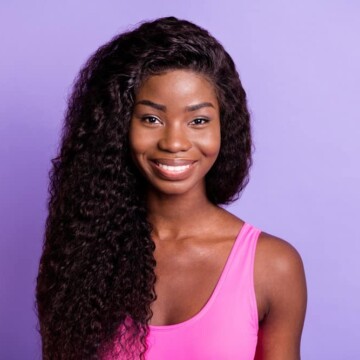

Is your hair curling inwards? Unless that's the look you're going for, it can really be a pain. The first step to addressing uncooperative curls is identifying the reason they're behaving that way.
That's where we can help. In this article, we'll share several reasons why your hair is curling inwards and what you can do about it.
Why Does My Hair Curl Inwards?
There are various natural and unnatural reasons why your strands are curling inward. We'll get into all of them in this section.
Your Strands Are Damaged
A sudden change in the direction of your curls might be a result of damage. Hair damage can change how your curls fall and cause them to curl inwards instead of outwards.
As your hair rubs against your shoulders or clothing, the friction can lead to breakage and textural changes. That is especially true for anyone with curly or fine hair because it's more fragile and prone to damage than every other hair type.
Free 50-page guide
Your hair is already growing. The problem is keeping it.
On average, hair grows a third to half an inch a month, and curlier hair tends to grow more slowly. If your length looks stuck, that’s your hair breaking off as fast as it grows in. Here are the seven causes of breakage and the weekly routine that stops them.
Free. One email a week after that. Unsubscribe anytime.

Your Curl Pattern
The way your hair naturally curls ultimately determines the direction your strands turn at the ends. Because it's natural, you'll have to correct inward-facing curls through styling.
The Way Your Hair Is Cut
Your haircut impacts how your hair falls and can cause your curls to turn inwards. The angle of your hairstylist's scissors determines whether your hair curls inwards or outwards.
When you get your hair cut, tell your stylist that you want your curls to turn away from your face. Then, they'll rotate their scissors and adjust their cutting technique, so your hair lays the way you want it to.
The Weather Is More Humid
The drier your hair is, the more it reacts to moisture in the air. This effect is particularly noticeable if you live near the ocean or in a hot and humid environment.
Being outside in humid weather can cause the ends of your straightened hair to curl at an unpredictable angle. Even if your hair only has a slight wave, you might find your hair curling increasingly inwards in response to the moist air.

The Grain of Your Hair
Haircuts and texture aren't the only things that influence how your hair falls. As your strands sprout from your scalp, they naturally fall in a particular direction. That pattern determines the grain of your hair.
Further complicating things is the fact that different areas of your scalp can grow in multiple directions. If you can rule out the other reasons on this list, your inward-facing curls might just be how your hair lays.
How to Get Hair to Curl Outwards
Are you looking for a solution to your inward-facing curls? If so, we've got you covered! Here is a selection of techniques to get your hair to curl outwards.
Style Your Hair With a Hot Tool
Hot tools like curling wands and flat irons are unmatched in their ability to transform even the most stubborn hair into beautiful waves and coils. However, heat styling can damage your hair, so avoid using this method more than once or twice a week.
To Start:
- Apply a high-quality heat protection spray to clean, dry hair.
- Turn on your preferred hot tool (e.g., curling iron or flat iron) and let it come up to temperature.
- Grab a small section of hair and use your hot tool to create your curls. Make sure you turn the device outwards so your curls fall in the right direction.
- Once you're satisfied with your style, keep everything in place with a blast of humidity-blocking spray.

Pin Curl Your Hair
Pin curls are a gentle, heatless method you can use to create well-defined curls on natural or relaxed locks. We recommend straightening your hair beforehand to prevent your natural texture from coming through.
To Create Pin Curls:
- Start by stretching or straightening freshly washed hair.
- Apply a non-water-based moisturizer to your strands and separate a small section of hair.
- Starting from the ends of your hair, roll the section upwards until it forms a loop.
- Secure the curl to your scalp with a hairpin and repeat the process on the rest of your hair.
- Let your hair air dry and then use your fingers or a wide-tooth comb to separate the tight curls.
- Polish off your hairstyle with a light spritz of hairspray, and you're ready to go!
Get a Different Haircut
If your haircut or texture is causing your hair to curl inwards, visit an experienced stylist and ask for a different cut. Explain your concerns to them, and they'll be able to provide your hair cut differently and change the direction of your curls with a few masterful cuts.
If you're concerned about losing too much length, you can grow your hair out for a month or two and then go to get the haircut.

How to Stop the Bottom of Your Hair From Curling
While curly ends add a fun element to your style, they can ruin an otherwise sleek do'. That's why we've provided you with this list of our top tips for getting the bottom of your hair to stop curling.
Try a Straightening Treatment
A straightening treatment might be just what you need to keep the ends of your hair pin-straight. These treatments can be long-term or short-term, depending on your preferences.
There are a variety of straightening treatments available, including:
Get a Trim
As we mentioned before, damage can impact how the ends of your hair behave.
Trims remove your damaged ends and can help your strands to fall in a direction that is much more flattering. They also keep the rest of your hair healthy, which prevents the issue from popping up in the future.
Style Your Hair Differently
Curly ends are more likely to occur (and more noticeable) on loose, straight hair. Styles like braids, ponytails, and twists keep your strands together in a much denser group. That decreases the likelihood of them becoming curly.
Keep Your Hair off of Your Shoulders
When the ends of your hair rub against your shoulders, they may start to develop a wave or curl. Pulling your hair up and away from your shoulders will help prevent the ends from curling.
Use Frizz and Humidity Blocking Products
If your ends are curling because of reversion, anti-frizz and humidity products can block out the moisture that causes the change in texture.
Most frizz-blocking sprays and serums use silicones to create the moisture-blocking effect, so make sure you add a monthly clarifying treatment to your hair routine to combat buildup.
Moisturize Your Locks
The ends of your hair are drier than the rest of your strands, which may cause them to revert and become curly. You can prevent this by making sure your hair is thoroughly moisturized. Use deep conditioning treatments, creams, lotions, or oils to impart and seal in hydration.
Grab Your Blowdryer
While letting your hair air-dry can cut down on heat damage, it might also exacerbate your curly ends. Blow-drying your hair will loosen your natural curls and give you more control over how your hair falls.

Related Articles
- How to Change 4C Hair to 3C
- How to Style Permed Hair in the Morning
- Why Does My Hair Always Flip Out at the Ends
- Why Is the Top Layer of My Hair Curly and the Bottom Straight
In summary, your hair may be curling inwards due to a variety of factors. Luckily, there are several ways to tame it. We hope this article has helped you determine the cause of your wayward curls and armed you with all the tools you need to fix the issue. We wish you the best with your hair!