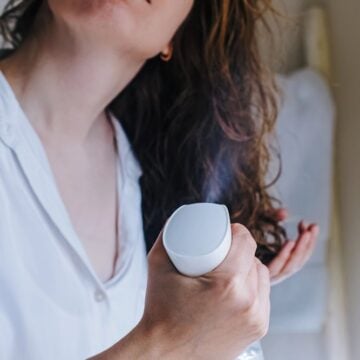
Curly natural hair is dry by nature, which means you have to devote considerable effort to keep it hydrated. This is why the Max Hydration Method (MHM) is so popular today among super curly girls.
If you've heard about the MHM and would like to know more about it, this is the place to be. We'll tell you all about the Max Hydration Method and give you step-by-step instructions for how to do it.
What is the Max Hydration Method?
The Max Hydration Method is an intensely moisturizing hair care regimen created by Pinke Cube from Black Hair Media.
The technique requires you to go through 5 main steps, most of which add moisture and nutrients to your hair.
Free 50-page guide
Your hair is already growing. The problem is keeping it.
On average, hair grows a third to half an inch a month, and curlier hair tends to grow more slowly. If your length looks stuck, that’s your hair breaking off as fast as it grows in. Here are the seven causes of breakage and the weekly routine that stops them.
Free. One email a week after that. Unsubscribe anytime.
The method is targeted toward those with low porosity 4B and 4C hair, though people with other hair types can use portions of the regimen to promote moisture.
So, if you're interested in what the MHM can do for your hair, keep on reading.
The Maximum Hydration Method requires you to complete 5 different steps, including:
- Cherry Lola Caramel Treatment
- Clarifying shampoo
- Co-wash and detangle session
- Bentonite clay rinse
- Leave-in conditioner and Styling Product application
You don't have to do all of the steps in the MHM, but completing all of them will yield the best results if you have kinky curly hair.

Maximum Hydration Method Benefits
The MHM is so popular because it helps bring users visual and tangible results. Here are some of the benefits people enjoy after trying the MHM:
- Hydrated strands that better resist hair damage, dryness, and brittleness.
- An enhanced ability to retain moisture.
- More manageable styling sessions.
- Increased curl definition.
- Reduced frizz.
In the following sections, we will tell you exactly how to do the Max Hydration Method.
How to Do the Max Hydration Method
Before we hop into the MHM steps, we'd like to give you a fair warning. The Max Hydration Method requires a couple of hours of your time and effort.
But by the end of your first session, you'll be amazed at the difference in your hair! Let's get into it.
1. Before You Get Started (Low Porosity Hair Only)
If you have low porosity hair, you should start with the Cherry Lola Treatment.
It will prime your hair for the process to follow by opening up your hair cuticles and softening and nourishing your strands with yogurt and amino acids.
To do a Cherry Lola Treatment, do the following:
- Mix 2 tablespoon of baking soda, 2 cups of plain yogurt, and 2 tablespoon of amino acids in a bowl.
- Apply the mixture to your hair. You can part it into 4 to 6 sections first if needed to ensure even distribution. Once you apply the mixture to each section, twist or braid it up to secure.
- Put on a plastic cap and allow the treatment to process for up to a half-hour.
- Rinse the mixture out of your hair and then proceed to step 2.
2. Clarify Your Natural Hair
The second step in the MHM is to clarify your hair. You have a few choices: clarify with shampoo, use baking soda and conditioner, or do an apple cider vinegar (ACV) rinse.
Below are the instructions for each hair clarifying method:
Use Clarifying Shampoo
To clarify your hair with shampoo, you'll have to get your hands on a clarifying shampoo, of course - but not just any clarifying shampoo.
Choose one that's sulfate-free and made of natural ingredients that nourish the hair, like Aquableu Apple Cider Vinegar shampoo. It'll deep cleanse your hair without completely stripping it of all moisture.
All you need to do is wet your hair thoroughly, apply the shampoo, lather, and rinse well. Be sure to focus the shampoo on your scalp, as this is where buildup accumulates.

Do a Conditioner and Baking Soda Rinse
Grab an empty spray bottle, fill it with ⅓ cup of your favorite sulfate-free conditioner and ½ tablespoon of baking soda.
Mix it together, and then apply it to your dry hair. After 15-30 minutes, rinse the mixture out of your hair and proceed to step 3.
Do an Apple Cider Vinegar Rinse
Another way you can clarify your hair is with an apple cider vinegar (ACV) rinse.
- Combine one part ACV with twice as much water in an empty spray bottle and swirl it around to mix.
- Spray the ACV mixture on your roots and scalp.
- Work the mixture into your scalp to get it clean and dislodge any buildup.
- Spray the rest of your hair with the ACV mixture, and then rinse it all out.
3. Cowash and Gently Detangle Hair
Now that your hair is clean, it's time to cowash and detangle your hair. This is how you do it:
- Wet your hair thoroughly.
- Gently separate your hair into 4 to 6 sections (braid or twist each section to keep it secure).
- Undo one section and apply the cowash to it. Massage the cowash into your scalp and work it into the length of your hair.
- While the cowash is still on the section, grab a rat-tail comb and detangle it.
- Repeat the previous two steps for the rest of the sections.
Your hair should now be clean and detangled. Move on to the next step.

4. Bentonite Clay Rinse
Bentonite clay not only cleanses your scalp and hair, but it leaves your hair stronger and more resilient. Here are the steps to take for your bentonite clay rinse.
- Mix 1 cup of bentonite clay with one cup of water with a whisk. If you have a lot of hair, double the recipe. Feel free to add a tablespoon of olive oil and raw honey to the clay for some added moisture.
- Apply the clay to your wet hair in sections. If the clay is thick and clumpy, add more water.
- After applying the clay to all of your hair, allow it to sit for up to 20 minutes.
- Rinse your hair thoroughly, being careful not to break your hair. Allow the water to soften up the clay before you begin touching and moving your hair around.
5. Leave-in Conditioner and Gel or Cream
After completing the bentonite clay rinse, apply a leave-in conditioner to your hair in sections from root to tip. Do the same for your gel or cream.
You can use the praying hand's method to smooth the product through your strands or smooth your curls in tiny sections (shingle) for maximum definition.
Once you've applied your styling products, shake your defined curls to separate them. From this point, until your curls are dry, try not to touch them to keep them frizz-free.
We recommend that you allow your hair to air dry rather than blow-dry it, as air drying helps you to maintain your hair's moisture levels and reduce frizz.
Optional Step: Stretching

Type 4 hair can shrink up to 80%. So, if you want to enjoy more of your length, we recommend stretching your hair.
To stretch your hair fast, gently separate your dry curls into 4 to 6 sections and lightly twist each section. Leave your hair twisted for at least a half-hour, and then take the braids down.
At this point, you can fluff your hair gently with your fingers or a hair pick. You're all done!
Related Articles
Keep Your Hair Hydrated: How Often to Do the MHM Method
By now, you may be thinking that the Max Hydration Method is too involved, and that's understandable, considering that there are so many steps involved as your hair reaches max hydration.
Luckily, you don't need to do the MHM every day. For the best results, we recommend that you do it every week or so as needed.
The Max Hydration Method can transform 4B and 4C hair from excessively dry and unmanageable to soft, smooth, and hydrated to the max! We encourage you to take the plunge and see for yourself!