

After defining and styling your curls, the last thing you want to do is ruin them as you catch your Zs. That's where nighttime curl protection comes in. But what exactly does that entail?
The truth is that it may look a little different from one person to the next.
In this article, we'll discuss how to sleep with curly hair, whether you should sleep with wet curls and tips for refreshing your curls in the morning. We'll also answer any related questions so you'll get all the information you need.
How to Sleep with Curly Hair
Chances are you didn't know there were so many ways to sleep with curly hair. It may even feel overwhelming to have so many options. But don't worry. This section will highlight each option and its ins and outs so you can make an informed decision on how to sleep with your curls.

Cover Your Hair with a Silk or Satin Scarf or Bonnet
For the vast majority of curly folks, it's imperative to cover your hair up at night with a silk or satin scarf or bonnet. Most of us have cotton pillowcases and comforters - they are extremely comfortable to sleep on.
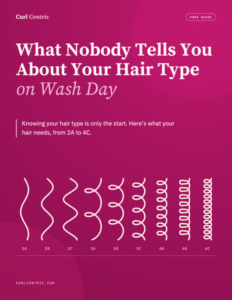
Free 8-page guide
You know your hair type. Here’s what it needs on wash day.
Our free guide gives you one page for each hair type group, from 2A to 4C. Each page tells you how often to start washing, what helps your waves, curls, or coils clump, and the problems your hair type runs into most. It also has a protein or moisture chart and a log for testing one change at a time.
Free. You’ll get the guide by email, two more emails on how to use it, and then one every Thursday, plus the occasional extra. Unsubscribe anytime.
While this bedding may create a welcoming environment for you, it's a potentially damaging one for your hair. As you toss and turn at night, your covers and pillowcase rub up against your uncovered curls, promoting frizz and zapping moisture from your hair cuticles.
To avoid this, you should cover your hair up with something - either a scarf or bonnet.
They can protect your hair from moisture loss and preserve your curls. Bonnets tend to work best for voluminous styles, while scarves are better suited to flatter styles or when pulling your hair up for the night (more on that later).

Put Your Curls in One or More Pineapples
If you've done any research on how to sleep with curls, you may have heard that you can put your hair in a pineapple. It simply requires you to pull all of your curls up into a ponytail at the crown of your head, near your widow's peak, and secure it with an elastic band.
You can sleep like that (without covering your hair up), or you can wrap your hair in a scarf or put on a bonnet for added protection.
If your hair isn't long enough to gather into a pineapple, you can put it into several pineapples. In this case, they won't all be situated in the front of your head. They'll be all over your head, and then you'll put a bonnet on to finish things off.
In the morning, you'll see that your curls are mostly undisturbed.

Twist or Braid Your Curls
If you prefer to stretch your curls overnight, you can twist, braid, or even French braid them. By doing this, you'll elongate your curls while also decreasing the surface area that'll be exposed to the air and your bedding.
The type of braids or twists you'll do depends on your skillset and the look you're going for in the morning. Twists will produce the least bit of stretch, and they're very easy to create.
All you need to do is take medium to large sections of hair, split them into two, and cross one strand over the other repeatedly. When you get to the ends, finger coil the hair to encourage a coil to form.
Three-strand braids and French braids will provide a little more stretch, but they're a bit more difficult to master for those who aren't skilled in braiding.
Three-Strand Braid Tutorial
French Braiding Tutorial
But if you separate your hair into a few sections and braid it up, you'll be greeted with stretched-out curls with more hangtime when you wake up. Watch this three-strand braid tutorial or this French braiding tutorial to learn how to master each braiding technique.

Sleep on a Silk or Satin Pillowcase
Sometimes, you might be rocking a style that doesn't mesh with the overnight protection methods we mentioned earlier. Or maybe you just don't want to bother with braiding, twisting, pineappling, or covering up your hair.
In that case, you can simply sleep on a silk or satin pillowcase. The fabric will glide against your hair instead of snagging it, and it won't suck the moisture from your hair as cotton fabrics can.
All you'll have to do when it's time to hit the sack is lie down and drift off.
Just be warned that if you don't pull your hair up before lying down, you might find that your hair is smashed or deformed in the morning. That's why it's often best to combine this nighttime curl protection method with another one for the best results.

Use a Durag
Though your hair is curly, you may not always wear it in its loose, curly state. If you're wearing a braided style or any low-profile hairdo that requires your hair to be flattened and sleek, a durag will certainly come in handy.
It's a smooth head covering that flattens and preserves your hairstyle.
To wear a durag, you'll simply place the rounded part over the crown of your head, positioning the front of the durag just in front of your hairline.
Then secure the hanging strings. Do your best not to tie them too tightly. Doing so could give you a headache or leave a dent across your hair that could ruin your style.

Should You Sleep with Wet Curls?
It's not a good idea to sleep with drenched curls, no matter how you look at it. The main problem you may run into if you sleep with wet curls is the threat of mold and mildew growth. And once that growth begins, it can be hard to stop it.
But that's not the only problem that comes along with sleeping with wet curls.
Many who do this wake up with a ton of frizz and a lot of styling to do the next day. So, if at all possible, avoid drifting off if your hair is wet.
There might be times when your hair is damp, and you don't have time to dry it before hopping into bed (or just don't feel like it). In situations like this, it's not the end of the world to go ahead to bed and deal with your hair in the morning.
But forming a habit of going to sleep with drenched or even damp hair is just not a good idea. It's for this reason that the remedies we gave above don't involve wet or damp hair at all.

How to Refresh Curls in the Morning
No matter how you sleep with your hair at night, there's always a chance you'll need to do some zhuzhing when you wake up. Even those who aren't super wild sleepers might wake up with a lopsided or smashed mane.
To fix this, you'll refresh your curls with one of the below methods:
Take Your Curls Down and Examine Them
You'll start by taking off your durag, scarf, bonnet, etc. All of your curls should be free. Take a good look at them and see which ones could use a bit of a pick-me-up. After you've done that, go to the next step.

Mist Your Hair with Water
Misting your hair with water is the next step. And we really do mean "misting." Drenching your hair every morning will not only cause your curls to revert to their product-free state, but it can contribute to hygral fatigue.
To avoid that, use as little water as possible to refresh your curls. The point of this step is to make your curls pliable so you can reshape them as you desire.
There are spray bottles out there that are specifically designed for misting. We urge you to get one of those. Focus the water on any areas that might have gotten flattened or misshapen at night.
Reapply Your Product
Pull out the styling product that you normally use on your hair. It might be Eco Style Gel or Shea Moisture Curl Enhancing Smoothie. Whatever you use, dispense some of it into your hands and smooth it over the curls you want to refresh. You don't have to be generous with the product, especially if your hair is fine or thin.

Finger-style Your Curls
This is the most labor-intensive step. Go in and finger-style your hair. This means twirling some curls around your fingers, smoothing the product down the length of some sections, etc.
Do what you need to do to get your style to look neat and cohesive. You may need to spritz some areas with water and add more product to get it looking just right.
Dry and Go
The final step of refreshing your curls is drying your hair. If you have the time, you can air dry. But if you're in a hurry, grab your blow dryer and pop on a diffuser attachment. It will speed up the drying process without disturbing your curls' texture. And that's it - you're ready for the day!

Ways to Get Overnight Curls
If you're feeling ambitious, you can use the nighttime for more than protecting your curls. You can use it for styling! There are several ways that you can manipulate your hair before bed to get gorgeous curls by morning, and we'll share them with you in this section.
Note: Some of these overnight curl methods will require you to dampen your hair. There's a risk of mold and mildew growth here, but as long as your hair isn't drenched, chances are you'll be okay. This is a risk, nonetheless.
Rod Set
The rod set is a tried-and-true way to get perfectly uniform curls in a matter of hours. You should only opt for these curls if you like a proper and put-together aesthetic.
This overnight style involves wrapping your hair in rods before bed and removing them in the morning. This is not something you'll do daily, but it's a cool way to get perfect curls every now and again.
Here's how to do a rod set on your curls:
- Ensure that your hair is washed, conditioned, detangled, and towel-dried.
- Apply a leave-in conditioner to your damp hair and use your fingers or a wide tooth comb to distribute it.
- Part your hair into four sections and use an elastic band or a few clips to keep each of them separate.
- Take down one of the sections and make a small subsection.
- Apply a little bit of hair mousse to that subsection and detangle it with a narrow tooth comb.
- Wrap the hair around a rod and secure it using the rod's closure mechanism.
- Repeat the previous two steps on the remaining hair in that subsection and all over the rest of your hair.
- Sleep on a silk or satin pillowcase. Don't cover your hair up, and sleep on it when it's not dry.
- When you wake up, check to see if your hair is dry. If it is, take the rods out.
- Fluff and separate your curls as needed. To cut down on frizz, coat your fingers in oil first.
If you'd like, you can spray your hair with a flexible holding spray to keep your curls in place.
Flat Twists
Are you looking for an easier way to get overnight curls? Try flat twists. Flat twists are similar to two-strand twists, but they lie flat against your scalp. They will give you curls that are flatter and more reminiscent of waves.
This is ideal if you prefer more of a natural look versus super uniform curls.
To get overnight curls with flat twists, you can start with your hair as is or stretched out. Either way, here are the main steps to follow:
- Separate your curls into four sections and secure each of them with clips or an elastic band.
- Choose a section and then create a medium-sized vertical subsection from front to back. Leave the other sections undisturbed.
- Detangle the subsection to ensure that any knots and tangles are eliminated. If your hair is in its natural state, you may want to spray some detangler on the hair first. Use a wide-tooth comb for the detangling process.
- Apply some mousse or curl definer to the subsection.
- Flat twist the subsection. This video tutorial will show you how to do it step-by-step.
- Continue making flat twists until there's no hair left to twist in that section.
- Repeat the process for all of the rest of the sections.
- Leave the twists in overnight and take them down in the morning.
- Coat your hands in oil and separate your twists.
- Fluff and style as desired.
Do Bantu Knots
Corkscrew curls are some of the most beautiful in existence. If you want to get that look overnight, all you need to do is make a few bantu knots in your hair and go to bed.
Start with clean hair, apply some styler, and then get to twisting up your bantu knots in sections. If you don't know how to do Bantu knots, this tutorial will show you how.
One thing you need to remember when doing bantu knots is that they take a long time to dry. So, it's important not to do them on wet hair if you plan on sleeping in them. Another thing to be aware of is how uncomfortable they can be to sleep on.
They stand on end and can dig into your scalp if you're not careful. So, when you're creating your bantu knots, don't make them too tight - if they can move freely, they'll be much easier to sleep on.

Do You Have to Put Your Curls Up When You Sleep?
Many hair gurus out there find that putting their hair up when they sleep is most beneficial for them. But does that mean you have to do the same?
The answer is that you don't have to put your curls up when you sleep, but you may find that you love doing it as much as your favorite influencer does.
The good thing about putting your hair up at night is that it's less likely to get smashed by your head as you rest.
If you find that sleeping without putting your curls up at night leaves you with a wonky mane in the morning, start sleeping with your curls up in a pineapple and see how things go. But, as you've seen by reading this article, there are alternative methods for sleeping with curls.
So, our advice is to try as many methods as you want to see which one(s) work best for you and when. It's not unusual to have to switch between methods depending on how your hair is styled, the season, your lifestyle, etc. You'll figure it out.
Related Articles
- How to Sleep With Wet Curly Hair
- Sleeping Hairstyles
- How to Wrap Your Hair at Night
- How to Put on a Bonnet
So, there you have it - everything you need to know about how to sleep with curls. We hope that you found all the information you were looking for, and we wish you the best with your hair!