

If you've got curls, coils, or kinks, you know the feeling of finishing a wash and looking down at a frightening amount of hair. It happens to all of us, and the first thing you want to know is whether that pile is normal.
The hair in your hands is telling you which of two completely different problems you have, and the two have opposite fixes. Shedding and breakage look similar in the sink, but one is your growth cycle working normally and the other is damage you can stop.
In this article, we'll show you how to tell the two apart in about ten minutes, using nothing but good light and a towel.

How to Tell Shedding From Breakage
The test takes one strand and about five seconds. Pick up a single hair and look at the end that came from your scalp.
If there's a small pale bulb on it, you're looking at shedding. That bulb is the root end of a hair that finished its life cycle and let go right on schedule. The strand will be more or less as long as the rest of your hair.
Free 50-page guide
Your hair is already growing. The problem is keeping it.
About a third of an inch a month on textured hair, not the half inch you’ve read. If your length looks stuck, that’s your hair breaking off as fast as it grows in. Here are the seven causes of breakage and the weekly routine that stops them.
Free. One email a week after that. Unsubscribe anytime.
If there's no bulb, you're looking at breakage. The strand snapped somewhere along its length, so what you're holding is a fragment that's shorter than your hair. The end will usually look frayed, split, or bluntly cut off.
That really is the whole test. Shedding starts at the root, breakage happens somewhere in the middle, and the end of the strand tells you which one you're looking at.
Both strands below are drawn to the same scale, so the length difference you’re seeing is real. The circles magnify the end of each one, because that’s where your answer is.
The bulb is small, roughly twice the width of the strand rather than a visible ball at the end, so give yourself good light. A contrasting towel will do more for this test than a magnifying glass does. And if you’re finding both kinds, that’s completely normal; what matters is which pile is bigger.
What Is Hair Shedding?
For those who aren't sure, shedding is simply a hair reaching the end of its life cycle and releasing from the follicle. Every hair on your head is running its own clock, independent of the ones growing next to it.
That clock has three phases: anagen, the growing phase, which runs for years; catagen, a short transition; and telogen, a resting phase that ends with the hair letting go.
At any given moment on a healthy scalp, roughly 86% of your hairs are in anagen, about 1% are in catagen, and about 13% are sitting in telogen. That last number is the one most of us forget. It means thousands of hairs on your head are finished right now, sitting in place and waiting their turn to be shed.
When they do let go, the American Academy of Dermatology puts normal shedding at 50 to 100 hairs a day. (AAD)
So shedding isn't damage, and it isn't a warning sign; it's your growth cycle doing exactly what it's supposed to do. A hair that sheds has already been replaced underneath by a new one in anagen, which is why normal shedding doesn't thin your hair over time.
What Is Hair Breakage?
Breakage is a different situation entirely, because it has nothing to do with your follicles. The hair is still attached and still growing; the shaft simply failed somewhere between your scalp and your ends, usually under mechanical stress.
That distinction matters because it changes what you're able to do about it. You can't stop a hair from shedding, since it was always going to let go eventually, but you can absolutely stop a hair from snapping.
There are really three things going on here, and they're easy to run together. We'll lay each one out below:
- Shedding. Hairs releasing from the root at the end of their cycle. This is normal, and it happens on every healthy head of hair.
- Breakage. Hairs snapping mid-shaft from damage or manipulation. This one is fixable, and most of the fix is in your hands.
- Hair loss. Follicles that have stopped producing. The AAD describes this as "when something stops the hair from growing," and unlike the first two, it doesn't resolve on its own.
Chances are, if you're here asking about shedding, what you're actually looking at is breakage. And a lot of women worried about hair loss turn out to be looking at ordinary shedding.
The Strand Test for Wash Day

The single-strand check tells you what one hair did on its way out. To know what's happening across your whole head, you'll want to look at a full wash day's worth of hair strands rather than one.
- Collect. Wash and detangle the way you normally would, then keep everything that comes out, both from the drain and from your hands.
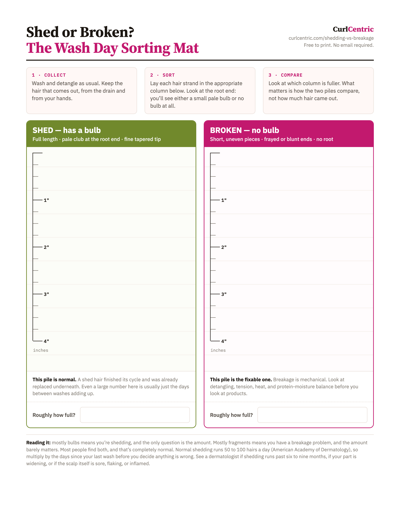
- Sort. Lay each hair strand in the appropriate column on the sorting mat below, or on a towel that contrasts with your hair; white for dark hair, dark for light. Look at the root end of each one, where you'll see either a small pale bulb or nothing at all. Give yourself good light for this, because the bulb is small rather than an obvious ball at the end.
- Compare. Look at which of the two columns is fuller. What you're judging is how the piles compare with each other, not how much hair came out in total. Length backs it up, since shed hairs cluster near your full length while broken pieces come out in a scatter of short fragments.
That third step is the one that's easiest to skip, and it's the one that matters most. A big pile of shed hairs next to a small pile of broken ones is a good result, even when the total looks alarming.
 1 page
Free printable
Shed or Broken? The Wash Day Sorting Mat
Two labeled columns and a real inch ruler, so you can do the sorting on the counter instead of in your head.
How Much Shedding Is Normal?
This is the part that usually gets left out, and it matters more for textured hair than for anyone else. The figure used is per day.
If you wash daily, then a day's worth of shedding is what you see. However, most curly and coily women don't wash daily; they wash every 5 to 10 days, because washing more often than that strips the hair. What lands in the sink on wash day is therefore a week or more of shedding, arriving all at once.
The arithmetic is worth doing. Seven days at 50 to 100 hairs a day works out to 350 to 700 strands in a single wash. Ten days works out to somewhere between 500 and 1,000.
That's a genuinely startling amount of hair to find in one place, and it's entirely normal.
The 50-to-100 figure everyone quotes represents hair's shed per day. If you wash your hair weekly, you're looking at a week's worth of hair in one sink. Move the slider to see what's normal for your own wash day routine.
A week of ordinary shedding all arrives at once. A pile that size on wash day is arithmetic rather than a warning sign.
50-100 hairs per day × 7 days
This is arithmetic on a population average rather than a measurement of your head. The 50-to-100 range comes from the American Academy of Dermatology, and it sits across scalps carrying anywhere from 80,000 to 150,000 follicles. So treat it as a way to recalibrate what "a lot" means, instead of a count you have to hit. It also only applies to hairs with a bulb; broken pieces are a separate problem, and no amount of them is normal.
Two honest caveats go with that number. The 50-to-100 range is a population average taken across scalps that carry anywhere from 80,000 to 150,000 follicles, so it's arithmetic rather than a measurement of your head.
And nobody is actually counting 700 hairs. The number is there to recalibrate what "a lot" means to you, not to be a test you pass.
When Excessive Shedding Means Something Else
Sometimes the volume really has changed, and it's worth knowing what that looks like. When a large number of hairs shift into telogen at the same time, the condition is called telogen effluvium. It's a temporary spike in shedding, usually set off by something that happened to your body a while back.
The timing is what gives it away, and it works backward from what you'd expect. The shed doesn't happen during the stressful event itself; it happens months afterward.
The AAD describes women noticing excessive shedding "a few months after the stressful event," and after childbirth, for example, shedding tends to peak about four months later. Common triggers include childbirth, illness or high fever, surgery, rapid weight loss, and sustained stress.
Here's the reassuring part. Telogen effluvium usually resolves on its own without any treatment, and the AAD says hair "regains its normal fullness" within six to nine months.
During that stretch, the ratio of growing to resting hairs shifts from roughly 86:13 toward 70:30, which is a real change but a temporary one.
What Month Does Hair Shed the Most?
Late summer through October, if you're going by the research. Five studies have looked at this over the last 45 years, and they broadly agree.
Randall and Ebling followed 14 men for 18 months and found shedding peaked in August and September, with about 60 hairs a day in August; that's more than double the preceding winter. (Randall & Ebling, 1991)
Courtois and colleagues tracked 10 subjects for 8 to 14 years and found that August through October carried the highest telogen percentages, while December through February carried the lowest. (Courtois et al., 1996)
Piérard-Franchimont and Piérard looked at 2,857 subjects and found more telogen effluvium between July and October, with the least in January. (Piérard-Franchimont & Piérard, 1999) Kunz, Seifert and Trüeb ran trichograms on 823 women and found telogen rates lowest in early February and highest in July. (Kunz et al., 2009)
Liu and colleagues found telogen hairs peaked in September in a Chinese cohort, with the women in the study rising from about 8% in January to 12% in September. (Liu et al., 2014)
We couldn't find a large study on this topic. However, there are five smaller ones, spread across four countries and 45 years, that all point to the same window.
Telogen is the resting phase, which means the hair has finished growing and is waiting its turn to be shed. Because that waiting period runs one to two months, the resting-phase peak in mid-summer shows up as hair in your sink in late summer and fall. So if your shed hair increases in September, the odds are good that nothing at all is wrong.
Telogen rates peak in mid-to-late summer. Because a resting hair takes another month or two to leave your head, the shedding itself lands in late summer and early fall.
One caveat belongs with all of that. Every one of those studies was run on predominantly straight-haired populations, and nobody has done this work on textured hair yet.
The seasonal pattern itself is well established; whether it holds in exactly the same way for coils is still an open question.
Why Textured Hair Breaks More Easily

Curly and coily hair isn't weaker in the sense of being poor quality; it's simply under more mechanical stress, and the reason is geometry.
A straight hair is close to round in cross-section, so it takes tension evenly along its whole length. A curved hair is elliptical, changes diameter along the shaft, and twists as it grows out of the follicle.
So when you comb, brush, detangle, or stretch a curl out to check your length, you aren't only applying tension. You're untwisting the strand at the same time, which loads the fiber in two directions at once.
Kamath and Robbins described exactly this. Curled hair takes tensile and torsional strain together, and that combination fractures fibers that either force on its own would leave intact.
The tighter your curl pattern, the more of this you're dealing with. That's why 4C hair breaks more readily than 2A waves, and why the same routine can be fine for one and destructive for the other.
It also explains why detangling is where most breakage actually happens; it's the one moment when you deliberately straighten every curve on your head.
So your hair care routine should assume the hair is fragile in tension and plan around it. Detangle with plenty of slip, use your fingers or a wide-tooth comb, work from your ends up toward the roots, and never dry-detangle coily hair.
How to Stop Hair Breakage
This is where those ten minutes of sorting pay for themselves, because the two piles call for completely different responses.
If it's mostly shedding, no product is going to fix it, and neither will a protein treatment. Shedding responds to whatever caused the shed in the first place, and in most cases that means time.
What you can do in the meantime is stop losing the hair you still have. A shed hair that you then break is length you don't get back.
If it's mostly breakage, we recommend looking at mechanical load and moisture before you reach for anything new in your product stash. The usual causes, roughly in order, are dry-detangling, tight styles worn too long, heat without protection, and a protein-moisture balance that has tipped too far in one direction.
Most of those are habits rather than products, which is genuinely good news, because habits are free to change.
Both extremes of that balance cause hair damage. Too much protein makes your strands brittle; too little leaves them limp and stretchy. Both end in the same broken pieces on your towel.
We've got a much longer walkthrough of the causes and the fixes in our guide to how to stop hair breakage. And if yours is concentrated at your crown specifically, take a look at hair breakage on top of your head.
One last thing worth saying plainly. Restoring hair that has already broken isn't really possible, since a snapped fiber doesn't rejoin. What you're actually doing from here is protecting the hair that hasn't broken yet.
When to See a Dermatologist
Sort your strands first, before you book anything. If the pile is mostly bulbs and mostly full-length strands, you're watching a normal process, and time is the only treatment it needs.
However, there are a few signs that are worth taking to a professional. See a dermatologist if the shedding has gone on longer than six to nine months, if you can see scalp through your hair where you couldn't before, if your part is widening, or if there's itching, pain, flaking, or visible inflammation.
Those point to something a diagnosis can actually help with, and the AAD is direct about it. A dermatologist can tell you whether you have hair loss or excessive shedding, and the sooner treatment begins, the better the prognosis.
This page can help you tell shedding from breakage. It can't diagnose hair loss for you, and that's a job worth handing to someone who can examine your scalp in person.
Frequently Asked Questions
How Do I Know if My Hair Is Shedding or Breaking?
The answer is at the root end of the strand. A small pale bulb means the hair shed from the follicle at the end of its natural cycle. No bulb at all, on a strand shorter than your overall hair length, means it broke. The most reliable version is to sort a full wash day's worth of hair and compare the two piles against each other, rather than judging from any single strand.
How Do You Fix Hair Breakage and Shedding?
Breakage and shedding require different things, because only one of them is damage. Breakage is mechanical, so it responds to gentler detangling, looser styles, less heat, and correcting a protein-moisture imbalance. Shedding is not damage at all, so there is nothing to repair. When shedding is genuinely excessive, it usually traces back to a trigger two to three months earlier and resolves within six to nine months.
Will Hair Regrow After Shedding?
Yes. A shed hair has already been replaced by a new one growing in the same follicle, which is why normal shedding does not thin your hair over time. Regrowth after telogen effluvium takes roughly six to nine months to look normal again. Hair loss, where the follicles themselves stop producing, is the one case that does not correct itself.
Is Seasonal Hair Shedding Real?
Seasonal shedding is well documented, at least in the research that exists. Five studies put peak telogen rates between July and September, and because a resting hair takes a month or two to release, the visible shed lands from about August through October. Shedding is lowest in January and February. Every one of those studies used predominantly straight-haired populations, so the pattern in textured hair has not actually been measured.
So there you have it. Ten minutes with a towel and good light will tell you which of these two you're dealing with. From there you'll know whether to change your routine or simply give your hair time.