


Over the last several years, the hair sponge has become increasingly popular.
Just a few years ago, it was only available at hair shows; now the hair sponge can be purchased at local beauty supply stores, Walmart, and Target, and it's available at many online retailers including Amazon.
Using the hair sponge, women with type 3 and type 4 hair types are able to achieve defined twists, curls, and coils, and even start dreads, using this innovative hair product.
Some hairstyles that would typically take hours are reduced to just minutes with help from the hair sponge.
Now women and men with tapered, short haircuts are making use of a hair sponge to define their coily, kinky hair.
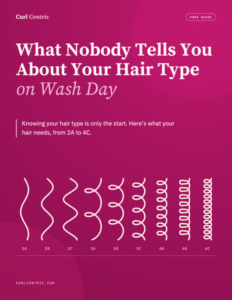
Free 8-page guide
You know your hair type. Here’s what it needs on wash day.
Our free guide gives you one page for each hair type group, from 2A to 4C. Each page tells you how often to start washing, what helps your waves, curls, or coils clump, and the problems your hair type runs into most. It also has a protein or moisture chart and a log for testing one change at a time.
Free. You’ll get the guide by email, two more emails on how to use it, and then one every Thursday, plus the occasional extra. Unsubscribe anytime.
The hair sponge, which is also marketed as a magic twist sponge, hair sponge brush, curl sponge, and afro curl sponge, is a device that's used to achieve many different hairstyles, mainly on natural short hair.
This article provides a comprehensive overview of everything that we know about the hair sponge, including our favorite curl sponges.
What Is a Hair Sponge?
 The hair sponge is available in several different versions. Although, regardless of the brand, it usually looks like a sponge that would be used for house cleaning, although it has holes in it.
Some of the sponges have small holes, while others have large holes. Some sponges are oval, rectangular, or round.
The majority of hair sponges feature an ergonomic design that fits in your hand comfortably.
What Is the Best Hair Sponge?
The idea of using what looks like a cleaning sponge on your hair may seem odd, but it can actually be very effective.
To figure out which type of hair sponge works best on your hair, it's essential to consider the results that you're trying to achieve.
Generally speaking, sponges that have small holes will work best on really short hair. These sponges produce uniform, tight, small coils and/or loose curls, depending on your individual natural hair texture.
On longer hair, hair sponges that have larger holes will produce larger curls or coils. When choosing the best sponge for your hair, you'll want to consider hole size, sponge size, shape, and durability.
Start with your hair, not the sponge
Will a hair sponge work on your hair right now?
Many of the articles on this topic were written by online retailers trying to sell you a hair sponge. They are unlikely to tell you the sponge won’t work on your hair length. Honestly, hair sponges only work in a fairly narrow window, so check where your hair sits before you buy one.
| Verdict | Your hair right now | Which sponge | What you’ll get |
|---|---|---|---|
| Too soon | Freshly big chopped, your hair is likely too short since the sponge holes are deep | None yet | The holes have nothing to grab. You’ll rub your scalp sore and see no coils. Give it a few more weeks. |
| Ideal | If you have a TWA and your hair is long enough to pinch between two fingers, your hair is an ideal length for using a hair sponge | Small holes | Tight, even coils in five to ten minutes. This is the length the tool was designed around. |
| Works | If you’re past the TWA stage by a few inches, you can still use a hair sponge with larger holes | Large holes | Looser, chunkier curls with more separation. Work in sections and it takes longer. |
| Poorly | Long enough to wrap around your finger | None | Your hair wraps around the sponge instead of rotating inside a hole, and that is how tangles start. Finger coils or two-strand twists give you a better result. |
One thing no packaging mentions: sponging the same coils over and over and leaving them in is how a lot of people start locs. If you don’t want locs, take the coils down and detangle on wash day.
How Do Sponges Work?

Hair sponges work by firmly but gently rubbing the sponge on your hair using a circular motion to create twists, curls, or coils.
The holes in the sponge, coupled with your hand movement, create small twists within the hair. Using the hair sponge to create these twists is much faster than if you were doing it by hand.
Some sponges have pyramid-shaped grooves rather than holes to add volume and texture to your natural hair. Double-sided sponges are also available with grooves on one side and holes on the other side.
Use it on damp hair, not soaking wet or not dry curls. Mist your hair with water, or work on hair that’s most of the way dry after a wash, then add a curl cream or gel before you start. Soaking wet hair slips straight out of the holes, and using a sponge on dry hair can lead to breakage. We especially like Aunt Jackie's Curl La La, though plenty of products do the job.
If you have relatively short hair, you'll likely be able to achieve the desired look in no more than five to ten minutes of rubbing the sponge onto your hair.
The timeframe will vary depending on the texture and length of your hair.
You can also use a twist sponge for starter locs or mini hair twist. To see this sponge in action, check out the following video by Janai Kirsten.
During the video tutorial, Janai discusses the difference between using the textured (spiky) side of the sponge versus the flat side with holes.
As you can see from the video, the hair sponge is designed to be used on naturally curly, coily, and kinky hair textures. A hair sponge can also be used on short natural hair for waves.
Sponges that have pyramid-shaped grooves tend to be the best type of sponges to use for creating waves.
A hair sponge used on straight hair isn't likely to generate the same results. It definitely doesn't hurt to try it, but remember that hair sponges tend to work the best on curly or kinky hair textures.
Generally speaking, they also work best with short hair.
In case you were wondering about the results you can achieve on long hair using a sponge, as mentioned previously, hair sponges that have large holes have been designed to use on longer hair.
If your hair is more than six to seven inches long, then it might not work as well. If you have longer hair, we encourage you to experiment with the sponge to determine if it creates your desired hairstyle.
Using Sponges On Short Hair

Most sponges work best when used on short hair, which makes them a great tool for both women and men.
Women that have recently big chopped and those who like to wear short TWA hairstyles may find that a sponge brush is helpful since it is an easy way of adding texture and curl definition to hair.
Some people also use hair sponges to improve the appearance of your hair's volume and that can be particularly helpful for most people who have very thin or fine hair.
Pros and Cons
Now that we've covered how to use twist sponges, let's take a few minutes to discuss the primary pros and cons when it comes to using a sponge to style your hair.
Pros:
- Works on a number of different natural hair types, but it generally works best on type 3 and 4 hair types
- Easy to use
- Reduces styling time significantly
- Relatively inexpensive
- Gentler than twisting with a rat tail comb, as long as your hair is damp and you keep the pressure light
Cons:
- If you rub the sponge too hard or the material of the sponge is too rough, some breakage may be caused. We don't recommend using "rough" sponges on your hair.
- If you use the product on dry hair, you'll increase the probability of causing hair damage, especially if you press down heavily on your hair.
- Might cause hair tangles
- Generally speaking, on longer hair, the product doesn't work as well
- Some hair sponges might have to be replaced frequently, as the quality in the marketplace varies significantly
Where Can You Buy Hair Sponges?

Due to a significant increase in popularity, hair sponges are available at most retailers that sell beauty products.
Also, beauty salons and barbershops often use hair sponges for certain hairstyles, you can also purchase sponges at many beauty salons and barbershops.
How Much Does a Hair Sponge Cost
Like most products, the cost of a hair sponge varies depending on where you purchase it, the brand, and the overall quality of the product.
Some of the least expensive sponges range in price from $5 to $10, but there are brands like NuDred that often cost more than $10. NuDred, however, is one of the first brands that I can remember advertising the sponge.
If you're interested, NuDred is a black-owned, family business from the Dallas, Texas area. The company is well-known for producing high-quality sponges that are long-lasting.
Many of the less expensive sponges have to be replaced more often, so read some reviews and do your research before you buy. see the current NuDred sponges on Amazon.
As you review the various types of hair sponges available on Amazon, keep in mind that sponges can be used to create various styles.
This can depend on the type of sponge that you purchase and how much time you spend rubbing the sponge on your hair.
For example, if you have a curlier hair type and enjoy wearing wash-and-go styles, a hair sponge can be very useful. Various sponge hairstyles can also be found on social media and YouTube.
Here's one of our favorites from YonkelC, who provides a detailed video tutorial on styling a short TWA with a sponge.
Note that after watching these, you'll need to determine whether the hair sponge is the right product for you.
Since they're relatively inexpensive, if you're still unsure, we recommend purchasing one and seeing if you like the way it makes your hair look.
Related Articles
- How to Make Shirley Temple Curls
- How to Coil Natural Black Hair
- What Does TWA Mean for Hair
- Straw Curls Before and After
How to Twist Your Hair Without a Sponge
It is possible, of course, to twist your hair without using a sponge. Many people, after all, have twisted their hair for many years before anyone invented the idea of using hair sponges for creating curly twists.
It is a fairly easy process, but it's a lot more time-consuming compared to using hair sponges. Before you start twisting your hair, make sure your hair is damp first. You can lightly mist your hair with a spray mist bottle.

Then part it into small sections using your favorite curl cream or twisting product. Then gently stretch a small section of your hair and wrap it around your finger until it has coiled into a small twist.
Instead of using your fingers, the tip end of a rat tail comb can be used instead. Repeat the process until all of your hair is twisted.
You can air-dry your hair or use a hair dryer (on low temp) for setting the style and to shorten the drying time.
The palm rolling method can also be used for longer hair. The method involves rolling your hair in between the two palms of your hands.
Another method lets you sponge your hair using a towel. It is called the towel method. It uses the same general technique that the hair sponge uses.
The only primary difference with it is you rub a towel over your hair using circular motions rather than using a sponge.
On longer hair, the towel method often works better when you're attempting to lock your hair.
But damage and breakage are possible, especially if you use a towel made out of rough material. The safer hair styling option is to use a hair sponge.
Frequently Asked Questions
The questions we get asked most about sponge styling, answered plainly.
Does a hair sponge damage your hair?
It can, and the two things that cause it are pressure and dryness. The sponge works by rotating a section of hair inside a hole, so if your hair's dry there's nothing helping it slide and the strand takes the friction instead. Damp hair and a light hand are the whole safety story. If your scalp is stinging, you're pressing too hard.
Should you use a hair sponge on wet or dry hair?
Damp. Not soaking wet or not dry hair. Mist your hair with water, or work on hair that's most of the way dry after a wash, then add a curl cream or gel before you start. Soaking wet hair slips straight out of the holes and gives you nothing, and dry hair gives you breakage.
Will a hair sponge turn my hair into locs?
It can if you let it. Sponging makes the same coils people use deliberately to start locs, so coils that get sponged over and over and never taken down will knot at the root and stay that way. If you want locs, that's the method working. If you don't, take the coils down and detangle properly on wash day.
How often can you use a hair sponge?
Treat it as a styling tool rather than a daily habit. Every wash day is fine for most people. Every day, on the same coils, with pressure, is how you end up with knots at the root and thinning at your hairline.
How long do sponge curls last?
Usually two to four days, and less in humidity. Sleep in a satin bonnet or on a satin pillowcase, and refresh by misting lightly and running the sponge over the surface rather than starting again from scratch.
How do you clean a hair sponge?
Wash it whenever you'd wash a hairbrush. Curl cream and gel build up inside the holes, the sponge stays damp between uses, and a dirty sponge puts all of that straight back onto your scalp. Warm water, a drop of shampoo, squeeze it through, rinse until the water runs clear, then let it dry fully with the holes facing up.
When should you replace a hair sponge?
When the holes lose their shape or the edges start to crumble. A sponge that's gone stiff or rough drags instead of rotating, and that's when it starts costing you hair. The cheaper ones usually need replacing every few months.
What can I use instead of a hair sponge?
Finger coils give you the same look with more control and no tool; they just take a lot longer. Two-strand twists work on longer hair, where a sponge stops being much use anyway. The towel method uses the same circular motion, but a rough towel does more damage than a sponge, so it isn't the safer option it sounds like.
The locs risk nobody mentions
Sponging your hair makes the same coils that people use on purpose to start locs. That’s the same technique, done with a tool.
So if you sponge the same coils over and over and never take them down, they will eventually knot at the root and stay that way. For anyone growing locs, that’s the method working. For everyone else it’s worth knowing before it happens, and the fix is simple: take the coils down and detangle properly on wash day.
How long sponge curls last
Expect two to four days on most hair, and fewer in humidity. What shortens it is friction against your pillow overnight, so sleep in a satin bonnet or on a satin pillowcase.
To refresh, mist lightly with water and run the sponge over the surface in the same direction you used the first time. You’re tidying the coils that already exist rather than making your coils again, so it takes a minute or two rather than ten, and it costs your hair far less than starting over.