Researched and written by Curl Centric. Read by an AI voice.
If your curls feel stiff after a protein treatment, protein is one possible reason, but buildup, dryness, and damage can feel similar. We'll explain what protein treatments do to your hair, whether protein overload is a scientifically defined condition, and how to tell what your hair may need without breaking a single strand.
Podcast: Play in new window | Download
Our free Protein and Moisture Check, in our protein treatment guide: https://www.curlcentric.com/protein-treatment-for-natural-hair/
Transcript
This is Curl Science by Curl Centric.
Free 8-page guide
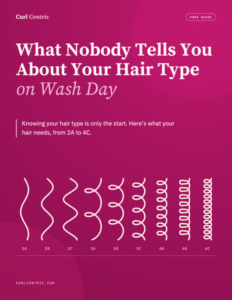
You know your hair type. Here’s what it needs on wash day.
Our free guide gives you one page for each hair type group, from 2A to 4C. Each page tells you how often to start washing, what helps your waves, curls, or coils clump, and the problems your hair type runs into most. It also has a protein or moisture chart and a log for testing one change at a time.
Free. You’ll get the guide by email, two more emails on how to use it, and then one every Thursday, plus the occasional extra. Unsubscribe anytime.
If your curls have ever felt stiff and straw-like after a protein treatment, someone has probably told you that you have protein overload. Or maybe your hair feels mushy when it's wet, and you've been told you need more protein. In this episode, we'll explain what protein treatments do to your hair, whether protein overload is a scientifically defined condition, and how to figure out what your hair may need without breaking a single strand. Then we'll tell you about our free Protein and Moisture Check.
Let's start with what's in the bottle. Your hair is made mostly of a protein called keratin. The protein in hair products is usually hydrolyzed, which means it has been broken into smaller pieces. The size of those pieces helps determine what they do.
In a lab study of relaxed, tightly coiled hair, the smallest pieces of keratin moved inside the strand and made it swell slightly, but they didn't make it stronger. Medium-sized pieces got inside too, while the largest pieces mostly stayed near the surface. The medium and largest pieces made the hair stiffer and reduced early breakage from 15 strands out of 50 to about 5 or 6. That study was partly paid for by the company that supplied these proteins, so keep that limitation in mind.
Here's the important part: the effect doesn't last forever. Researchers describe protein conditioning as temporary, and shampooing washes off the extra protein on your hair. A protein treatment can patch your hair for a while, but it isn't a permanent repair.
So why might damaged hair benefit from protein? Damage causes hair to lose protein. In one study, bleached hair lost about five times as much protein during combing as untreated hair. In another, hair that was permanently colored and then relaxed with a lye relaxer lost several times as much protein as untreated hair. Sun exposure can cause some protein loss, too.
Chemically damaged hair is especially weak when it's wet. In one lab study, bleached hair broke under about 35 percent less force when it was wet than when it was dry. In another, relaxed, tightly coiled hair lost about 35 percent of its strength in humid air, while untreated coily hair showed no clear drop. When it's wet, chemically damaged hair is weaker and stretches much more easily, which may be part of why it can feel mushy on wash day.
So is protein overload real? It's a term you'll hear in the natural hair community, not a condition researchers use. Protein really can make hair stiffer. But in the study we just described, the protein that made hair stiffer also made it break less, not more. If your hair feels stiff, protein is one possible reason, but buildup, dryness, and damage can feel similar.
Before we get to how to tell them apart, one quick ask. If you want more answers like this, follow the show, so the next one finds you.
First, let's clear up a few things you may have heard. Rice water is high in starch, with much less protein. Coconut oil has no protein in it. In lab tests, it actually reduced how much protein hair lost. Amino acids, which you'll see on many labels, are the building blocks of protein, and in the relaxed-hair study, an amino acid didn't make hair stronger either. Some bond-building ingredients aren't proteins. If you're counting protein, check the rest of the label.
And as we covered in our breakage episode, researchers found that the sulfur-rich proteins that help give hair its strength were laid out normally in hair from Black African volunteers, the same as in hair from other groups. The damage they saw was consistent with combing and handling.
So how do you tell what your curls may need? You may have seen the strand test, where you wet a strand and pull it to see whether it stretches or snaps. Please skip it. You could break your own hair to get an answer, and one strand doesn't tell you much. Wet hair stretches more easily than dry hair, and how far it goes before it breaks depends partly on how fast you pull.
Instead, pay attention during your next wash day. Start immediately after rinsing out your conditioner. Does your hair feel soft and smooth, rough and dry, coated and slick, or mushy and unusually stretchy?
Then check it again when it's completely dry. Is it soft with some bounce? Dry and rough again? Stiff and crunchy like straw? Or heavy, dull, and flat?
Next, look at your comb and towel. A long hair with a tiny round bump at one end usually shed from the root, which is normal. It's normal to shed 50 to 100 hairs a day. Lots of short pieces without a bump are more likely to be breakage.
Then think about what you've used. How many products containing protein have you used during the past two weeks? During the past year, have you bleached your hair, relaxed it, colored it permanently, or flat-ironed it often? Finally, look at your ends. Are they smooth and even, or split, frayed, and see-through?
Here's how to read those clues. If your hair became stiff and crunchy after you started using protein products, pause them. Clarify once if your hair also feels coated. Then use a moisturizing conditioner without protein on the label, and give it two or three wash days before you change anything else.
If your hair feels mushy or unusually stretchy when wet and has been bleached, relaxed, or permanently colored, consider trying one light protein product. To spot the protein, look for ingredient names like hydrolyzed wheat protein, keratin, or collagen. Stop if your hair becomes stiff, rough, or harder to manage.
If your hair feels coated, heavy, or dull, product buildup may be the cause. Try a clarifying wash, which we explain in our clarifying shampoo episode. If your hair simply feels dry and rough, it may need more conditioning rather than more protein. For your next two or three wash days, use a moisturizing conditioner without protein on the label.
If you see split ends and lots of short broken pieces, that's damage. Protein may hold split ends together for a while, but only until your next shampoo. Trim those ends over time and cut back on high heat, chemical processing, and rough handling.
Whatever you try, change one thing at a time and give it two or three wash days before deciding whether it helped. If a lot more hair than usual is coming out from the root, or your scalp is painful, itchy, or inflamed, see a dermatologist.
Our free Protein and Moisture Check walks you through these same clues. It asks six questions about your last wash day and your recent routine, and gives you a starting point, from trying more conditioning, a light protein product, or a clarifying wash to addressing damage that may need a trim. Then you can paste in a product's ingredient list, and it will check how much protein the formula appears to contain. Protein ingredients closer to the top of the list usually count more because they're generally present at higher levels.
So here's what we'd do. Don't diagnose protein overload from one stiff wash day. Look at what you've used, what your hair has been through, and how it feels wet and dry. Consider a light protein product when chemically damaged hair feels weak and mushy. Pause protein when your hair becomes stiff after protein products, and remember that buildup, dryness, and damage can feel similar. Never break your hair to test it.
Our free Protein and Moisture Check is linked in the show notes. And if this helped, follow the show for the next one.
That's it for this episode. If it helped, follow Curl Science in your podcast app so the next one reaches you, and leave us a rating while you're there. Curl Science is researched and written by the Curl Centric team, and it's read by an AI voice.
Sources
- Malinauskyte E et al. Int J Cosmet Sci. 2021;43(1):26-37. PMID 32946595
- Fernandes C et al. Polymers. 2023;15(3):608. PMID 36771909
- Draelos ZD. Int J Trichology. 2010;2(1):24-29. PMID 21188020
- Gavazzoni Dias MF. Int J Trichology. 2015;7(1):2-15. PMID 25878443
- Silva AL, Nunes AS, Gesztesi JL. J Cosmet Sci. 2004;55 Suppl:S175-9. PMID 15645094
- França-Stefoni SA et al. J Cosmet Dermatol. 2015;14(3):204-8. PMID 26177865
- Santos Nogueira AC, Joekes I. J Photochem Photobiol B. 2004;74(2-3):109-17. PMID 15157906
- Malinauskyte E et al. Biopolymers. 2020;111(11):e23401. PMID 32926408
- Rele AS, Mohile RB. J Cosmet Sci. 2003;54(2):175-92. PMID 12715094
- Di Foggia M et al. Int J Biol Macromol. 2021;167:620-632. PMID 33279560
- Khumalo NP, Dawber RP, Ferguson DJ. Exp Dermatol. 2005;14(4):311-4. PMID 15810890
- Yu Y, Yang W, Meyers MA. Acta Biomater. 2017;64:15-28. PMID 28919511
- Lazarus BS et al. iScience. 2021;24(8):102798. PMID 34355149