Researched and written by Curl Centric. Read by an AI voice.
High porosity often reflects damage that has built up over time, and low porosity usually doesn't. We explain what the two mean, how to tell where your hair may sit, and what each one really needs.
Podcast: Play in new window | Download
The full guide, with every source: Hair porosity.
Our free hair porosity quiz: https://www.curlcentric.com/hair-porosity-test/
Free 8-page guide
You know your hair type. Here’s what it needs on wash day.
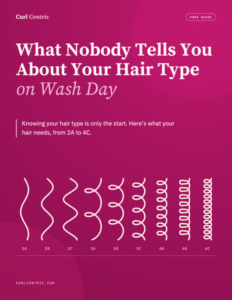
Our free guide gives you one page for each hair type group, from 2A to 4C. Each page tells you how often to start washing, what helps your waves, curls, or coils clump, and the problems your hair type runs into most. It also has a protein or moisture chart and a log for testing one change at a time.
Free. You’ll get the guide by email, two more emails on how to use it, and then one every Thursday, plus the occasional extra. Unsubscribe anytime.
Transcript
This is Curl Science by Curl Centric.
If you've ever been told you have low porosity hair and then bought a steamer, a heat cap, and a cabinet full of light oils, or been told you have high porosity hair and started piling on heavy butters, this one's for you. In this episode, we'll explain what low and high porosity actually mean, how to tell where your hair may sit, and what it really needs.
Porosity describes how much water your hair can take in and hold. In a lab, scientists can measure it by soaking hair, spinning off the extra water, and weighing how much water the strands held. They can also measure the tiny pores inside a strand directly.
Here's what those tests show. Porosity isn't three separate boxes. It's one sliding scale, and chemical damage pushes your hair higher on it. In one lab test, after soaking, water made up about 31 percent of the weight of untreated hair. For hair with permanent color, it was about 32 percent. For permed hair, it was about 35 percent, for relaxed hair, 36 to 38 percent, and for bleached hair, almost 55 percent. That's about three-quarters more than untreated hair.
Bleach works quickly. In another study, one minute of bleaching nearly tripled the surface area of the tiny pores inside a strand. When bleaching continued, smaller pores began merging into larger ones.
So where do low, medium, and high porosity come from? They're labels used in salons and hair books, not separate scientific categories. The lab studies we found don't describe a special group of extra-sealed hair below ordinary, undamaged hair. Undamaged hair simply sits near the low end of the scale. High porosity, on the other hand, lines up closely with damage.
That's why, as we said in our porosity float test episode, high porosity often reflects damage that has built up over time. Low porosity usually isn't a sign of chemical damage. In the lab, hair that hadn't been bleached, permed, or relaxed sat near the low end.
So why does some undamaged hair seem to repel water on wash day? Your scalp's natural oil and leftover product can coat the outside of each strand and make water bead up. In one lab study, the amount of hair in the sample changed how fast it took up moisture from the air, so how much hair you have might also play a part in how long it takes to soak through. Hair that takes forever to get wet may be healthy hair that simply needs more water and more time.
What about curl type? You may have heard that 4C hair is naturally low porosity or that curly hair is naturally high porosity. Lab studies comparing hair from different backgrounds found small differences in how the hair absorbed water. In two studies, hair from people of African descent absorbed water vapor slightly faster than European or Asian hair, though European hair held slightly more. Those background differences were small next to what bleach did in the soaking test, so your hair's history is the better clue.
That brings us to how to tell where yours may sit. Start with your hair's history because it carries the most weight. Have you bleached or highlighted your hair? Used permanent color, a relaxer, or a perm? Those chemical processes move hair higher on the porosity scale, with bleach causing the largest change. Frequent high heat damages hair too, but it doesn't fit neatly on this scale. It can leave tiny holes inside the strand, yet in one lab test, heat-damaged hair took up less water vapor than unheated hair. Your ends may also be more porous than your roots because they're older and have been through more.
Then look at how your hair behaves. Damaged, high porosity hair may absorb water and dry quickly. In one study, bleached hair released its water about an hour faster than untreated hair. It's also more likely to frizz, tangle, and feel rough. Hair near the low end may take longer to become fully wet and dry, and products may seem to sit on its surface. Treat all of those signs as clues, not a final answer.
Before we get to what each one needs, one quick ask. If you want more answers like this, follow the show, so the next one finds you.
If your hair sits near the high end, here's what lab research supports.
First, condition every time you wash. Many conditioning ingredients stick especially well to damaged hair. Their main job is to reduce friction and static so your strands slide past each other instead of snagging. Regular rinse-out conditioner adds surprisingly little water, so think of it as protection and slip, not as a way to add water.
Second, consider coconut oil before you wash. In lab tests, coconut oil used before or after shampooing reduced protein loss from both damaged and undamaged hair. Sunflower oil and mineral oil didn't. That research came from a company that sells coconut oil hair products, so keep that limitation in mind. Oils can also slow how quickly water moves into and out of your hair, although plenty of water still gets through.
Third, lean slightly acidic. In one study of bleached hair, a pH of 5, which is mildly acidic, kept the hair's protein in the best condition. A gentle, slightly acidic conditioner can be a good choice.
Fourth, a protein treatment may help temporarily. In a study of relaxed, very curly hair, medium and large pieces of keratin made strands stiffer and reduced breakage. Protein can temporarily patch or coat damaged areas, but it doesn't regrow your cuticle and eventually washes away.
Most importantly, stop adding damage. Lighten less often, turn down the heat or skip it, and trim damaged ends over time. New growth from a healthy scalp comes in near the low end of the scale.
If your hair sits near the low end and hasn't been through a lot of high heat, the good news is that it's probably healthy. Focus on giving it enough water and a manageable amount of product. Wet your hair thoroughly and give the water time to move through all your curls. Start with less product because using too much can leave a coating on the surface. Clarify when your hair starts to feel coated, which we explain in our clarifying shampoo episode.
What about steamers and heat caps? Gentle warmth may help some conditioners soak in and work a little better. Your cuticle is made of overlapping scales, like shingles on a roof, not a door on a hinge, though warmth and water can lift their edges. If you like how your curls feel after a warm deep conditioning treatment, keep doing it. Just don't feel that you need special equipment.
One thing applies to everyone. Wet hair gives way more easily than dry hair. Healthy wet hair can stretch a little and bounce back, but stretching it too far can cause lasting damage. Whatever your porosity, detangle gently with conditioner in your hair, starting at your ends.
So here's what we'd do. Don't stress about choosing the perfect box. Ask what your hair has been through, then watch how it behaves on wash day. If it's been bleached, permanently colored, relaxed, or damaged by heat, condition every time, consider coconut oil before shampooing, and stop adding new damage. If it hasn't been heavily processed, use less product, give your hair more water and time, and clarify when it feels coated.
Our free hair porosity quiz is linked in the show notes. It asks nine questions, gives more weight to your hair's history than how it feels, and takes about ninety seconds. And if this helped, follow the show for the next one.
That's it for this episode. If it helped, follow Curl Science in your podcast app so the next one reaches you, and leave us a rating while you're there. Curl Science is researched and written by the Curl Centric team, and it's read by an AI voice.