
Hair Porosity Quiz: Test Your Hair's Porosity at Home
The glass of water test doesn't work, and chances are you've already noticed that yourself. This hair porosity quiz asks nine questions instead, and it weighs what you've put your hair through more heavily than how your hair feels on wash day.
Always free
Nothing to sign up for
Every claim sourced
If you've spent any time reading about curly hair, you've probably come across the float test. You drop a clean strand into a glass of water, wait a few minutes, and see whether it sinks or floats.
It's an appealing test because it's so simple, and just about every hair site will tell you to try it. Unfortunately, it doesn't work, and chances are you've suspected that already.
Here's the problem. Your hair is coated in sebum from your scalp plus whatever product you used last, and oil floats on water, so most strands float no matter what your porosity actually is. Wash your hair, use a different conditioner, and you'll get a different answer next week.
That's why this hair porosity quiz asks a different set of questions. Four of them are about what you've put your hair through over the years, four are about how your hair behaves on wash day, and the last one is the float test itself.
We'll ask about it, and then we'll throw your answer out. Your result explains why.
Hair Porosity Quiz
Nine questions, and it takes about ninety seconds. We weigh what you've put your hair through more heavily than how your hair feels, because that's the half with real research behind it. At the end, we'll also tell you which of your answers we ignored, and why.
These four questions carry most of the weight in your result. High porosity is mostly cuticle damage, and you already know your hair's history better than any test does.
The evidence behind these four isn't as strong as step 1. However, they're the best signals you can watch for at home, and they catch the cases your hair's history misses.
Answer it anyway. Your result will explain what this answer was really telling you.
How We Estimate Your Hair's Porosity
Most hair porosity quizzes treat every answer the same way, and most of them finish by recommending something for you to buy. This one weighs each of your answers by how much research is behind it, and we're not selling you anything.
What You Have Put Your Hair ThroughBleach, permanent color, relaxers, heat, and time. High porosity is mostly cuticle damage, and that's something researchers can measure directly, so these four questions carry the most weight in your result. To give you a sense of the scale, one minute of bleaching nearly triples the pore surface area of a hair fiber.
How Your Hair Behaves on Wash DayHow long your hair takes to get wet, how long it takes to dry, what a humid day does to it, and what conditioner does. The evidence behind these is weaker, and we'll say so. However, they're the best signals you can watch for at home, and they catch the cases your hair's history misses.
The Float TestWe'll ask, and then we'll throw your answer out. A strand of hair floats or sinks based on what's coating it, not on how much water gets inside it. Your result will explain what your answer was really telling you.
What Your Hair Porosity Quiz Result Means
Your result puts you in one of three places. Here's what each one looks like day to day, and what it should change about your routine. Keep in mind that your porosity and your hair type are two different things, so a fine strand and a coily strand can land in the same column.
Low Porosity Hair
Low porosity hair has a tight, flat cuticle, and water has to work to get past it. If that's your result, you already know the signs. Your hair takes a while to get properly wet in the shower, it dries slowly once you're out, and conditioner has a habit of sitting on top instead of sinking in.
Here's the good news. Low porosity usually isn't damage at all, and it's often just how your hair grew, which means there's nothing to repair. What helps you most is plenty of water, a little time, and lighter products rather than heavy butters. Gentle warmth from a plastic cap or a warm towel may help some conditioners spread, but it doesn't open your cuticle.
Medium Porosity Hair
If this is your result, your hair sits right in the middle of the range. Medium porosity, sometimes called normal porosity, means water passes through your hair cuticles at a reasonable rate and stays a reasonable amount of time.
Conditioner does roughly what the bottle says it will, and your color takes evenly, because there's nothing unusual about the way your hair takes things in. That predictability is the advantage, even though it rarely feels like one.
Medium porosity gets very little attention online, and we think we know why. There isn't much to sell you when your hair is already behaving. If that's your result, the best thing you can do is protect what you've got and stop hunting for a fix.
High Porosity Hair
High porosity hair soaks up water almost the moment it hits the shower, and it dries quickly afterward, often before you've finished styling. That happens because the outer layer of your strands has gaps in it, so water moves in and out without much resistance.
It feels wonderful while it's wet and rough once it isn't, and a humid day will swell and frizz it within minutes, because that same open cuticle lets the moisture in the air straight into your hair.
High porosity is mostly damage your hair has picked up along the way, usually from color, bleach, relaxers, or heat. Getting moisture in was never your problem, so your effort should go toward keeping it there. Seal after you moisturize, use protein more often than other people do, and trim on a schedule.
What Each Hair Porosity Test Measures
Every test you've been told to try responds to something real. However, it's usually not the thing the test claims to be measuring, which is why your answer keeps changing on you. Here's what each one is really reading.
If you've tried the float test more than once, chances are you got a different answer the second time. Here's why. Every one of these hair porosity tests responds to something real, but it's usually not the thing the test claims to be measuring. We've sorted them below from the least trustworthy to the most.
| The test | What it claims | What it's really reading | Evidence |
|---|---|---|---|
| The float test | Sinks = high porosity. Floats = low. | Surface tension, which tells you whether your lipid layer is intact, not how much water gets in. | D Never validated. In a chemist’s replication, untreated, oiled, and gelled strands all floated; only conditioner-treated hair sank. Residue decided it. |
| The strand or slip test | Snags = high porosity. Smooth = low. | Friction coarse enough to feel, which your porosity isn't, because a cuticle scale lifts about a millionth of a meter. | D Never validated. Finds damage you could already see, and nothing else. |
| The spray or drop test | Beads on top = low. Soaks in = high. | The same surface tension the float test reads, plus how tightly your strands happen to sit against each other. | D Never validated. Measures the float test’s one variable a second time. |
| How long it takes to wet, and to dry | Slow both ways = low porosity. | Water genuinely moving in and out, though your hair's density, thickness, and length all muddy the result. | C Your best signal at home, as long as you treat it as a clue, not a verdict. |
| What has actually been done to your hair | Bleach, color, relaxers, heat, years. | The thing itself, because high porosity is mostly accumulated cuticle damage and you already know your hair's history. | A Directly measured. One minute of bleaching nearly triples a fiber’s pore surface area. |
| Lab measurement | Pore volume, pore size, and how much surface is inside the strand. | Exactly what it says, which is why this is what the research runs on. | A Needs equipment that measures how much gas or water vapor a strand soaks up. There's no home version of that, and nothing you can buy substitutes for one. |
Evidence key: A measured directly in peer-reviewed research · B peer-reviewed but indirect or industry-funded · C expert consensus, no direct measurement · D tradition, never tested.
Sources: Hessefort, Holland & Cloud, J Cosmet Sci 2008;59(4):303–15 · Robbins, Chemical and Physical Behavior of Human Hair, 5th ed., Springer 2012 · Syed, Cosmetics & Toiletries 2002;117(11):57–62 · La Torre & Bhushan, J Cosmet Sci 2006;57(1):37–56.
The Hair Porosity Cheat Sheet
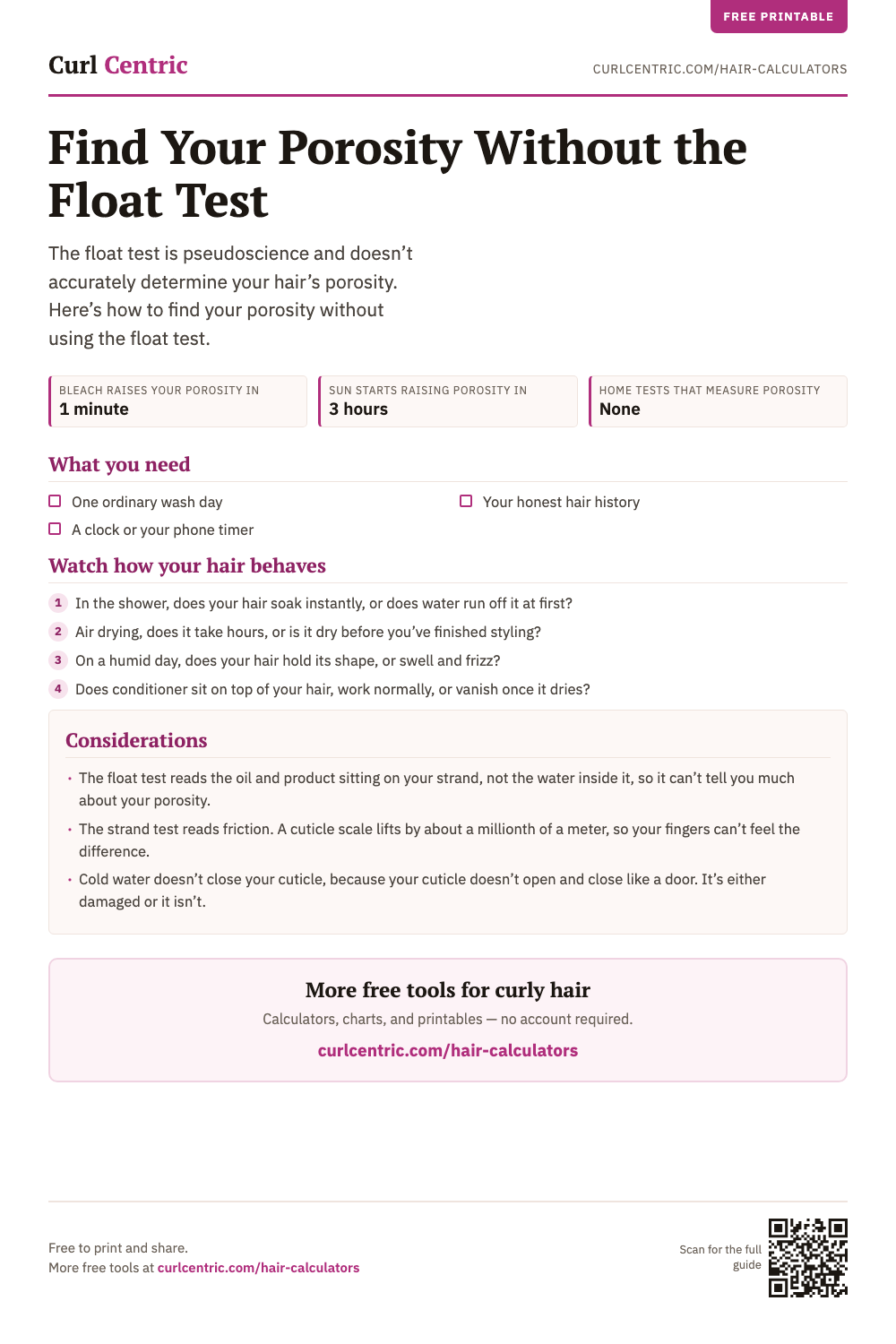
Find Your Porosity Without the Float Test
The same questions on a single page, along with the routine for your result and the five things that aren't worth your time. Print it out, keep it with your products, and you won't have to come back here to check.
It's free, and we won't ask for your email.
Frequently Asked Questions
How Accurate Is a Hair Porosity Test?
No at-home hair porosity test measures your porosity accurately, and that includes this quiz. The methods researchers use require equipment that measures how much gas or water vapor a strand of hair absorbs, and there's no version of that you can run in your bathroom.
However, you can estimate two things fairly well at home.
The first is how much your hair has been through, and the second is how your hair behaves on wash day. Together, those two answers cover almost everything a porosity label was going to tell you anyway, including which products to reach for, how often your hair needs protein, and whether heat is worth using during a deep conditioning treatment.
Why Doesn't the Float Test Work?
The float test reads the outside of your hair rather than the inside. Undamaged hair is waterproofed by a fatty acid called 18-MEA, which is bonded to every cuticle scale and repels water strongly enough to hold an entire strand on the surface of a glass. When that layer gets stripped away by damage, the strand wets out and sinks.
Product residue moves the result too. When a chemist repeated the test at home, untreated strands, oiled strands, and gelled strands all floated for the entire test. The only sample that sank was the one with conditioner on it.
Is High Porosity Hair Bad?
High porosity hair isn't bad, and it isn't something you did wrong. It simply means your cuticle has picked up wear along the way, usually from color, bleach, relaxers, heat, or years of wash days.
It does change your routine, though. If your hair is high porosity, getting moisture in was never your problem, so your effort should go toward keeping it there. It's also worth remembering that porosity isn't permanent in the way the label makes it sound, because the hair growing in at your scalp right now hasn't been through any of it.
Related Articles
What Is Hair Porosity?The full guide, including what actually raises your porosity and how fast
Hair Typing SystemYour curl pattern and your porosity are two different things
Free Hair CalculatorsEvery free tool and printable we've made
Natural Hair Dictionary248 terms explained in plain language