

A silk press gets curly, coily, or kinky hair straight using heat alone — no relaxer, no texture-altering chemicals, nothing permanent. Done well, it lasts one to three weeks, and your curl pattern comes back at the first wash.
Done at the wrong temperature, it doesn't come back at all.
That's where most silk press guides go wrong, including this one until we rewrote it. So we've rebuilt it around the number that actually decides the outcome: how hot the iron is when it touches your hair.
What Is a Silk Press?
A silk press for natural hair is a styling technique that helps to transform curly, kinky, or coily natural hair into a straighter, sleeker version of itself. The process involves the following steps:
- Shampooing
- Conditioning
- Moisturizing and Prepping
- Blow drying
- Straightening
- Wrapping
It's step-intensive, and it's usually done by a professional. Silk presses are efficient enough at straightening that even resistant curls, coils, and kinks can end up the straightest they've ever been. Once the hair is straight, your stylist can add curls back through the lengths for movement and body.
Free 50-page guide
Your hair is already growing. The problem is keeping it.
About a third of an inch a month on textured hair, not the half inch you’ve read. If your length looks stuck, that’s your hair breaking off as fast as it grows in. Here are the seven causes of breakage and the weekly routine that stops them.
Free. One email a week after that. Unsubscribe anytime.
Where the Silk Press Came From
The technique behind it is older than the name. French hairdresser Marcel Grateau built heated styling tongs around 1872 for the marcel wave, and heated combs reached Black hair care in the United States in the decades that followed.
Two names matter here, and they're often reported wrong. Annie Malone was the first in the African American community to patent the hot comb. Madam C.J. Walker, who trained as Malone's apprentice, improved the design and built the business that put it in households across the country — but she didn't invent it, despite how often you'll read that she did. Walter Sammons patented a further improved iron comb in 1920.
What people called a press and curl back then is the direct ancestor of today’s silk press. The difference is the tooling: ceramic and titanium plates with actual temperature control, instead of a metal comb heated on a stove with no way to know how hot it was.
The technique is older than the name, and the credit is usually given to the wrong person.
Builds heated styling tongs to create the marcel wave. The tool that becomes the hot comb starts here, in a Paris salon, with nothing to do with textured hair.
Becomes the first person in the African American community to patent the hot comb, and builds a hair care business around it.
Trains as Malone’s apprentice, then improves the design and builds the company that puts a heated comb in households across the country. Popularized it. Did not invent it.
Patents a further improved iron comb, refining the tool again.
The same idea — heat, tension, no chemicals — with ceramic and titanium plates and a temperature dial. The technique didn’t change nearly as much as the ability to know how hot the tool actually is.
That Madam C.J. Walker invented the hot comb. She didn’t — she improved and popularized a tool that already existed, and the first patent in the Black community belonged to Annie Malone, the woman who trained her. Walker’s achievement was building the business and the distribution, which is a large enough accomplishment without the invention attached to it.
Sources: Smithsonian National Museum of African American History and Culture, “Sizzle.” U.S. patent records for Walter Sammons, 1920.

Who is a Silk Press For?
A silk press is a good fit for the average person with curly natural hair, but it's not for everyone. The problem many run into with silk presses is they require you to put a significant amount of heat on your hair to get it straight.
It's definitely not for people with existing heat damage or those with brittle hair in danger of breaking off. To get the best possible results from your silk press session, your hair should be relatively healthy. If that's the case, you should be a good candidate for the style.
A silk press is a good fit for the average person with curly natural hair, but it's not for everyone. The problem many run into with silk presses is they require you to put a significant amount of heat on your hair to get it straight.
It's definitely not for people with existing heat damage or those with brittle hair in danger of breaking off.
The variable that decides this isn't your curl pattern or your porosity — it's your hair's chemical history. Hair that's been colored, bleached, relaxed, or keratin-treated starts breaking down at a measurably lower temperature than virgin hair, which means the settings that are safe for your friend may not be safe for you even if your curls look identical.
Skip the silk press for now if:
- You already have heat damage — sections that stay straight after washing
- You've bleached or lightened in the last few months
- You're relaxed, or transitioning off a relaxer
- Your ends are splitting or your hair is breaking mid-strand
“The first thing I ask isn't your curl pattern, it's what you've had done. Color, a relaxer years ago, a keratin treatment you forgot about — that changes my whole setup before I touch your hair.”
Kira Byrd · trained barber, hairstylist and natural hair educator

How Long Does a Silk Press Last?
One to three weeks is the realistic answer. Looser textures tend toward the longer end and type 4 hair toward the shorter end, and then your habits and your climate decide the rest.
If your silk press reliably lasts a month, that usually means you sweat very little and live somewhere dry - not a target the rest of us should measure against.
One to three weeks is the realistic answer. Looser textures tend toward the longer end and type 4 hair toward the shorter end, and then your habits and your climate decide the rest.
What shortens it:
- Sweat. The more you sweat at your scalp, the faster your roots revert.
- Water-based products. The water in them starts the reversion.
- Humidity. In a humid climate, a silk press can revert within days.
- Incomplete straightening. If the hair wasn't fully stretched and pressed, it reverts sooner.
If your silk press reliably lasts a month, that's usually a sign you sweat very little and live somewhere dry — not a target the rest of us should be measuring against.
How to Make Your Silk Press Last Longer
Mostly this comes down to leaving it alone.
Keep your hair detangled with a rat-tail or wide-tooth comb. Wrap it at night and cover it with a silk or satin scarf. Avoid water — wrap up before going out in the rain, stay out of humid rooms where you can, and keep workouts light or pull your hair up before them.
Keep product use to a minimum too. You're not washing this hair for a while, so everything you put on it stays there. Go easy on oils and serums. If your roots get oily, a little dry shampoo will absorb it.
One thing worth being honest about: every time your hair reverts and you reach for the iron to smooth it again, that's another heat exposure. Touch-ups are where a safe silk press quietly turns into a damaging one.
Silk Press vs. Flat Iron: The Difference
Both silk presses and flat iron services require you to straighten your hair, so the two get confused constantly. The main difference between a silk press and a flat iron session is that a silk press involves many more steps - a clarifying wash, a deep conditioner, a heat protectant, a full blow-out, and a wrap at the end.
Flat ironing essentially refers to running a flat iron over sections of hair to get them straighter. It's one step, usually on hair that's already dry. That's why a flat iron pass on unstretched coils takes more heat and more passes to get the same result - and more passes is where the damage comes from.
Silk Press vs. Blowout: Also Not the Same Thing
A blowout stops at the blow dryer. Your hair gets stretched smooth and full, but it keeps a bit of body and texture, and it takes less total heat. A silk press keeps going — flat iron, then wrap — to get the hair completely flat and glassy.
So a blowout is the lower-heat option. If you want your length stretched for a week without committing to a flat iron on every strand, that's the one to ask for.
The Heat Settings That Protect Your Curl Pattern
Here's the part almost every silk press guide gets wrong, and it's the reason people lose their curls.
Hair keratin — the protein your strands are built from — starts decomposing at around 392°F. Past roughly 428°F, it denatures and melts, and that change is permanent. No protein treatment brings it back. Yet the standard advice across the internet, including on this page until this update, has been to run a flat iron at 400 to 450°F on thick or coarse hair.
That advice sits inside the damage range. Here's what we recommend instead.
Your chemical history matters more than your curl pattern. Hair that has been colored, bleached, or previously straightened starts breaking down about 45°F earlier than virgin hair — which is why one temperature chart for “fine, medium, coarse” is not enough.
| Hair state | Flat iron ceiling | Passes | Why this number |
|---|---|---|---|
| Virgin, fine or fragile | 300–330°F150–165°C | 1 | Cuticle degradation begins around 150°C, and fine strands reach core temperature fastest. |
| Virgin, medium | 330–350°F165–177°C | 1–2 | Comfortably below the 200°C point where cortex decomposition starts. |
| Virgin, coarse or coily | 350–375°F177–190°C | 1–2 | The most heat coily hair should need, still under the 392°F threshold. |
| Color-treated or bleached | 300–330°F150–165°C | 1 | Chemically treated hair begins decomposing at 175°C — roughly 45°F earlier than virgin hair. |
| Previously relaxed or keratin-straightened | 300–330°F150–165°C | 1 | Acid straightening plus flat ironing leaves the fiber in a metastable state that starts relaxing above 158°F. |
| Already heat-damaged | Don’t press | 0 | Denaturation is irreversible. A silk press cannot restore a lost curl pattern and will deepen the damage. |
A flat iron set to 450°F sits inside the second band. That is the setting most “thick or coarse hair” charts still recommend, including, until this update, ours.
How to read this: the thresholds are measured values. The per-state ceilings are conservative working limits we derived from those thresholds with a safety margin — they are our recommendation, not a figure lifted from the studies.
Sources: Lima, C.R.R.C., et al., “Thermal Induced Changes in Cuticle and Cortex to Chemically Treated Hair,”Biopolymers 117(1), 2026. Li, C., et al., “Prevention of Hair Heat Damage via Thermoresponsive Organic Silicon-Modified Keratin,”Molecules 31(3), 2026.
Fifty-three degrees separate the hottest setting textured hair should ever need from the temperature where keratin starts melting. On a dial that goes to 450, that is about two clicks.
Thresholds from Lima et al., Biopolymers 117(1), 2026. The 300–375°F working range is our conservative recommendation derived from them — see the table above for the ceiling that applies to your hair.
“I've never needed 450 on anyone. If I'm reaching for more heat, that's my blow-dry telling me I rushed it — I go back and stretch the section properly instead of turning the iron up.”
Kira Byrd · trained barber, hairstylist and natural hair educator
Two rules go with the table. An extra pass beats a hotter iron — a second pass at 350°F does less damage than one pass at 425°F, so if your hair isn't straightening, stretch it better with the blow dryer rather than turning the iron up. And heat protectant helps but doesn't make heat free: in testing, a thermal protectant improved tensile strength by about 6.6% against heat-damaged hair. That's worth having. It is not a shield.

How to Do a Silk Press on Natural Hair
To do a silk press on natural hair without ruining your hair or breaking it off, you'll have to focus on two things: (1) being gentle with your hair and (2) protecting your hair from the heat from the blow dryer and straightener.
Shampoo and Condition Your Hair
Shampoo your hair with a clarifying shampoo. A regular shampoo won't do, as it won't be powerful enough to remove buildup from your strands. Wet your hair down, apply the shampoo, focusing on your roots, and then rinse thoroughly.
A clarifying shampoo will give your hair a truly clean slate. Follow up the shampoo session with a conditioner or deep conditioner.
Apply the product to your hair, focusing on your ends, and then use a wide-tooth comb to remove any tangles from your hair. This is the best time to do it because the conditioner makes your hair slippery, which aids in detangling.
Moisturize and Protect Your Hair From the Heat to Come
Apply your favorite moisturizing cream to your hair to further replenish the moisture after that potentially harsh clarifying shampoo session. Apply the moisturizer all over, but ensure that your ends are fully coated.
Don't over-apply the product, but try not to miss any areas. Then, apply your heat protectant and comb it through. A protectant measurably helps - roughly a 6.6% improvement in tensile strength against heat-damaged hair in testing - but it doesn't make heat free, so it isn't a reason to turn the iron up.
Blow Dry Your Hair
Use a blow dryer with a comb attachment to dry and stretch your hair. This part is extremely important to the silk press process. You want to stretch your hair as much as you can with the blow dryer so that you won't need to do multiple passes with the straightener later.
Section your hair out into at least 4 to 8 sections before blow drying, and secure each section with an elastic or clip. Then, working one section at a time, blow dry your hair from ends to roots. Set your blow dryer to medium heat. Blow drying at around 158°F is already enough to cause lasting cuticle damage, so there's nothing to gain from the high setting.
Straighten Your Hair
The straightening step is the most tedious part of the silk press process, but it's 100% doable if you follow the instructions below closely:
- Turn on your flat iron and set it using the ceilings in the table above. Don't exceed 375°F on virgin hair, or 330°F if your hair is color-treated, bleached, relaxed, or keratin-treated.
- Part your hair into 4 sections - 2 in the front and 2 in the back.
- Starting with one of the 4 sections, separate out a small, thin horizontal section.
- Gently detangle the section of hair with a fine-tooth comb.
- Clamp the flat iron down on the horizontal section.
- Place the teeth of a rat-tail comb through that same horizontal section right in front of the flat iron (on the same side as your ends).
- Pull both the flat iron and the comb through the section of hair to straighten it.
- Part out a new horizontal section and straighten it using the above steps. Keep going until you've straightened all of your hair.
A rat-tail comb runs through the section just ahead of the flat iron, and the two travel down together. The comb does the smoothing, so the iron only has to set what the comb already straightened.
This is the single highest-value habit in the whole process. If a section is not going straight, the answer is a better blow-out and a slower chase — not a hotter iron.
“One pass, done right, beats three passes chasing it. Most of the damage I see walking through my door came from someone going over the same section again and again.”
Kira Byrd · trained barber, hairstylist and natural hair educator
Wrap Your Hair
To give your hair some movement and a slight bend at the ends, you'll wrap your hair in saran wrap and then sit under a hooded dryer for about 5 minutes. Keep it short - the wrap is there to set a shape, not to add more thermal load. Then remove the wrap and comb the hair down to reveal your silky straight strands.
What a Professional Silk Press Costs
Expect $75 to $150 for a standard silk press, and $95 to $160 if it includes a deep conditioning treatment. Add a steam treatment and you're at $120 to $160.
Location moves this number more than anything else on the list. Use it as a range to negotiate against, not a fixed price.
Figures are salon listing averages rather than survey data. Budget a 15% tip on top, and expect length, density, and how much new growth you are working with to push you toward the higher end of whichever band applies.
Location moves that number more than anything else. Houston runs about $82 to $125 with a median near $90. In New York, the range stretches from $65 at smaller studios to $280 with an established stylist in Manhattan or Brooklyn. A Dominican salon silk press typically lands between $80 and $150, and an express service on short hair can be $60 to $95.
These are salon listing averages rather than survey data, so treat them as a range to negotiate against, not a fixed price. Budget a 15% tip on top, and expect length, density, and how much new growth you're working with to push you toward the higher end.
Are Silk Presses Bad for Natural Hair?
Silk presses have the potential to be bad for natural hair since natural hair is prone to dryness and breakage even when you go nowhere near the heat. When you add heat to the mix, damage is often not far behind.
That's why silk presses are often associated with damage and breakage.
But if you give your hair adequate protection during the silk press process and have relatively healthy hair to begin with, you shouldn't have much to worry about.
Silk presses have the potential to be bad for natural hair, since natural hair is prone to dryness and breakage even when you go nowhere near heat. Add heat and damage is often not far behind. That's why silk presses are so often associated with breakage.
All heat styling has a cost. The question isn't whether a silk press stresses your hair — it does — but whether the amount of stress is small enough that your curl pattern survives it.
But the risk is a function of temperature, passes, and frequency — all three of which you control. At 350°F with one pass, twice a year, on healthy virgin hair, the risk is low. At 450°F with three passes every six weeks on color-treated hair, curl loss isn't a risk, it's a schedule.
Reverting or Heat-Damaged? How to Tell the Difference
This is the question people actually panic about, and almost nobody answers it.
“Reversion isn't failure, it's your hair working. What worries me is the section that stays flat when it's soaking wet — that one isn't coming back.”
Kira Byrd · trained barber, hairstylist and natural hair educator
After a wash, healthy hair reverts — it goes back to its curl pattern. Heat-damaged hair doesn't, because the protein structure that held that curl has been denatured, and that's permanent. The tell is what happens when the strand is wet:
Do this on soaking wet hair with no product in it. One strand, stretched and released. What happens next is the whole answer.
Test three places, not one — your ends, your hairline, and your crown, where the iron passed most. A mixed result is normal, because damage is usually localized. Keep the one-page printable by the mirror and check again after your next wash.
- Reverting: curls or waves reappear when wet, the pattern matches the rest of your head, and the strand springs back when you stretch and release it.
- Heat-damaged: the section stays limp and straight when wet, often just at the ends or around the face where the iron passed most, and the strand stretches and stays stretched instead of springing back.
If it's damage, no product reverses it. The only fix is cutting it off over time. What you can do is stop the cause — drop the temperature, drop the frequency, and treat the rest of your hair as the thing you're protecting.
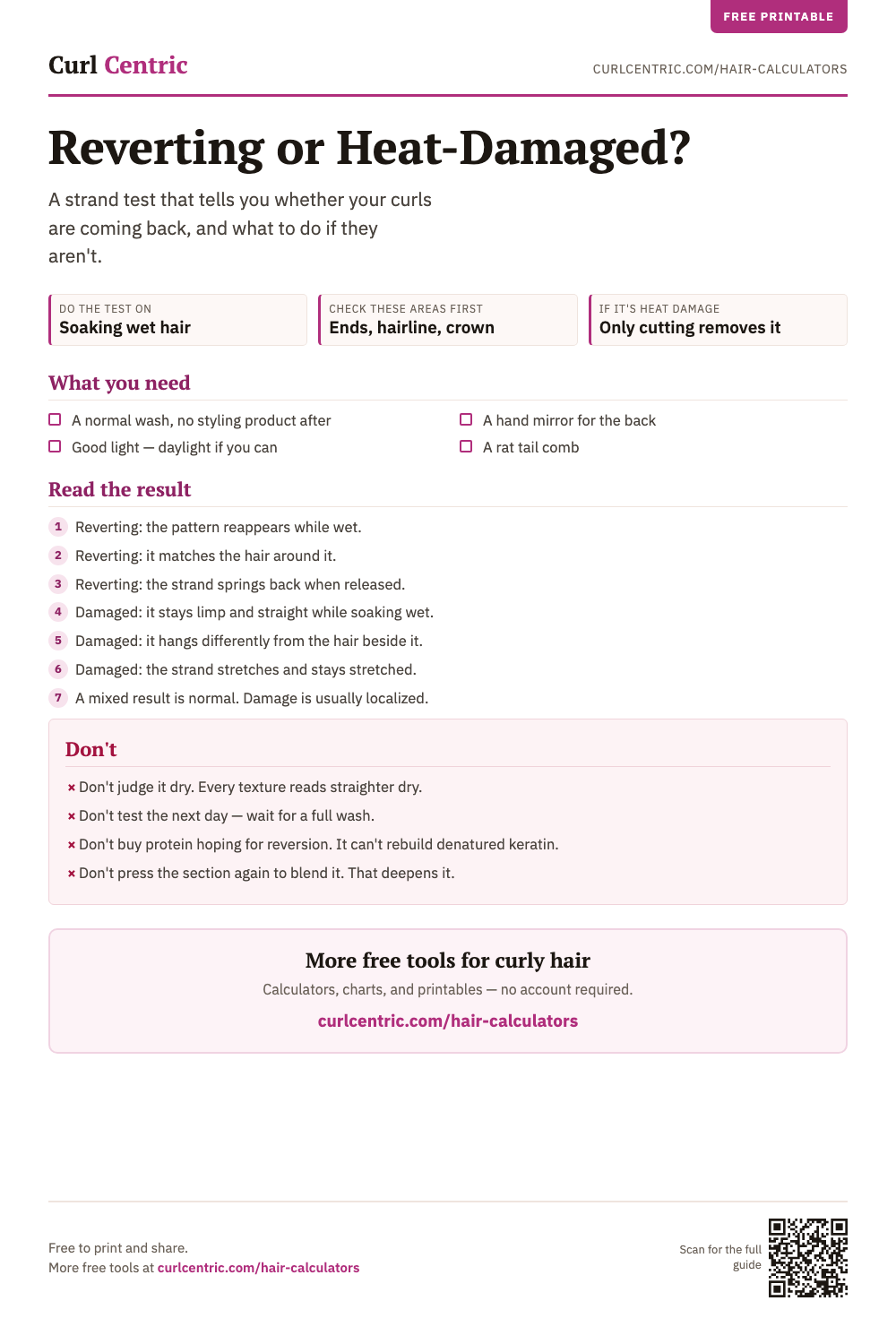 1 page
Free printable
Reverting or Heat-Damaged?
The strand test on one sheet, so you can run it at the sink on wash day instead of scrolling with wet hands.
How Often Should I Get Silk Presses?
There's no single number, and how often you can get one depends on the same three variables as everything else on this page: how hot, how many passes, and what your hair has already been through.
As a working guide: two to four times a year on healthy virgin hair is comfortable. Every six to eight weeks is what a lot of salons will book you for, and that pace is survivable on strong hair at the right temperature but will show on fine or chemically treated hair. If you've colored or relaxed, treat every silk press as a decision rather than a routine.
The American Academy of Dermatology's guidance points the same way: use a flat iron on dry hair at a low or medium setting and no more often than every other day, and a hot comb or curling iron once a week at most. That's written for heat styling generally rather than for silk presses specifically, but the direction is the same one every measurement on this page points in.
Whenever you do get one, keep the iron at the lowest temperature that works and use a heat protectant.
Silk Press Pros and Cons
The upside:
- Straight, sleek hair without a permanent change. Your texture comes back, unlike a relaxer.
- No chemicals. The straightening is heat, not a chemical reaction with your hair's structure.
- It shows your length. Shrinkage disappears, which is often the whole point.
- It works on resistant textures that other methods struggle with.
- You can do it at home with the right tools and a realistic temperature.
The downside:
- Heat damage is a real risk, and at the wrong temperature it's not a risk but a certainty.
- Maintenance is restrictive. Water, sweat, and humidity are all working against you.
- Results are temporary — one to three weeks.
- It's expensive done professionally, and slow done at home.