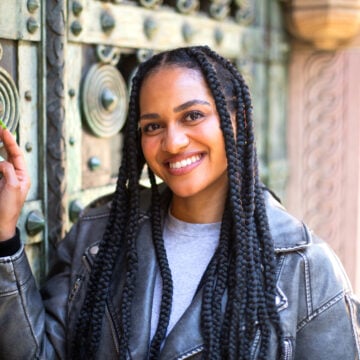

Knotless box braids are one of the newer braid types. Yet countless women, men, and kids have taken them for a test drive. If you haven't, you probably have a lot of questions about them.
One of the most commonly asked questions about knotless box braids is, "Do knotless braids hurt?" That's precisely what we'll address in this article. Let's get into it!
Do Knotless Braids Hurt?
Knotless box braids can hurt. You may have heard that knotless box braids are pain-free, but things are a little more complicated than they may seem. The process of getting knotless box braids installed requires many steps, and each step could potentially hurt.
The shampooing and conditioning processes are generally painless. But the detangling process can be painful if it's not done with a detangler and a wide-toothed comb. What's more, is that insufficient detangling can lead to pain all throughout the parting and braiding process. All of this applies to any braided style.

But what's different with knotless box braids is that each braid is started with your own natural hair instead of the braiding hair. With typical box braids, the braider needs to get a good grip on the natural hair and use enough tension to keep the braiding hair from slipping.
Free 50-page guide
Your hair is already growing. The problem is keeping it.
On average, hair grows a third to half an inch a month, and curlier hair tends to grow more slowly. If your length looks stuck, that’s your hair breaking off as fast as it grows in. Here are the seven causes of breakage and the weekly routine that stops them.
Free. One email a week after that. Unsubscribe anytime.
This can result in quite a bit of pain at the start of each braid.
With knotless box braids, you don't have to worry about the pain associated with attaching the braiding hair at the roots of each braid. Braiding hair is added along the length of the braid instead of the roots, so there's less pain involved.
That being said, there's no way to guarantee there won't be any pain when getting knotless box braids. The act of braiding requires tension and a degree of pulling at the scalp, so you'll still probably have to deal with a degree of pain here and there when getting knotless box braids.

How to Minimize Pain with Knotless Box Braids
Minimizing pain with knotless box braids comes down to mindful hair prep and careful braiding. Contrary to what a lot of people may think, braids don't have to hurt. Here are some tips to be mindful of before getting any type of braids, including knotless box braids:
Wash and Condition the Hair Before Braiding
Braiding dirty hair with visible build-up is a great way to guarantee a painful braiding session. You or your stylist will eventually need to comb through the build-up, and that will definitely be painful.
In addition, conditioning the hair should be non-negotiable. The conditioning step is for more than nourishing your hair and replenishing moisture; it's also for detangling the hair.
If you or your stylist takes a few minutes to run a wide-tooth comb through your hair and remove tangles while the hair is coated in conditioner, you'll feel less pain throughout the rest of the styling process.

Skip the Blow Dryer with Comb Attachment
In the interest of achieving the sleekest results possible, many people resort to using a blow dryer with a comb attachment to stretch and smooth out the natural hair before the braiding process. This may work well for those who don't mind the pain, but there's a less painful way to get similar results.
Instead of combing through the hair with a blow dryer, braid the hair in large sections and then blow dry the hair while it's in the braids. The hair won't get as sleek as it would with a blow dryer, but you won't be in nearly as much pain.

Be Mindful of Pulling
It's really easy to pull on the hair too hard while braiding, but if you or your stylist are mindful of it, there'll be less pain. Braiding with tension doesn't have to result in pulling on the entire braid.
If you're getting your braids done at a salon, don't be afraid to speak up if the stylist is pulling your hair. Asserting yourself can be uncomfortable, but you'll save yourself a lot of pain if you do. Try your best to be as respectful as you can while addressing your stylist; they may not be aware that they're pulling your hair.

Do Finished Knotless Box Braids Hurt?
Before deciding whether to try knotless box braids, consider how the braids will feel post-installation. Since the roots of knotless box braids aren't very tight, you might think that you won't have any pain, but that may not be the case for you.
One of the main things you'll have to consider when it comes to pain is how long your knotless braids are. The longer they are, the heavier they may feel, and that weight will be on your roots. This is where the pain comes in.
Yet another thing to consider is how large your braids are in relation to the size of your parts. If you have larger braids and small parts, you'll have a lot of pressure on your roots. This is not a concern for small braids and larger parts or balanced parts and braids.

What to Do if Your Knotless Braids Hurt
Getting your hair braided requires a lot of hair manipulation. Your scalp might be a little sore after all the combing, brushing, tugging, and parting that comes along with the style. But this pain should not be bad enough for painkillers, and it should dissipate within hours.
If your pain is severe or lingers for more than a day or so, you may need to take action.
Start by spraying your hair with some water or your favorite leave-in conditioner. It could make your roots a little frizzy, but it'll help to cool things down and reduce irritation. Doing this can give you some relief in a pinch.
If you have your knotless box braids pulled up into a ponytail, an updo, or any other style, take them down. Your pain could stem from the roots being over-directed. Taking your braids down and letting them hang free can drastically reduce your pain levels.
In instances where repositioning your braids and moisturizing your scalp doesn't work, your only option may be to take them down. Yes, you might feel like everything you went through was a waste of time and money. But if you leave tight braids in, there's a chance that you could experience traction alopecia, which could lead to permanent hair loss.

Should You Do Your Own Knotless Box Braids?
Knotless box braids usually look better when done by a professional. But if you're tender-headed or just want to take control of the styling process, you can definitely do the style on your own hair.
Just watch a lot of video tutorials, take your time, and be patient. DIYing your braids could be the best possible option for you.
To execute the style correctly, you'll have to become an expert in feeding in braiding hair. Once you get that down, you'll quickly realize that everything else is easy!
Doing your own knotless box braids not only gives you the power to be gentle during the styling process but can also save you some money. In most cases, you'll have to pay at least $100 for knotless box braids. You'll pocket that money if you do it yourself!
Related Articles
So, there you have it-knotless box braids can be painless, but there are instances in which they might be uncomfortable. We hope you found all the information you were looking for.
Whether you get your knotless box braids done by a professional or you do them yourself, use the tips and tricks in this article to make the process as painless as possible!