

Curl Centric: Curly Hair Products, Hairstyles, and Hair Growth Techniques

  • Hair Care
  • Hair Growth
  • Hairstyles
  • Locs
  • Products
  • Resources
    • Hair Calculators
    • Natural Hair Dictionary
    • Curly Hair Questions
  • Take the quiz
menu icon
go to homepage
  • Hair Care
  • Hair Growth
  • Hairstyles
  • Locs
  • Products
  • Resources
    • Hair Calculators
    • Natural Hair Dictionary
    • Curly Hair Questions
  • Take the quiz
search icon
Homepage link
  • Hair Care
  • Hair Growth
  • Hairstyles
  • Locs
  • Products
  • Resources
    • Hair Calculators
    • Natural Hair Dictionary
    • Curly Hair Questions
  • Take the quiz
×
Home » Podcast

How Fast Does Hair Grow?

Half an inch a month is one of two answers from the same study. We walk you through both numbers, whose hair each one came from, and what they mean for your length.

Kenneth ByrdBy Kenneth ByrdMBA · 15+ years in hair care · Co-founder of Curl CentricUpdated Sep 27, 20264 min read · Reviewed by Kira Byrd

Evidence-basedPublishing since 2008May contain affiliate links

Researched and written by Curl Centric. Read by an AI voice.

Half an inch a month is one of two answers from the same study. We walk you through both numbers, whose hair each one came from, and what they mean for your length.

https://media.blubrry.com/4040496/content.blubrry.com/4040496/curl-science-01-how-fast-does-hair-grow.mp3

Podcast: Play in new window | Download

The full guide, with every source: How long it takes for hair to grow.

Transcript

This is Curl Science by Curl Centric.
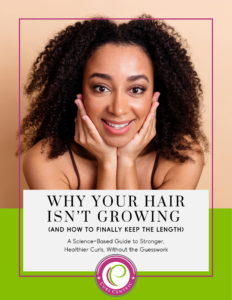
Why Your Hair Isn’t Growing - free guide from Curl Centric

Free 50-page guide

Your hair is already growing. The problem is keeping it.

On average, hair grows a third to half an inch a month, and curlier hair tends to grow more slowly. If your length looks stuck, that’s your hair breaking off as fast as it grows in. Here are the seven causes of breakage and the weekly routine that stops them.

Free. One email a week after that. Unsubscribe anytime.

There are two hair growth rates in the study everyone quotes. Almost nobody hears about the second one.

Here's what happened. In 2001, researchers publishing in the British Journal of Dermatology measured hair growth across different groups of volunteers, using the same method on all of them. Caucasian hair grew about 396 micrometers a day, which works out to roughly half an inch a month. African hair grew about 256 micrometers a day, which is closer to a third of an inch. Same study, same method, two numbers, and only the first one ever made it into circulation.

So half an inch a month isn't wrong. It's just one of the answers.

Which means the useful question isn't how fast hair grows. It's which number is closer to yours, and how much room there is on either side of it.

There's a lot of room. Inside a single group, the slowest grower came in at 150 micrometers a day and the fastest at 363. That's nearly two and a half times the difference between two people with the same hair type. It was also a small study, thirty-eight people, so treat these as rough anchors rather than promises. Wherever you sit, you don't get to know your exact rate, and nobody selling you anything knows it either.

Now here's the part that changes what you do on wash day, and this part is the same for everybody.

Take whichever number is closer to your hair. Over a year, that's somewhere between about three and a half and five and a half inches of brand new hair. It arrived at your scalp on schedule. The question is whether it was still there at the ends in December.

Because that's where length actually goes missing. Hair doesn't stop growing when it stops getting longer. It stops getting longer when the ends start breaking off as fast as the roots push new hair out.

That has been measured too. In 2007, researchers examined the hair of 1,042 South African schoolchildren and found that combed hair reached a length and then simply stayed there, usually within about a year of a haircut. Not because the follicle quit. Because breakage had caught up with growth.

The plateau length in that study was around two inches, and that number is specific to the hair they measured. The mechanism isn't. Whatever your texture, a length plateau is not a ceiling your hair can't pass. It's a tie.

And a tie is good news, because a tie can be broken from either side. You can't do much about the growth side; that rate is mostly yours and you're stuck with it. The breakage side is almost entirely in your hands.

So here's where the leverage is.

Detangle on wet, conditioned hair, and start at your ends. Conditioner gives the comb something to slide on, so it passes through instead of snagging. Work up an inch at a time. It's slower than raking straight through from the roots, and every tangle you force apart is a strand you don't keep.

Watch the tension in your styles. The American Academy of Dermatology puts the ceiling on braids at six to eight weeks, and says plainly that if a style feels painful, it's too tight. Thicker braids pull less than fine ones. Shorter lengths are lighter, so they drag less. And your hairline should be the loosest part of any style, because it's the first place tension shows.

Protect your ends at night. They're the oldest hair on your head, they've been through every wash day you've ever had, and they break first.

None of that makes your hair grow faster. That's the point. You already have the growth. The only question is how much of it you're still holding at the end of the year.

We've put the full breakdown, with both studies and the numbers behind them, in a free fifty page guide. It's at curlcentric.com/keep-the-length.

That's it for this episode. If it helped, follow Curl Science in your podcast app so the next one reaches you, and leave us a rating while you're there. Curl Science is researched and written by the Curl Centric team, and it's read by an AI voice.

PinterestXFacebookReddit

More Podcast

  • How Often Should You Wash Curly Hair?
  • What Does Your Hair Type Actually Tell You?
  • How Do You Get Rid of Dandruff?
  • Does Biotin Really Help Hair Grow?
Kenneth Byrd

About the author

Kenneth Byrd

Co-founder and Managing Partner

Publishing on textured hair since 2008MBA, University of Alabama at BirminghamExecutive education, WhartonTop 40 Under 40, Birmingham Business Journal

Kenneth does the research behind the guides here: reading the studies and checking whether a claim holds up before it gets published, under our editorial guidelines. Outside Curl Centric he leads an operations organization of more than 1,000 people, and he serves on the board of Oasis Counseling for Women and Children. Curl Centric's hair typing system is the first listed reference in a peer-reviewed paper in the International Journal of Women's Dermatology, and it is cited by Wikipedia.

More about KennethAbout Curl Centric

Kira Byrd

Hey, I’m Kira

Curl Centric is run by me and my husband Kenneth. We’ve been publishing evidence-based hair care since 2008 to help you care for your curls with confidence.

More about us →
Why Your Hair Is Not Growing: free guide

Free guide

Your hair is growing. It’s also breaking.

If your length looks stuck, your hair is breaking off about as fast as it grows in. Here are the seven causes and the weekly routine that stops them.

Free. One email a week. Unsubscribe anytime.

Start here

What is natural hair?Find your hair typeWhat is hair porosity?Build a hair regimenHair calculators

Footer

Why Your Hair Isn't Growing - free guide from Curl Centric

Free 50-page guide

Your hair is already growing. The problem is keeping it.

Hair grows about a third to half an inch a month, and the tightest curls grow slowest. If your length looks stuck, that's your hair breaking off about as fast as it grows in. We'll send you the seven causes of breakage and the weekly routine that stops them.

Free. One email a week after that. Unsubscribe anytime.

Written and reviewed by Kenneth and Kira Byrd Independently owned, publishing since 2008 950+ guides, fact-checked before publishing Editorial and advertising teams kept separate

Curl Centric®

Evidence-based curly hair care from Kenneth and Kira Byrd, a husband-and-wife team teaching textured-hair techniques since 2008.

Start Here

Natural Hair 101 Hair Typing Guide How to Grow Natural Hair Building a Hair Regimen Deep Conditioning Natural Hair Dictionary

Free Tools

Calculators & Printables Hair Growth Calculator Shrinkage Calculator Choosing Your Products Curl Science Podcast Browse All Articles

Who We Are

Kira Byrd, Co-founder Kenneth Byrd, Co-founder About Curl Centric Editorial Guidelines Contact Us FAQs Press Kit
Natural Hair Community, LLC 1401 Doug Baker Blvd, Ste 107 604, Birmingham, Alabama 35242 1 (844) 424-2875 admin@curlcentric.com Privacy Policy Terms & Conditions Sitemap

CurlCentric.com is an independent, advertising-supported publisher. Curl Centric® services, articles, content, and products are provided for informational purposes only. Curl Centric does not provide professional medical advice, diagnosis, or treatment. Curl Centric follows a strict editorial policy that produces accurate, factual, and honest content to help you make the right hair care decisions. Curl Centric has an affiliate relationship for some of the products that we recommend. We may receive compensation if purchases are made using our links, at no extra cost to you. CurlCentric.com is a participant in the Amazon Associates Program. As an Amazon Associate, we earn from qualifying purchases. To ensure that we maintain our editorial integrity, our editorial team does not receive direct compensation from our sponsors and advertisers. The product recommendations and advertisers that appear on Curl Centric are from companies that compensate us through an exclusive, full-service ad management partner. This compensation does not influence the content we publish or the product reviews shown on our site.

Copyright © Curl Centric®. All rights reserved. Curl Centric® is a trademark of Natural Hair Community, LLC.

Back to top ↑